SpaceX’s 100th Orbital Mission of 2026: How Starlink Is Reshaping the Future of Global Internet
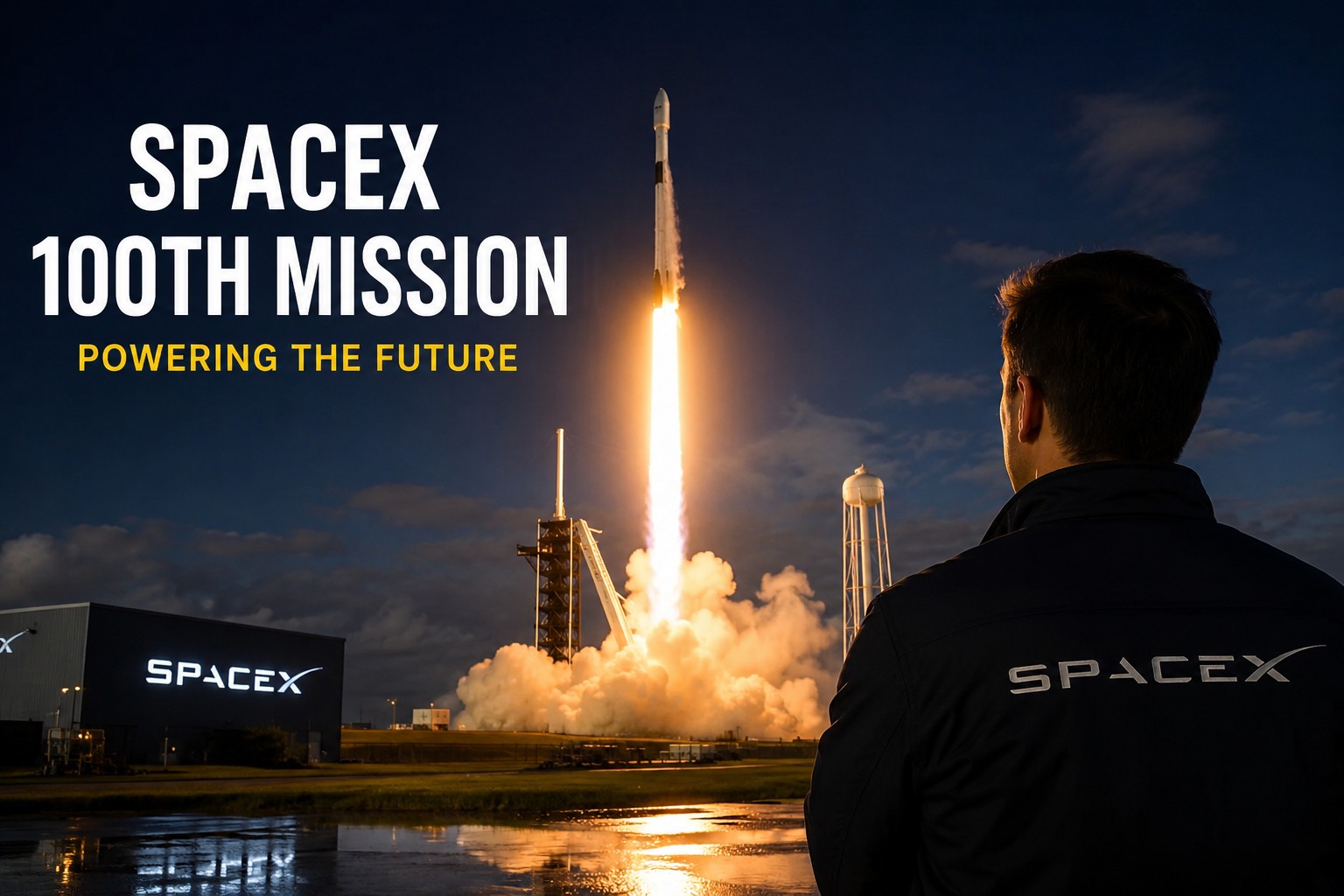
SpaceX has reached another remarkable milestone in the rapidly changing world of spaceflight. The company’s Falcon 9 rocket successfully launched its 100th orbital mission of 2026, carrying a new batch of Starlink broadband satellites into low Earth orbit. The mission, known as Starlink 15-20, lifted off from Space Launch Complex 4 East at Vandenberg Space Force Base in California shortly after midnight local time on August 22.
The achievement is significant not simply because the number “100” sounds impressive. It demonstrates how frequently modern rockets can now operate and how closely SpaceX has connected reusable launch technology with the expansion of a commercial satellite network.
The mission also highlights the central role Starlink now plays in SpaceX’s launch schedule. With thousands of satellites already deployed, the company is continuing to build one of the largest satellite constellations ever created.
SpaceX Reaches 100 Orbital Missions in One Year
For decades, launching a spacecraft was an expensive and relatively infrequent activity. Rockets were often treated as disposable vehicles, and preparing a new launch could take months or even longer.
SpaceX has pursued a very different model.
The company’s Falcon 9 system is designed around reusability, particularly the first stage. After separating from the upper stage, the booster can return to Earth and land on a drone ship or landing zone. It can then be inspected, refurbished and prepared for another mission.
During the Starlink 15-20 mission, the Falcon 9’s first-stage booster, designated B1100, successfully returned to the drone ship Of Course I Still Love You approximately eight and a half minutes after liftoff. It was the booster’s ninth flight.
That ability to repeatedly use expensive rocket hardware is one of the key reasons SpaceX can maintain such a high launch frequency.
Reaching 100 orbital missions in a single calendar year therefore represents more than a company record. It reflects a broader change in the economics and logistics of spaceflight.
What Was Carried on the 100th Mission?
The payload was another group of Starlink satellites intended to expand SpaceX’s broadband internet constellation.
According to Spaceflight Now's mission coverage, the Starlink 15-20 flight carried 29 broadband satellites into low Earth orbit.
The satellites are part of Starlink, SpaceX’s satellite-based internet system. Unlike traditional communication satellites positioned much farther from Earth, Starlink satellites operate in low Earth orbit.
This closer position provides an important advantage: signals generally have a shorter journey between users and satellites. That can help reduce latency, making satellite internet more practical for activities that require relatively quick responses, including video calls, online services and other interactive applications.
However, the system requires a huge number of satellites because each individual satellite covers only a portion of Earth at a particular time. As satellites move across the sky, other satellites can take over the connection.
This is why SpaceX continues launching new batches rather than treating the constellation as a project that will eventually have a simple “finished” point.
Why Does Starlink Need So Many Satellites?
At first glance, thousands of satellites may seem excessive. But Starlink's design depends on creating a dense network in orbit.
Imagine trying to provide internet access to an aircraft flying across an ocean. A single satellite cannot remain directly above that aircraft indefinitely. As the satellite moves relative to the aircraft and Earth, another satellite needs to become available.
A large constellation makes this handoff possible.
The same principle applies to users in remote regions. Traditional broadband networks rely heavily on physical infrastructure such as fiber-optic cables, telephone lines and cellular towers. Building those systems can be difficult or economically impractical in isolated locations.
Satellite internet offers another approach: instead of bringing a cable to every location, the connection can travel through space.
That does not mean Starlink eliminates the need for ground infrastructure. User terminals, gateways and other network components remain important. But satellites can provide coverage where conventional terrestrial networks are difficult to deploy.
Starlink Has Passed the 11,000-Satellite Threshold
The latest launches come as the Starlink constellation continues to expand at extraordinary speed.
SpaceX founder Elon Musk said before the August 22 mission that the Starlink network had surpassed 11,000 satellites in orbit. Independent tracking and reporting also placed the constellation above the 11,000 mark around this period.
It is important to understand that “satellites in orbit” and “operational satellites” are not necessarily identical figures.
A newly launched satellite may initially spend time checking its systems, adjusting its orbit and moving toward its intended operational position. Satellites can also eventually be retired or deorbited.
As a result, satellite counts can change frequently, and different tracking organizations may report slightly different numbers depending on how they classify spacecraft.
Nevertheless, the broader trend is unmistakable: Starlink has grown from an ambitious satellite-internet experiment into an enormous orbital network.
The Falcon 9’s Reusability Is the Hidden Story
The Starlink satellites received most of the attention from the mission, but the Falcon 9 booster’s recovery is equally important.
A conventional disposable rocket is used once. After delivering its payload, most of the vehicle falls back toward Earth or burns up during atmospheric reentry.
SpaceX's approach is fundamentally different.
The first stage performs a controlled return after separation. It uses its engines and aerodynamic control surfaces to guide itself toward a landing location. For missions requiring a drone-ship landing, the booster travels toward a vessel positioned downrange.
The successful recovery of B1100 during the 100th mission illustrates how routine this process has become.
This matters economically because the company does not have to manufacture an entirely new first stage for every launch.
More importantly, repeated use provides operational experience. Each flight can generate additional information about how rocket hardware behaves under repeated launch and reentry conditions.
The result is a launch system that can support a much higher flight rate than traditional expendable rockets.
Starlink and the New Economics of Space
There is a deeper connection between Starlink and SpaceX’s launch strategy.
SpaceX is both a launch provider and the operator of one of the world's largest satellite constellations. That gives the company a unique incentive to make launches frequent, reliable and relatively inexpensive.
Every additional Starlink launch adds capacity to the company's internet network. At the same time, operating its own launch system gives SpaceX greater control over when and how satellites are deployed.
This creates a powerful cycle.
More efficient launches make it easier to deploy satellites. More satellites expand the network. A larger network can support more customers and geographical coverage. The growing network, in turn, creates a reason to continue launching.
That relationship helps explain why Starlink missions make up such a large portion of SpaceX's overall launch activity. Space.com reported that the majority of SpaceX's Falcon 9 missions in 2026 had been dedicated to Starlink expansion by this point in the year.
What Could Starlink Mean for Remote Communities?
One of the most important potential benefits of satellite internet is connectivity in places where traditional broadband infrastructure is difficult to build.
Consider a rural community located far from a major city. Installing fiber-optic infrastructure may require substantial construction, long cable routes and significant investment.
A satellite-based system changes the problem.
Instead of physically extending a network all the way to every community, a user terminal can communicate with satellites passing overhead. The satellites then connect through the wider Starlink network and associated ground infrastructure.
This could be particularly useful for remote homes, businesses, ships, aircraft and other locations where conventional connectivity is limited.
The technology is not a universal replacement for fiber. Fiber can offer extremely high capacity and stable performance in areas where infrastructure already exists. But satellite connectivity can fill important gaps.
The Challenges of Building a Massive Satellite Constellation
The rapid growth of Starlink also raises questions about the long-term impact of placing so many objects in orbit.
One concern is space traffic management.
Earth orbit is becoming increasingly crowded with satellites, rocket stages and other objects. As the number of spacecraft increases, operators must carefully track their positions and coordinate maneuvers to reduce collision risks.
Another concern involves astronomy.
Large numbers of bright satellites can appear as moving points of light across astronomical images. SpaceX and astronomers have worked on techniques to reduce the brightness of newer Starlink spacecraft, but the issue remains an important topic in discussions about large satellite constellations.
There is also the broader question of orbital sustainability. Satellites eventually need to be removed from useful orbits and safely disposed of. Designing spacecraft and operating them responsibly becomes increasingly important as the number of satellites grows.
In other words, the success of a mega-constellation is not measured only by how quickly it can be built. Its long-term management is equally important.
What This Milestone Says About the Future of Spaceflight
SpaceX's 100th orbital mission of 2026 provides a useful glimpse into where the commercial space industry may be heading.
The traditional model of spaceflight centered on relatively rare missions carrying expensive individual spacecraft. The emerging model is increasingly based on high launch frequency, reusable rockets and large satellite networks.
That change could have consequences far beyond Starlink.
Frequent and reusable launches can make it easier for governments, research institutions and commercial companies to place satellites into orbit. As launch capacity grows, new applications could become economically practical.
Earth observation, communications, navigation, scientific research and other space-based services may all benefit from lower launch barriers.
SpaceX is also developing Starship, a much larger launch system intended to eventually take over some roles currently performed by Falcon rockets. The company's long-term ambitions therefore extend well beyond the current Falcon 9 era.
Frequently Asked Questions
What was SpaceX's 100th orbital mission of 2026?
It was the Starlink 15-20 mission, launched from Vandenberg Space Force Base in California on August 22, 2026. The mission carried a new batch of Starlink satellites into low Earth orbit.
How many Starlink satellites were launched?
Specialist launch coverage from Spaceflight Now reported 29 Starlink satellites on the Starlink 15-20 mission.
Why does SpaceX launch Starlink satellites so frequently?
Starlink requires a large constellation to provide continuous coverage and capacity around the world. SpaceX therefore regularly replaces, upgrades and expands the satellite network.
What makes Falcon 9 different from traditional rockets?
Its first stage is designed to be recovered and reused. During the 100th orbital mission, booster B1100 successfully landed on a drone ship after launch.
How many Starlink satellites are in orbit?
SpaceX said the constellation had surpassed 11,000 satellites in orbit around the time of the August 2026 milestone. Exact counts can change as satellites are launched, become operational, are retired or reenter the atmosphere.
Conclusion
SpaceX's 100th orbital mission of 2026 is a striking demonstration of how quickly spaceflight is becoming a high-frequency commercial operation. The Starlink 15-20 mission combined several elements that have become central to SpaceX's strategy: a reusable Falcon 9, rapid launch operations and the continual expansion of a massive low-Earth-orbit satellite constellation.
The most important story, however, is not simply that SpaceX launched another group of satellites. It is that launches of this scale are becoming increasingly routine.
A few decades ago, putting spacecraft into orbit was an extraordinary event. Today, SpaceX is demonstrating that orbital launches can operate on a much more regular schedule. With Starlink already exceeding 11,000 satellites in orbit and reusable rockets supporting frequent missions, the company is helping define a new era in which space infrastructure may become an increasingly normal part of everyday life.
The ultimate challenge will be balancing that extraordinary growth with reliability, affordability and responsible management of Earth's increasingly crowded orbital environment. If SpaceX succeeds, the 100th mission of 2026 may eventually be remembered not as an endpoint, but as another milestone in the transition toward a far more active commercial space economy.