7 Warning Signs of Kidney Disease You Should Never Ignore
Author: Admin
Your kidneys can lose a significant amount of function before you feel anything is wrong. That is what makes kidney disease so dangerous—and why recognizing possible warning signs matters.
🩺 Your Kidneys May Be Struggling Without You Knowing
The kidneys are remarkable organs. Every day, they filter your blood, remove waste and excess fluid, help maintain the body's mineral balance, contribute to blood-pressure regulation and support the production of red blood cells.
But there is a catch: kidney disease often develops silently.
In the early stages of chronic kidney disease (CKD), most people have no noticeable symptoms. In many cases, the first indication comes from a routine blood or urine test rather than from how the person feels.
That is why a new or persistent change in your body shouldn't automatically be dismissed as stress, ageing or simply being tired.
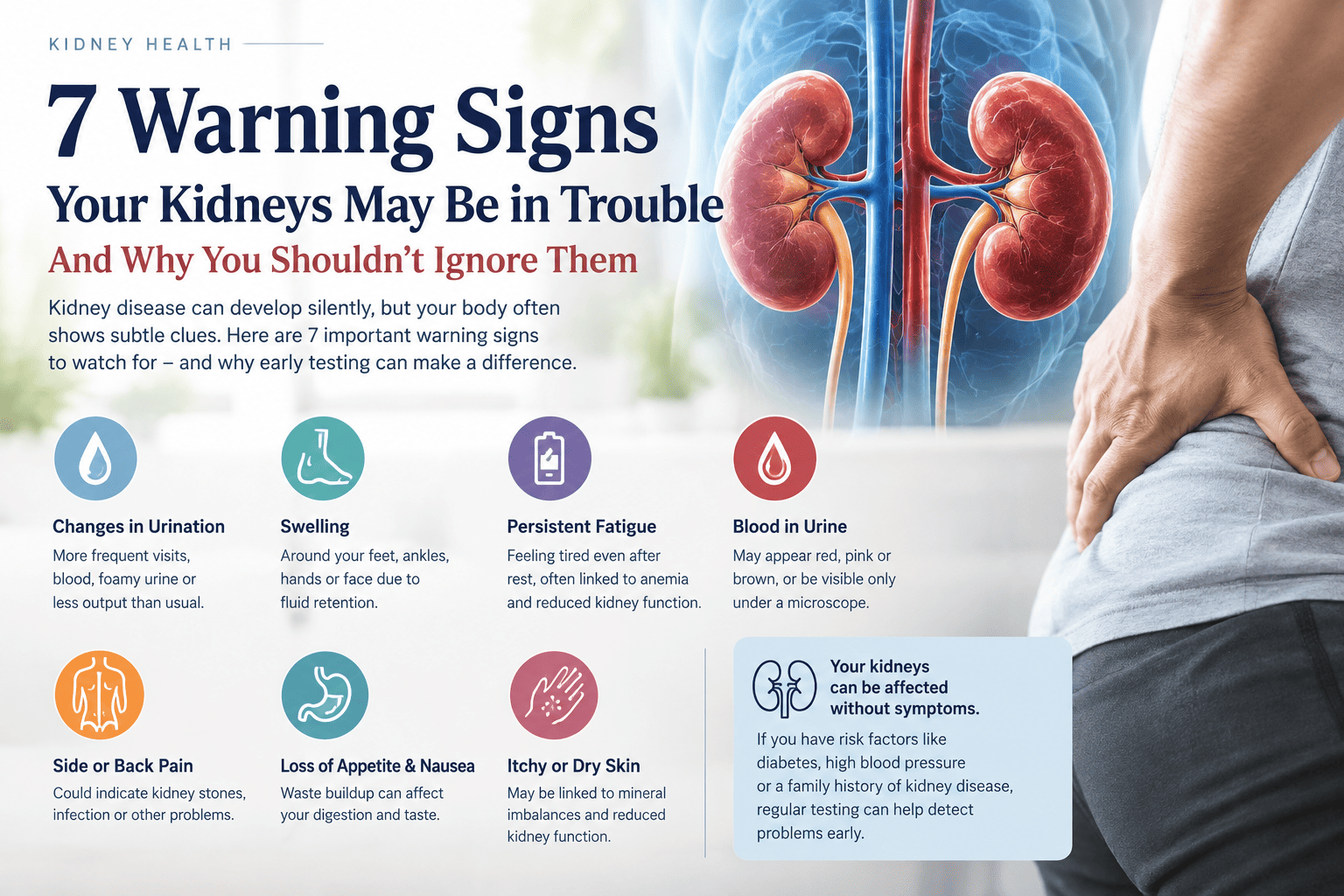
When kidney function becomes more seriously impaired, symptoms can begin to appear. Here are seven important signs to understand.
🚨 1. Your Urination Pattern Suddenly Changes
Your urine can provide useful clues about what's happening inside your body.
A kidney-related problem may sometimes be associated with:
More frequent urination • Less urine than usual • Foamy urine • Blood in the urine • Changes in urinary habits
Persistent foamy urine can be particularly important because it may occur when protein, including albumin, is leaking into the urine. Persistent albumin in urine can be a sign of kidney damage.
Some people also notice that they need to get up several times during the night to urinate.
However, don't assume that every urinary change means kidney disease. Urinary infections, medications, diabetes, hydration and other conditions can produce similar symptoms.
The key is persistence. If a significant change continues or you notice blood in your urine, it's worth getting medically assessed rather than trying to diagnose the cause yourself.
💧 2. Swelling Appears Around Your Feet, Ankles or Face
Have your shoes suddenly started feeling tighter?
Are your socks leaving unusually deep marks around your ankles?
Unexpected swelling can sometimes be related to fluid retention.
Healthy kidneys help remove excess fluid and sodium from the body. When kidney function is significantly impaired, the body may retain more fluid, leading to swelling—particularly in the legs, feet and ankles. Swelling can also occur in the hands or face.
Morning puffiness around the eyes can also occur in some kidney conditions.
But swelling is not exclusive to kidney disease. Heart, liver and circulation problems, medications and other conditions can also cause it.
So the important question isn't simply, "Do I have swollen ankles?"
It's:
"Why are they swollen, and is the swelling persistent or getting worse?"
😴 3. You Feel Tired All the Time
Everyone gets tired.
The concern is persistent, unexplained fatigue that doesn't improve with adequate rest.
As kidney disease advances, people may experience tiredness, weakness, sleep problems and difficulty concentrating.
One reason can be anemia, which can occur as a complication of chronic kidney disease.
Imagine someone who previously climbed stairs without thinking twice but now feels unusually exhausted after one flight. They may initially blame work, poor sleep or getting older.
Sometimes that's exactly what it is.
But if the fatigue persists without an obvious explanation—especially alongside swelling, urinary changes or loss of appetite—it's worth discussing with a healthcare professional.
🩸 4. You Notice Blood or Persistent Abnormalities in Your Urine
Seeing blood in your urine can be alarming, and it should not simply be ignored.
Blood in urine can occur with a number of conditions, including problems affecting the kidneys or urinary tract. Some kidney diseases involving the filtering units can cause blood or protein to appear in urine.
The urine may appear pink, red, brown or cola-colored when there is visible blood, although blood can also be present without being obvious to the naked eye.
Importantly, blood in the urine does not automatically mean kidney disease. Kidney stones, urinary infections and other conditions can also cause it.
That's precisely why testing matters.
Rather than guessing the cause based on urine color, a doctor can perform a urine examination and determine whether further investigation is necessary.
🧍 5. Persistent Pain in Your Side or Back
Pain around the side of the back, particularly beneath the ribs, can sometimes occur with kidney problems such as kidney stones or kidney infections.
Kidney infection may also cause symptoms such as fever, chills, nausea, vomiting or urinary problems.
Kidney stones, meanwhile, can cause severe pain that may come in waves and can radiate toward the lower abdomen or groin.
But here's an important distinction:
Not every backache is a kidney problem.
Muscle strain, poor posture, spinal problems and many other common conditions can cause back pain.
The combination of severe or persistent side/back pain with fever, vomiting, blood in the urine or urinary symptoms is much more concerning and deserves prompt medical attention.
🤢 6. Your Appetite Drops—and You Feel Nauseated
As kidney function becomes severely impaired, waste products can accumulate in the bloodstream.
This can contribute to symptoms such as:
Loss of appetite • Nausea • Vomiting • Weight loss
These symptoms can make a person eat less, which can eventually lead to unintended weight loss.
Some people may also notice an unpleasant or altered taste in their mouth in advanced kidney disease.
But again, there are many possible explanations for nausea or poor appetite. Stomach problems, infections, medications, stress and other illnesses can cause exactly the same symptoms.
The combination of symptoms matters more than any single symptom.
🧴 7. Your Skin Becomes Very Dry or Itchy
Persistent itching might seem completely unrelated to your kidneys.
Yet dry and itchy skin can occur in advanced kidney disease. Changes in the body's mineral balance and accumulation of waste products can contribute to skin symptoms.
This doesn't mean every person with itchy skin has kidney disease.
Dry weather, allergies, eczema, medications and numerous skin conditions can cause itching.
But if severe or persistent itching appears together with fatigue, swelling, appetite loss or changes in urination, it becomes more important to investigate the underlying cause.
⚠️ The Most Important Thing About Kidney Disease
Here's the part many people don't realize:
You can have kidney disease without having any symptoms.
In fact, early CKD commonly has no symptoms, and many people don't discover it until kidney damage has progressed.
That's why waiting for symptoms isn't the best strategy.
If you have diabetes, high blood pressure, heart disease or a family history of kidney failure, your risk is higher and kidney testing becomes particularly important.
🧪 How Do Doctors Actually Check Your Kidneys?
You don't need to rely on symptoms to find out how your kidneys are doing.
Two important tests are commonly used to evaluate kidney health:
1. eGFR — Blood Test
A blood test measures creatinine, which can be used to estimate your glomerular filtration rate (eGFR).
The eGFR gives healthcare professionals an estimate of how well your kidneys are filtering blood.
2. uACR — Urine Test
A urine albumin-to-creatinine ratio (uACR) checks for albumin in the urine.
Persistent albumin in urine can indicate kidney damage—even when a person feels completely healthy.
Depending on the situation, doctors may also check blood pressure, perform additional blood or urine tests, or order imaging such as an ultrasound.
❤️ Who Should Be Especially Careful?
Certain health conditions can quietly damage the kidneys over time.
Diabetes and high blood pressure are two of the most important risk factors for chronic kidney disease. Heart disease and a family history of kidney failure can also increase risk.
For someone with diabetes, for example, feeling perfectly healthy doesn't necessarily mean the kidneys are unaffected.
That's why regular testing can be much more valuable than waiting for symptoms to appear.
🛡️ 5 Simple Ways to Protect Your Kidney Health
There is no miracle juice, supplement or "kidney detox" that can guarantee healthy kidneys.
Instead, kidney protection is largely about managing the factors that cause or accelerate kidney damage.
Control the big risks
🩸 Keep blood pressure under control
High blood pressure can both contribute to kidney damage and develop as a consequence of kidney disease.
🍬 Manage blood sugar
If you have diabetes, maintaining your blood glucose within your recommended range is important for protecting the kidneys.
🧂 Don't overdo sodium
A balanced diet with appropriate sodium intake can support overall cardiovascular and kidney health.
🚭 Avoid smoking
Smoking can increase cardiovascular risk and may worsen kidney disease progression.
🏃 Stay physically active
Regular physical activity, healthy weight management and adequate sleep support overall health and can help manage important kidney-disease risk factors.
🍒 What About Cranberry Juice and Kidney "Cleanses"?
This is where online health advice can become misleading.
Cranberry products are sometimes discussed in relation to urinary tract infections, but that is not the same thing as treating chronic kidney disease.
Likewise, drinking a particular juice, tea or herbal preparation should not be considered a treatment for damaged kidneys.
If kidney disease is suspected, the priority should be proper diagnosis and treatment of the underlying problem, rather than relying on a supposed kidney cleanse.
🚑 When Should You See a Doctor?
Don't panic because of one isolated symptom. Many of these symptoms have causes unrelated to kidney disease.
But you should consider medical evaluation if you have persistent or unexplained changes in urination, blood in your urine, ongoing swelling, unexplained fatigue, persistent nausea, significant appetite loss or other symptoms that are getting worse.
More urgent assessment may be needed when severe side or back pain occurs with fever, chills, vomiting or blood in the urine, because infections and other acute kidney or urinary problems can become serious.
🔍 The Bottom Line
Kidney disease doesn't always announce itself.
Sometimes there is swelling. Sometimes urine changes. Sometimes a person simply feels exhausted or loses their appetite.
And sometimes there is no warning at all.
That's why the smartest approach isn't to wait until your kidneys start making you feel sick. If you have risk factors such as diabetes, high blood pressure, heart disease or a family history of kidney failure, talk to your healthcare professional about appropriate kidney testing.
A simple blood test and urine test can reveal problems that symptoms may not.
Your kidneys may be working quietly—but that doesn't mean they should be ignored.
📌 Quick Medical Reminder
Having one or more of these symptoms does not mean you have kidney disease. Symptoms can have many different causes. Only appropriate medical evaluation and testing can determine whether kidney disease is present.