Pakistan Introduces AI Sign Language Interpreter to Make Critical Information Accessible to Deaf Community
For many people, an emergency announcement is something they can hear and immediately act upon. But for millions of deaf and hard-of-hearing people, the same announcement may not be accessible at all. A warning about a flood, earthquake, severe weather, evacuation order, or other urgent situation can become difficult to understand when it is delivered only through spoken language.
Pakistan is now taking an important step toward closing that communication gap with artificial intelligence.
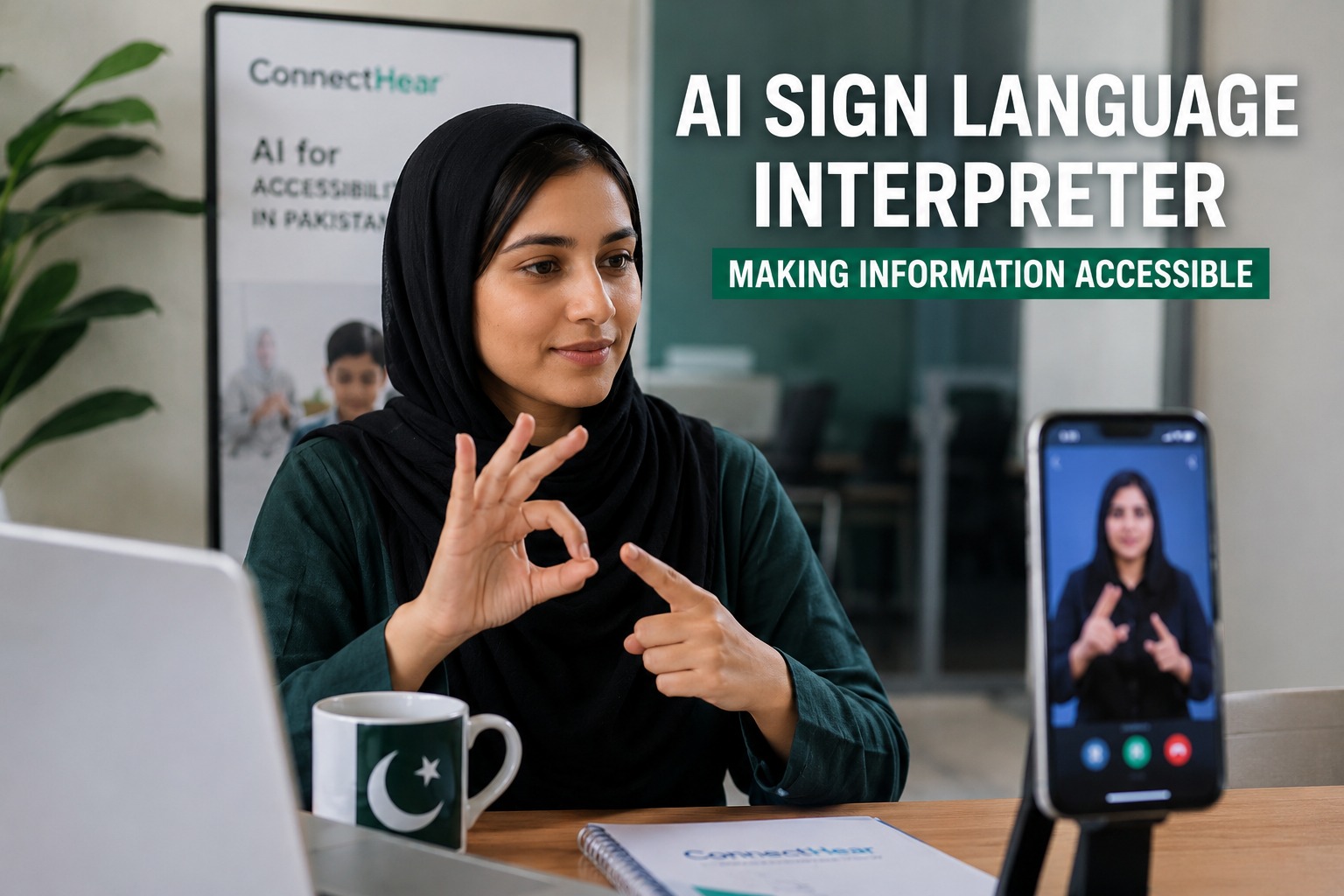
An AI-powered sign language interpreter and accessibility system has been introduced as part of SUNO, an initiative developed by Pakistani social enterprise ConnectHear in collaboration with Ufone. The technology is designed to make important information more accessible to deaf and hard-of-hearing people by presenting it in Pakistani Sign Language. Recent developments have also highlighted SILA, an AI interpreter associated with the SUNO initiative, as part of this broader effort to make communication more inclusive.
The development is significant because it moves beyond the idea of accessibility as an optional feature. Instead, it treats accessible communication as an essential part of public information and emergency preparedness.
Why Accessible Communication Matters
Communication during an emergency is not simply about receiving information. It can determine whether a person has enough time to protect themselves, leave a dangerous location, contact family members, or seek assistance.
Traditional warning systems often depend heavily on television broadcasts, radio, loudspeakers, telephone calls, or spoken announcements. These channels can create an obvious barrier for people who cannot hear them.
This challenge becomes particularly serious in a country such as Pakistan, where floods, earthquakes and other disasters can affect large populations. The GSMA has identified around 1.35 million people with disabling hearing loss as being particularly vulnerable to communication barriers during disasters.
For a deaf person, receiving an emergency message several minutes late—or depending on another person to explain it—can make an already dangerous situation even more difficult.
SUNO was created specifically to address this problem. The system uses AI-generated sign-language content to communicate important warnings and information in a format that deaf and hard-of-hearing people can understand more independently.
What Is SUNO and How Does It Work?
SUNO is an AI-powered early-warning and accessibility initiative developed by ConnectHear with Ufone. It was initially focused on disaster and emergency communication, particularly situations such as floods and earthquakes.
The basic concept is straightforward but powerful: information that would normally be communicated through conventional alerts can be transformed into sign-language video content and distributed through digital channels.
Ufone's network and communication infrastructure play an important role in distributing these alerts. The original system was designed to send sign-language video alerts through Ufone's WhatsApp bot, with the service intended to reach people across Pakistan without additional cost for the alert itself. ConnectHear provides the technology for creating the accessible sign-language content, while Ufone contributes the nationwide distribution infrastructure.
This combination is important because creating accessible content is only one part of the problem. The information must also reach people quickly and reliably.
The partnership therefore brings together two different capabilities: AI and accessibility technology on one side, and telecommunications infrastructure on the other.
The Role of SILA in AI-Powered Sign Language Accessibility
The latest development has brought attention to SILA, described as an AI interpreter designed to make sign-language communication more accessible.
Rather than relying entirely on human interpreters for every piece of information, AI can help make sign-language content more scalable. A system can potentially assist with transforming prepared information into accessible sign-language material without requiring an interpreter to manually produce every individual announcement.
ConnectHear has described its broader technology work as using AI to improve communication and information access for people with disabilities. The organisation has also developed virtual interpretation services that connect deaf users with trained interpreters.
This distinction is important. AI does not necessarily mean human interpreters become unnecessary. In many situations—particularly complex conversations involving healthcare, legal matters, education or sensitive personal information—human interpretation can remain extremely valuable.
Instead, AI can provide an additional layer of accessibility, especially when information must be produced rapidly or distributed to large numbers of people.
From Emergency Warnings to Everyday Information
The potential of this technology extends beyond natural disasters.
Imagine a public announcement at a railway station, airport, hospital or government office. Hearing people may receive the information through a loudspeaker, while deaf passengers may have to search for written instructions or depend on someone nearby to explain what is happening.
An AI-supported sign-language system could help make such information accessible in a more direct way.
The same principle could apply to public-health announcements, evacuation instructions, weather warnings, transportation updates and other important messages.
This is where the technology becomes more than an emergency tool. It can contribute to a broader digital-accessibility ecosystem in which deaf people are able to receive information with greater independence.
Pakistan's government has already shown interest in AI-powered sign-language solutions. In July 2025, the Ministry of Information Technology and Telecommunications held a high-level meeting examining AI-based sign-language technologies and accessibility for the Deaf community. The meeting included presentations from Pakistani startups working on real-time sign-language interpretation, AI communication tools and accessible public alerts.
That wider policy interest could help create opportunities for AI accessibility technologies to move into mainstream public services.
Why the Pakistani Sign Language Element Is Important
One of the most important aspects of the initiative is its focus on Pakistani Sign Language (PSL).
Sign languages are not simply universal versions of spoken languages translated into hand movements. Different communities use different sign languages, vocabulary and linguistic structures.
That means a system developed specifically for Pakistani users can potentially provide a much more relevant experience than a generic international sign-language solution.
Localisation is particularly important when communicating emergency instructions. A warning must be immediately understandable. Confusing terminology, unfamiliar signs or culturally inappropriate communication can reduce the usefulness of an otherwise advanced technology.
Building AI around the needs of the local Deaf community therefore matters as much as the AI itself.
A Major Shift Toward Inclusive Technology
The development of SUNO reflects a broader change in how technology can be used to solve social problems.
Artificial intelligence is frequently discussed in terms of productivity, automation, search, entertainment and business. But its social value can be equally important when it removes barriers for people who have traditionally been excluded from mainstream systems.
ConnectHear's work has focused on this idea for years. The organisation was founded in 2017 and has developed technology and services aimed at improving communication between deaf and hearing communities. Its virtual interpretation platform provides access to trained sign-language interpreters, including for situations such as visiting a doctor, bank or supermarket.
SUNO represents another stage of that development: using AI and telecommunications infrastructure to make critical information available at scale.
The project was supported through the GSMA Mobile for Humanitarian Innovation Fund, which backed the development of AI technology for sign-language interpretation and emergency alerts.
What This Could Mean During a Flood or Earthquake
Consider a flood warning issued for a community at risk.
A conventional emergency system might broadcast the warning through television, radio, SMS or loudspeakers. A deaf resident may miss the spoken announcement or receive only a written message that lacks sufficient detail.
With an accessible AI-powered system, the warning can also be presented through sign-language video.
The difference is not merely technological. It gives the individual a better chance of understanding the situation without waiting for another person to interpret the message.
This can be particularly important for people living independently.
During an emergency, family members and neighbours may themselves be trying to evacuate or find safety. A communication system that gives deaf individuals direct access to warnings can reduce their dependence on others.
That is why inclusive emergency communication should be viewed as part of disaster preparedness rather than simply as a convenience.
Challenges That Still Need to Be Addressed
Despite its promise, AI-powered sign-language technology should not be treated as a perfect replacement for human communication.
AI systems need to be trained and evaluated carefully to ensure that signs are accurate, understandable and appropriate for the local community. Errors in an ordinary informational message may be inconvenient, but an error in an emergency warning could have serious consequences.
Connectivity is another challenge.
Pakistan includes remote and disaster-prone areas where internet access can be unreliable. ConnectHear and Ufone have therefore been working on solutions that can function more effectively in low-connectivity environments. Earlier plans included improving virtual interpretation services for areas with weak connectivity and using Ufone's network to distribute accessible alerts.
There is also the question of adoption. Technology can only be effective if people know that it exists and understand how to use it.
Community awareness, training and collaboration with Deaf organisations will therefore be essential. ConnectHear's disaster-response initiative has included community outreach alongside technological development, recognising that accessibility requires both infrastructure and user participation.
The Bigger Picture for Pakistan
Pakistan's introduction and expansion of AI-powered sign-language technology could become an important example of how emerging technologies can support digital inclusion.
The April 2026 national deployment initiative involving ConnectHear, GSMA and Ufone marked a move from earlier pilot work toward broader public-broadcast applications. The initiative brought together representatives from government, telecommunications, humanitarian organisations and other stakeholders to explore scalable accessible communication.
That progression is significant.
A successful accessibility technology should not remain limited to a demonstration or small pilot project. Its real value appears when it becomes part of the systems people rely on every day.
If AI sign-language technology can eventually be integrated into government announcements, emergency-management systems, telecommunications services, hospitals, transportation networks and other public platforms, it could help create a more inclusive digital environment across Pakistan.
A Step Toward Communication Without Barriers
The most important achievement of this technology may not be the AI itself. It is the recognition that information should be accessible to everyone.
For deaf and hard-of-hearing people, receiving an emergency warning in a familiar sign language can mean greater independence, faster decision-making and potentially greater safety.
SUNO's development shows what can happen when artificial intelligence is combined with local expertise, telecommunications infrastructure and a clear understanding of a community's needs. The introduction of SILA further demonstrates the direction in which this technology is moving: from simply providing access to information toward creating more direct and intelligent communication tools.
Pakistan's journey with AI-powered accessibility is still developing, and challenges around accuracy, connectivity, adoption and scale remain. But the direction is encouraging.
Technology is most meaningful when it solves problems that affect real lives. By bringing Pakistani Sign Language into AI-powered public communication, Pakistan is taking a significant step toward ensuring that critical information does not stop at the barrier of hearing—and that, when an important message needs to reach everyone, more people have the opportunity to understand it.
Frequently Asked Questions
What is SUNO in Pakistan?
SUNO is an AI-powered early-warning and accessibility initiative developed by ConnectHear in collaboration with Ufone. It was designed to make emergency information accessible to deaf and hard-of-hearing people through sign-language alerts.
What is SILA?
SILA is an AI interpreter associated with ConnectHear's broader sign-language accessibility work and the SUNO initiative. It is intended to help make important information available in an accessible sign-language format.
Who developed SUNO?
SUNO was developed by Pakistani social enterprise ConnectHear in collaboration with Ufone, with support from the GSMA Mobile for Humanitarian Innovation Fund.
Can the technology be used outside emergencies?
Its potential extends beyond disaster warnings. AI-powered sign-language communication could support public announcements, telecommunications, healthcare, transportation, government services and other situations where accessible communication is required.
Why is Pakistani Sign Language important?
Using Pakistani Sign Language makes the technology more relevant to the local Deaf community. Sign languages differ between communities, so local linguistic and cultural understanding is essential for effective communication.
Conclusion
Pakistan's move toward AI-powered sign-language communication is an important development in both artificial intelligence and digital inclusion. SUNO and the emerging SILA technology demonstrate how AI can be used for a purpose far more meaningful than automation: helping people receive information independently and safely.
The real test will be whether these tools can become accurate, reliable, affordable and widely available. If that happens, the technology could help transform the way public information reaches Pakistan's Deaf community—from emergency warnings to everyday announcements.
In that sense, the most important innovation is not simply an AI interpreter. It is the possibility of building a communication system in which accessibility is designed into the message from the beginning, rather than added only afterward.
Pakistan has taken an important step in that direction.