Could a Nuclear Explosion Really Save Earth From a City-Killer Asteroid?
Introduction: When the Threat Comes From Space
Imagine astronomers discover a large asteroid on a collision course with Earth. It is roughly 160 meters across—about the size of a football field—and calculations suggest that it could strike a populated region.
At that point, the problem is no longer science fiction. Scientists would have to answer a difficult question: Can humanity change the asteroid’s fate before it reaches Earth?
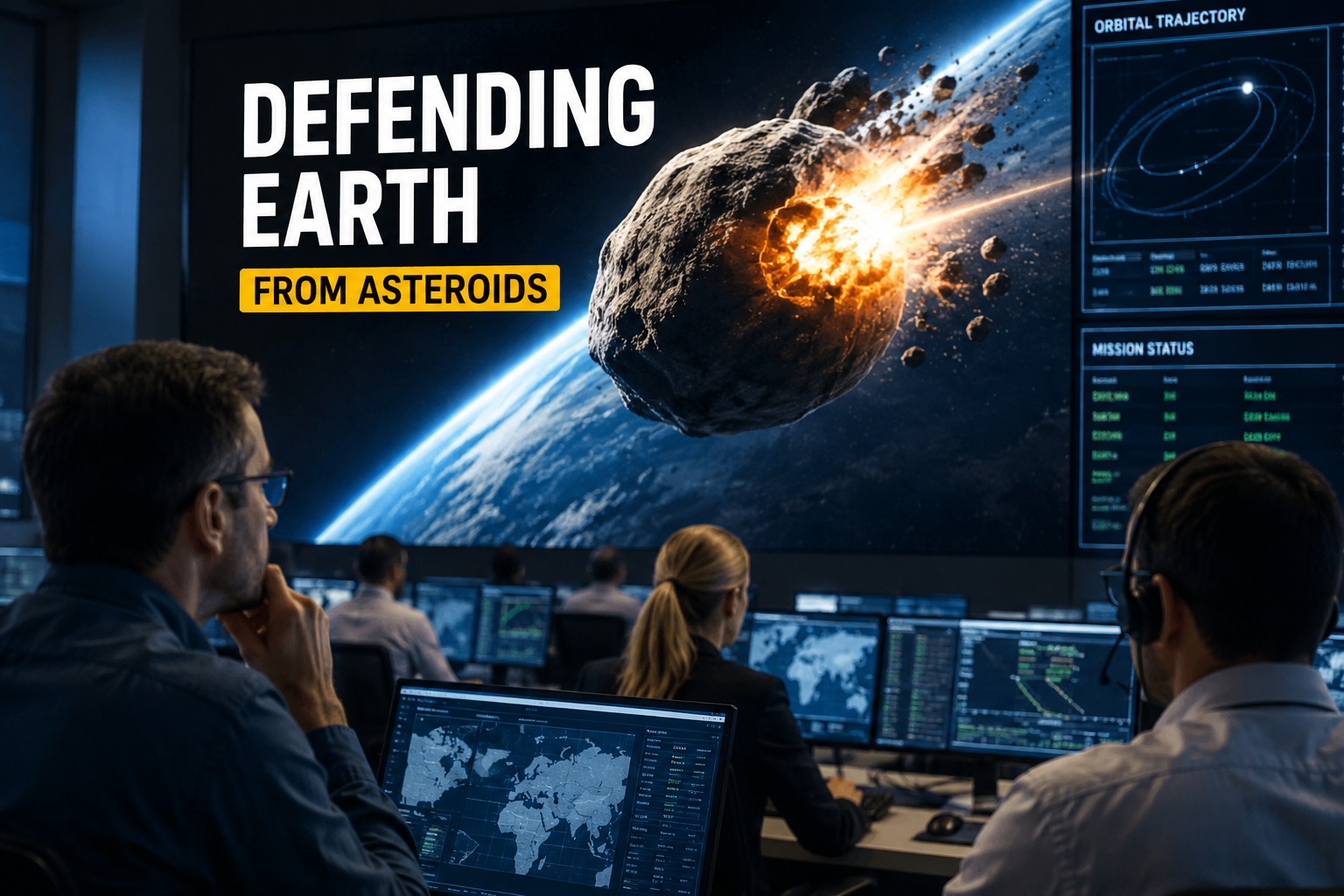
A new generation of computer simulations is examining one of the most dramatic possibilities: using a nuclear explosive device to disrupt a threatening asteroid. A 2026 study led by researchers including Lawrence Livermore National Laboratory scientists modeled the effects of a nuclear explosion on a hypothetical 160-meter asteroid. The results suggest that nuclear mitigation could be a potentially effective last-resort planetary-defense option, particularly when an asteroid is large or there is not enough warning time for slower techniques.
But there is an important distinction. The objective would not simply be to “blow up” an asteroid like a movie villain. The real scientific challenge is to make sure that the resulting fragments do not remain on dangerous trajectories toward Earth.
Why a 160-Meter Asteroid Is a Serious Threat
Asteroids come in an enormous range of sizes. Many are small enough to burn up in Earth's atmosphere or cause limited damage. A body measuring around 160 meters, however, belongs to a much more concerning category.
If such an object struck a populated area, the consequences could be catastrophic. Its enormous mass and high impact velocity would release an immense amount of energy. The exact consequences would depend on its composition, density, speed, angle of entry and impact location.
This is why planetary defense focuses not only on discovering potentially hazardous asteroids but also on understanding whether humanity could alter their trajectories.
NASA's planetary-defense work has repeatedly emphasized a crucial principle: an asteroid does not necessarily need to be destroyed to prevent an impact. If its trajectory can be changed sufficiently early, even a relatively small alteration in its velocity can eventually make it miss Earth. NASA's NEO Deflection App, for example, demonstrates how the required velocity change depends strongly on the asteroid's size and the amount of time available before a potential impact.
That leads to an important question: why consider nuclear technology at all?
Why Nuclear Explosions Are Being Studied
For an asteroid discovered decades before a predicted impact, scientists have several less extreme possibilities. One of the most important is a kinetic impactor—a spacecraft deliberately sent into the asteroid at very high speed.
NASA demonstrated that this basic concept can work with its Double Asteroid Redirection Test, or DART. In 2022, DART collided with the asteroid moonlet Dimorphos and successfully altered its orbit, providing the first full-scale demonstration that a spacecraft can deliberately change the motion of an asteroid.
However, a kinetic impactor is not necessarily the best answer for every scenario.
A very large asteroid may require an enormous amount of momentum to move. A threatening object might also be discovered relatively late, leaving insufficient time to plan, launch and intercept a conventional spacecraft.
Nuclear devices therefore remain under study as an emergency option. NASA technical studies have evaluated nuclear explosive devices alongside kinetic impactors and other approaches for hypothetical asteroid threats.
The idea is not necessarily to completely vaporize the asteroid. Instead, the enormous energy released by a nuclear explosion could rapidly heat material on the asteroid's surface. The escaping material produces a reaction force, while intense energy deposition and shock effects can fracture the asteroid. Together, these processes can alter its motion and potentially break it into pieces that disperse rather than strike Earth as one large body. NASA has previously described this type of nuclear-deflection concept in its planetary-defense research.
What the New 2026 Simulation Found
The recent study, published in The Planetary Science Journal, represents a more detailed attempt to understand what could happen when a nuclear explosive device interacts with a large, porous asteroid.
Researchers led by Isaiah Santistevan modeled a hypothetical asteroid approximately 160 meters across. The simulations used advanced hydrodynamic modeling to examine how asteroid material would respond to the energy deposited by a nuclear explosion. The researchers considered different asteroid structures and different scenarios rather than assuming that every asteroid behaves like a solid block of rock.
That distinction matters enormously.
Real asteroids are not necessarily solid, uniform spheres. Some contain fractures, voids and loosely connected material. Others may behave more like collections of rubble held together partly by gravity. Their composition can also vary substantially.
As a result, a nuclear explosion could produce very different outcomes depending on the asteroid's internal structure.
The simulations indicated that disruption was highly likely in two of the three scenarios examined, based on the extent of damage, the direction in which material moved and the change in the asteroid's velocity. The researchers nevertheless stopped short of claiming that nuclear disruption is guaranteed to make every fragment harmless.
That caution is one of the most important parts of the research.
The Biggest Problem: Breaking an Asteroid Is Not Enough
It may sound simple: find the asteroid, destroy it and save Earth.
In reality, that could create a second problem.
Suppose a large asteroid is broken into hundreds or thousands of pieces. If those fragments continue along almost the same trajectory, Earth could still be hit by a dangerous stream of debris.
Instead of one large impact, humanity could potentially face multiple smaller impacts.
This is why planetary-defense researchers distinguish between disruption and successful mitigation. A successful strategy must consider not only whether the original asteroid is fractured, but also how much the fragments spread out, how their velocities change and whether enough of them remain capable of reaching Earth.
The 2026 simulations provide valuable information about the early stages of this process, but computer models cannot simply fast-forward the entire event indefinitely. Long-term fragment evolution remains a complicated problem involving gravity, orbital mechanics and the physical properties of the debris.
NASA's earlier asteroid simulations have highlighted a similar issue. In some cases, fractured asteroid material can eventually be influenced by gravity in ways that cause pieces to regroup.
Therefore, “the asteroid broke apart” should never automatically be interpreted as “Earth is safe.”
Why Early Detection Still Matters More Than Any Nuclear Solution
The most powerful planetary-defense technology is arguably not a weapon at all.
It is time.
If scientists discover a hazardous asteroid many years or decades before a predicted impact, they may only need to make a tiny change to its velocity. Given enough time, that small difference can accumulate into a huge positional difference by the time the asteroid reaches Earth's orbital neighborhood.
NASA's planetary-defense tools demonstrate this principle by showing how deflection requirements depend on when the maneuver occurs. Earlier intervention generally provides much more opportunity to alter the eventual impact trajectory.
This is why astronomers continuously search for near-Earth objects and calculate their orbits.
The 2025 Planetary Defense Conference hypothetical scenario provides a useful example of how seriously scientists approach this process. NASA and international partners studied reconnaissance, trajectory modification and disruption options for a simulated asteroid threat, including kinetic impactors and nuclear explosive devices.
These exercises are not predictions that a particular asteroid will hit Earth. Instead, they function as emergency drills for an extremely difficult problem.
Nuclear Deflection Versus Kinetic Impact
The two approaches have different strengths.
A kinetic impactor is comparatively straightforward in concept: send a spacecraft into an asteroid and transfer momentum to it. DART demonstrated that this principle works. It is particularly attractive when there is sufficient warning time and the target can be accurately characterized.
A nuclear approach potentially delivers vastly more energy and may therefore become relevant when the target is exceptionally large or when the warning period is short.
NASA research has explicitly noted that nuclear explosive devices could become more important for very large objects or scenarios involving limited warning time.
There is also another emerging area of research. Scientists have been investigating extremely energetic, non-nuclear methods of transferring energy to an asteroid's surface. A 2024 Nature Physics study, for example, demonstrated laboratory-scale asteroid-deflection experiments using intense X-ray pulses and used simulations to explore how such mechanisms could eventually scale to much larger targets.
This illustrates a broader point: nuclear technology is only one part of a much larger planetary-defense toolbox.
What Could Make a Nuclear Strategy Fail?
Several uncertainties remain.
First, scientists would need to know what the asteroid is made of and how strongly its internal material is connected. A metallic asteroid could behave differently from a porous rocky body.
Second, the asteroid's orbit would have to be known with extremely high accuracy. A successful intervention requires changing the trajectory in a useful direction—not merely changing it randomly.
Third, the time available would be critical. Launching and guiding an interceptor to a rapidly moving object in deep space is an enormous engineering challenge.
Finally, the resulting fragments would need to be tracked. A successful defense requires confidence that the debris will not simply become another impact threat.
These uncertainties explain why researchers rely heavily on simulations. Lawrence Livermore scientists, for example, use advanced modeling to study how asteroid material responds to nuclear energy deposition and how debris disperses after disruption.
Is This a Realistic Way to Save Earth?
The answer is potentially—but only under specific circumstances.
It would be misleading to say that scientists have proven that a nuclear explosion can reliably destroy any asteroid headed toward Earth. They have not.
What the research does show is that nuclear explosive devices deserve serious consideration as part of planetary-defense planning, especially for large objects or situations in which conventional methods may not provide enough time.
The strongest evidence comes from a combination of computer modeling, previous planetary-defense studies and real-world demonstrations such as DART. Each addresses a different part of the problem.
DART showed that humans can deliberately alter an asteroid's motion. Advanced simulations show how much more energetic intervention might behave. Future research will need to connect these pieces into reliable mission strategies.
The Bigger Lesson: Detection Is Our First Line of Defense
The most fascinating part of this research may not actually be the nuclear explosion.
It is the growing realization that planetary defense is becoming an engineering discipline rather than merely a theoretical idea.
Scientists now have tools to discover near-Earth objects, calculate their trajectories, model their internal structures, simulate impacts and test deflection strategies. NASA's planetary-defense program combines asteroid detection, tracking, characterization and mitigation planning as part of a coordinated approach to potential threats.
A nuclear device, if ever required, would therefore represent something closer to a last line of defense than a first choice.
If an asteroid is detected early enough, a small trajectory change may be far preferable to attempting to destroy it. If it is detected late, however, the situation becomes dramatically more difficult—and high-energy disruption could become one of the few remaining options.
Frequently Asked Questions
Could a nuclear explosion completely destroy a 160-meter asteroid?
Not necessarily. The purpose of the simulations is to understand disruption and the resulting motion of material. Breaking the asteroid into fragments does not automatically mean that every fragment becomes harmless.
Would a nuclear explosion have to hit the asteroid directly?
Not necessarily. Research has investigated standoff nuclear explosions in which energy reaches the asteroid without requiring the explosive device to physically penetrate it. The 2026 simulations specifically examined how energy deposited on the asteroid's surface could drive material away and damage the interior.
Is a 160-meter asteroid currently on its way to hit Earth?
The 160-meter object in the recent research is a hypothetical threat scenario, not a prediction that such an asteroid is currently heading for Earth. NASA's planetary-defense exercises likewise use simulated objects to test response strategies.
Is nuclear defense the best asteroid-defense method?
Not necessarily. If an asteroid is detected sufficiently early, non-nuclear methods such as kinetic impactors may be preferable. Nuclear options become more interesting when the asteroid is very large or the warning time is short.
Conclusion: A Last Resort, Not a Magic Shield
Could an atomic explosion save Earth from a city-killer asteroid?
Science suggests that it could potentially help—but the answer is much more complicated than simply blowing up a space rock.
The latest simulations show that nuclear energy could seriously disrupt a roughly 160-meter asteroid under certain modeled conditions, supporting the idea that nuclear mitigation may have a role in planetary defense. But researchers still have to solve the difficult problem of what happens to the fragments afterward.
The most reassuring conclusion is therefore not that humanity has a giant space weapon waiting for the next asteroid. It is that scientists are developing multiple layers of protection.
Early detection gives us time. Kinetic impactors can change trajectories. Advanced simulations help predict outcomes. And nuclear disruption may provide a last-resort option when the threat is too large or the warning period is too short.
For a civilization living on a planet constantly moving through a crowded solar system, that combination of observation, mathematics and engineering may ultimately be our most important defense.