5 Trillion Data Points in One Prompt: The AI Model Trying to Understand the Physical World
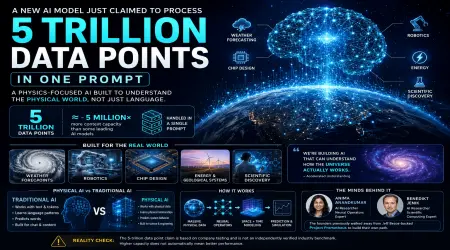
🚨 5 TRILLION Data Points. ONE Prompt.
A new AI model is taking a radically different approach to artificial intelligence — instead of simply understanding language, it is being designed to understand how the physical world behaves.
Imagine giving an AI system an enormous representation of a physical environment containing 5 trillion data points and asking it to analyse the whole thing in a single prompt.
That is exactly the kind of capability claimed by a new AI company called Accelerated Understanding Inc.
And the idea behind the technology could be far more important than the headline number.
The next big AI breakthrough may not be about better chatbots. It may be about teaching machines how the real world works.
💥 THE BIG NUMBER
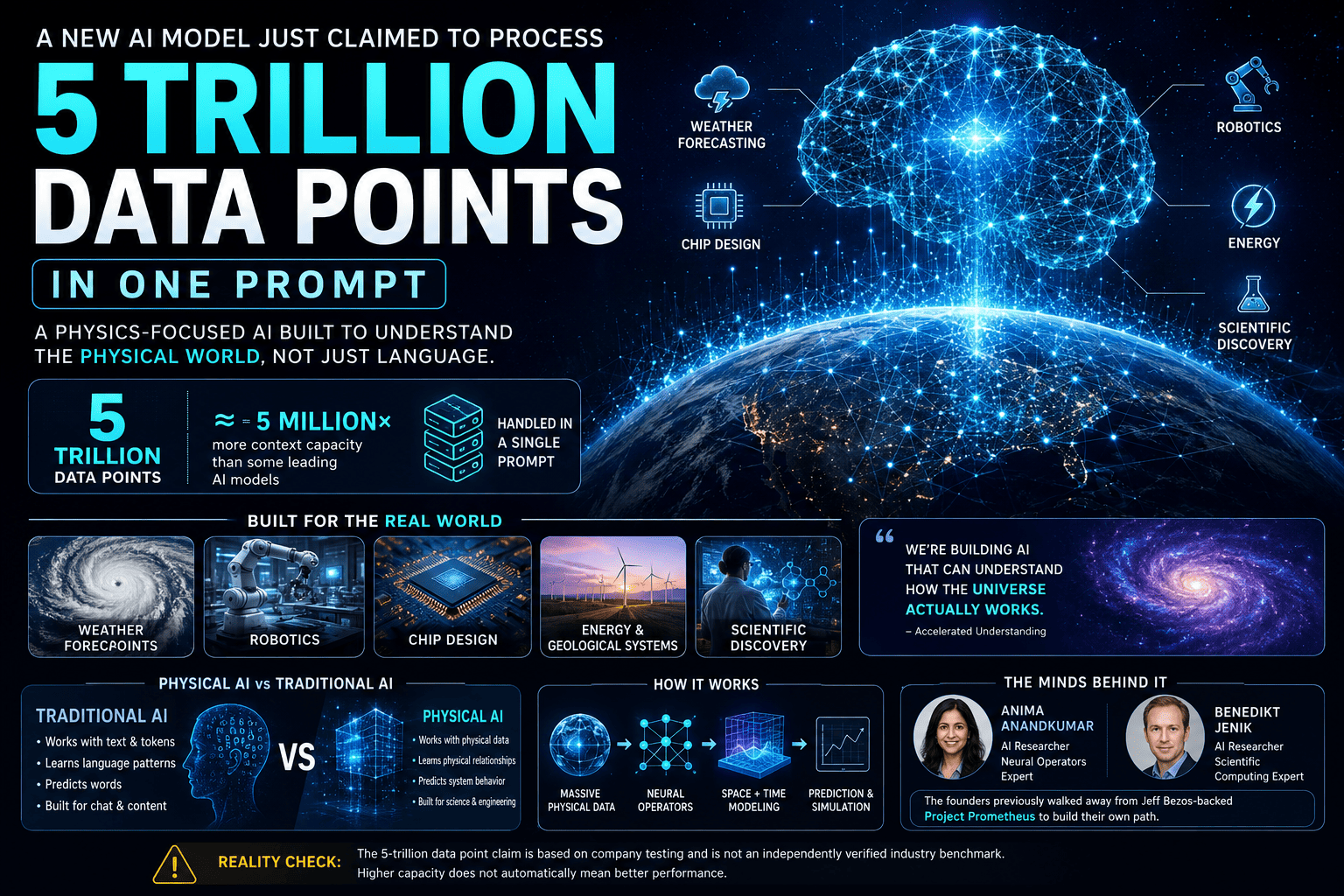
5,000,000,000,000
Data points processed in a single prompt
According to the company, its model demonstrated the ability to handle 5 trillion data points during testing.
The company says this is roughly 5 million times greater than the context capacity typically associated with some leading language models.
⚠️ Important: This is a company-reported testing claim. The 5 trillion figure should not be confused with 5 trillion text tokens, nor should it automatically be interpreted as proof that the model is better than leading general-purpose AI systems.
The interesting part is what those data points represent.
🧠 This Isn't Another ChatGPT
Most of the AI systems that have exploded in popularity over the last few years are fundamentally built around language.
They learn patterns from enormous quantities of text and other data and become remarkably good at:
- Writing
- Coding
- Answering questions
- Summarising information
- Reasoning
- Generating content
But the physical world doesn't behave like a paragraph.
A weather system doesn't move from word → word → word.
A rocket doesn't follow a sequence of sentences.
A semiconductor doesn't "understand" language.
Physical systems involve variables interacting across:
SPACE + TIME + MOTION + ENERGY + TEMPERATURE + PRESSURE
And that's where Accelerated Understanding is taking a different route.
🌎 From Understanding Words to Understanding Reality
The company was founded by AI researchers Anima Anandkumar and Benedikt Jenik, who are working on AI systems designed specifically for physical and scientific problems.
Rather than treating the physical world as ordinary language data, their approach uses neural operators — a class of AI techniques designed to learn relationships between complex functions and physical systems.
The ambition?
Don't just describe what happened.
Predict what happens next.
⏳ The 4D Problem
Here's an easy way to understand the challenge.
We normally think of the physical world as:
X + Y + Z
That's three-dimensional space.
But everything in the universe also changes with:
TIME
So researchers often think about physical systems as:
3D SPACE + TIME = 4D
Consider a hurricane.
At 10:00 AM, its centre is in one location.
At 2:00 PM, it has moved.
At 6:00 PM, it has changed direction, speed, pressure and intensity.
An AI system designed for physical simulation needs to understand both the state of the system and how that state evolves over time.
That's dramatically different from simply predicting the next word in a sentence.
🔬 HOW THE CONCEPT WORKS
MASSIVE PHYSICAL DATA
🌍
Weather • Motion • Energy • Materials • Geological systems
↓
NEURAL OPERATORS
🧠
AI learns relationships between physical variables
↓
SPACE + TIME
⏳
The model represents how systems evolve
↓
PREDICTION & SIMULATION
⚡
Possible future states can be modelled
The ultimate goal is to make extremely complicated physical simulations faster and more useful.
🌦️ 1. WEATHER FORECASTING
Weather may be one of the clearest examples of why physical AI could matter.
The atmosphere is an enormous interconnected system.
Temperature changes in one region can influence pressure. Pressure affects wind. Wind influences clouds. Clouds influence rainfall.
Everything is connected.
A powerful physics-focused AI could potentially analyse huge quantities of atmospheric information and model how weather systems evolve.
The dream:
More data → faster simulation → better prediction
It could eventually help scientists study extreme weather and improve forecasting models.
🤖 2. ROBOTS THAT UNDERSTAND PHYSICS
Today's AI-powered robots are becoming increasingly capable.
But intelligence in the physical world requires more than recognising an object.
A robot needs to understand:
What happens if I push it?
Will it fall?
How much force should I use?
What happens if the surface is slippery?
How will the object move?
A physical AI model could potentially help robots develop a better internal understanding of how objects and environments behave.
Instead of simply seeing the world...
The AI could learn to predict the world.
💻 3. CHIP & SEMICONDUCTOR DESIGN
Modern computer chips are incredibly complex.
Engineers need to model how materials, electricity, heat and physical structures interact.
Traditionally, many of these problems require sophisticated simulations and enormous computational resources.
Physics-focused AI could potentially accelerate parts of this process by learning how physical systems behave.
That could help engineers explore more designs without manually running every possible simulation.
⚡ 4. ENERGY & GEOLOGICAL SYSTEMS
The Earth beneath our feet is another massive physical system.
Underground environments can involve:
- Rock structures
- Pressure
- Heat
- Fluids
- Geological formations
- Energy movement
These systems are difficult to observe directly.
AI capable of modelling complex physical relationships could potentially become a powerful tool for energy and geological research.
🔬 5. SCIENTIFIC DISCOVERY
This may ultimately be the biggest opportunity.
Today, scientists often use computers to simulate complicated physical systems.
But simulations can be extremely expensive and time-consuming.
Imagine an AI that could help researchers explore thousands or millions of possible scenarios.
Instead of:
Hypothesis → Simulation → Wait → Result
the future could move toward:
Hypothesis → AI Simulation → Thousands of possibilities → Best candidates
That could dramatically accelerate certain areas of research.
🧩 WHY NEURAL OPERATORS MATTER
Traditional AI has been dominated by the Transformer architecture.
Transformers are extraordinarily powerful and are the foundation of many modern generative AI systems.
But not every problem is naturally a language problem.
Physical systems are continuous.
They exist across:
Space
Time
Fields
Forces
Interactions
Neural operators are designed to learn relationships involving functions and continuous physical systems.
That makes them particularly interesting for applications involving physics and scientific simulation.
In simple terms:
Transformers are exceptionally good at learning patterns in sequences.
Neural operators are designed to learn patterns in complex physical systems.
That's an oversimplification, but it captures the basic idea.
🆚 LANGUAGE AI vs PHYSICAL AI
| Traditional Generative AI | Physics-Focused AI |
|---|---|
| Words & tokens | Physical data |
| Language patterns | Physical relationships |
| Text generation | Simulation |
| Predicts sequences | Predicts system behaviour |
| Chatbots & assistants | Science & engineering |
| Human language | Physical world |
The two aren't necessarily competitors.
In fact, they could eventually work together.
Imagine a scientist asking a language AI:
"What would happen if we changed this parameter?"
The language model could communicate with a physics model that actually runs the simulation.
One understands the question.
The other understands the physical system.
👨🔬 WHO IS BEHIND IT?
The project comes from AI researchers Anima Anandkumar and Benedikt Jenik.
Anandkumar is particularly well known for her work in machine learning and neural operators.
The company's approach attracted attention partly because the researchers had previously been associated with discussions around Project Prometheus, the AI initiative backed by Amazon founder Jeff Bezos.
Rather than simply following the conventional large-language-model path, the researchers pursued their own approach to AI and scientific modelling.
🌌 THE BIGGER IDEA
Here's where this gets really interesting.
For years, the AI race has largely followed one formula:
More data
+ Bigger models
+ More computing
= More capable AI
And that formula has worked remarkably well.
But there is a fundamental limitation.
The universe isn't made of text.
A storm isn't a paragraph.
A galaxy isn't a document.
A machine isn't a sentence.
A molecule isn't a conversation.
Reality operates according to physical relationships.
And if AI is eventually going to become a true scientific and engineering partner, it may need to understand those relationships directly.
⚠️ BUT THERE'S A CATCH
A headline saying "AI can process 5 trillion data points" sounds spectacular.
But capacity isn't everything.
A system can process enormous quantities of information and still produce inaccurate predictions.
The real test will be:
How accurate is it?
How fast is it?
How expensive is it?
Can independent researchers reproduce the results?
Does it outperform existing scientific simulation methods?
Those questions will determine whether this becomes a genuine technological breakthrough or simply an impressive research demonstration.
For now, the 5-trillion figure should be viewed as an ambitious company claim rather than an independently established industry benchmark.
🚀 FROM CHATBOTS TO WORLD MODELS
The AI industry may be moving toward a much bigger concept:
WORLD MODELS
AI that doesn't merely know facts about the world...
but can build an internal representation of how the world behaves.
Imagine asking an AI to:
Design a more efficient aircraft.
It could potentially understand the geometry, simulate airflow, analyse forces, test thousands of variations and recommend a design.
Or:
Predict how this storm will evolve.
The system could model the atmosphere rather than simply retrieve information about previous storms.
That is a very different vision of artificial intelligence.
🔮 WHAT COMES NEXT?
We may eventually see AI develop along several parallel paths:
🗣️ Language AI
Understanding and generating human language.
👁️ Vision AI
Understanding images and video.
🧠 Reasoning AI
Solving complex intellectual problems.
🌎 Physical AI
Understanding physical systems.
🔬 Scientific AI
Helping discover new knowledge.
And eventually...
ALL OF THEM COULD WORK TOGETHER.
A human asks the question.
A language model understands it.
A reasoning model determines the approach.
A physics model runs the simulation.
And the AI system returns the result in language humans can understand.
✨ THE FINAL THOUGHT
The most fascinating part of this announcement isn't really 5 trillion.
It's the direction.
Artificial intelligence began by learning how humans write and speak.
Now researchers are trying to teach AI how the physical world behaves.
If successful, that could take AI beyond being a tool for generating text, images and code.
It could turn AI into something much more powerful:
A MACHINE FOR SIMULATING REALITY.
And perhaps the biggest AI breakthrough of the future won't be an AI that knows everything humans have written...