Solar Storms May Be More Dangerous Than Previously Thought, Scientists Warn
Solar storms have always been considered one of nature's most powerful cosmic events, but new scientific research suggests their impact on Earth could be even more severe than experts previously believed. While these storms occur millions of kilometers away on the Sun, their effects can reach our planet within hours, disrupting satellites, communications, navigation systems, and even electricity grids.
As humanity becomes increasingly dependent on advanced technology, understanding the risks posed by space weather is no longer just a scientific curiosity—it has become a matter of global security and infrastructure resilience. Recent findings indicate that the consequences of extreme solar storms may extend far beyond temporary communication outages, potentially affecting transportation, emergency services, financial systems, and modern digital life.
What Are Solar Storms?
Solar storms are disturbances caused by intense activity on the Sun. They typically occur when the Sun releases enormous amounts of energy through solar flares or coronal mass ejections (CMEs). These eruptions send billions of tons of electrically charged particles hurtling through space.
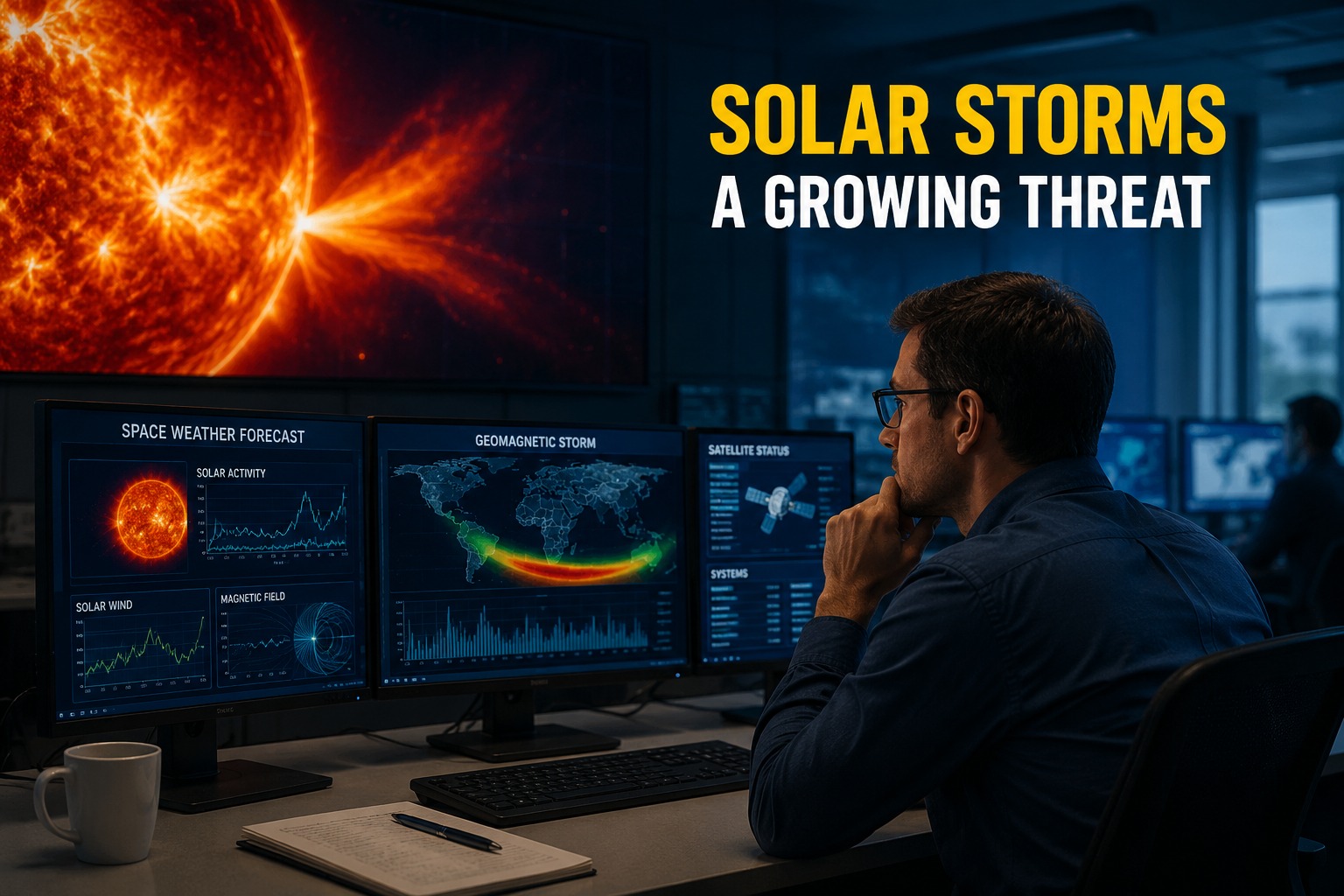
When these particles collide with Earth's magnetic field, they create what scientists call geomagnetic storms, a major component of space weather. Earth's magnetic field provides significant protection, but extremely powerful storms can still interfere with technology operating both in space and on the ground.
Space weather is influenced by changes in the Sun's activity and the interaction between solar particles and Earth's magnetic environment. Although invisible to most people, these events can have widespread technological consequences.
Why Are Scientists Issuing a New Warning?
According to a recent study published through Academic Conferences & Publications, researchers argue that the potential effects of severe solar storms have likely been underestimated. Their analysis suggests that current risk models may not fully capture how interconnected today's technological infrastructure has become.
In previous decades, many assessments focused on direct impacts such as satellite failures or localized power outages. However, modern societies depend on a vast network of interconnected systems, including:
- Global internet infrastructure
- GPS navigation
- Aviation communication
- Financial transactions
- Emergency response networks
- Cloud computing services
- Mobile communication systems
A disruption in one system can quickly trigger failures in several others, creating a cascading effect that amplifies the overall damage.
Understanding Space Weather
Unlike ordinary weather, space weather originates from the Sun rather than Earth's atmosphere. The Sun follows approximately an 11-year activity cycle, during which periods of heightened activity produce more solar flares and coronal mass ejections.
When powerful eruptions are directed toward Earth, charged particles compress Earth's magnetosphere, disturb radio signals, and generate electrical currents in the ground. These induced currents can overload transformers and electrical infrastructure.
Scientists continuously monitor solar activity using specialized satellites that observe the Sun around the clock. Early detection provides valuable warning time, although predicting the exact strength and impact of a solar storm remains challenging.
How Solar Storms Affect Modern Technology
One reason scientists are increasingly concerned is that today's world is far more dependent on sensitive electronic systems than ever before.
Satellite Operations
Satellites are among the first systems affected by space weather. High-energy particles can damage electronic components, interfere with onboard computers, and alter satellite orbits due to increased atmospheric drag.
Communication satellites, weather satellites, Earth observation satellites, and military satellites all face varying degrees of risk during major solar events.
GPS and Navigation Systems
Global Positioning System (GPS) signals travel through Earth's upper atmosphere. During geomagnetic storms, disturbances in the ionosphere can reduce positioning accuracy.
This affects aviation, maritime navigation, agriculture, surveying, emergency services, and autonomous technologies that rely on precise location data.
Power Grids
Perhaps the greatest concern involves electrical power networks.
Geomagnetically induced currents generated during severe solar storms can enter high-voltage transmission lines and transformers. In extreme cases, these currents may cause transformer damage, equipment failures, and widespread blackouts.
Because large transformers are expensive and difficult to replace, recovery from major failures could take weeks or even months.
Internet Infrastructure
Although fiber-optic cables themselves are largely immune to solar radiation, the electronic equipment supporting global communication—including power supplies, repeaters, and data centers—can still be vulnerable.
Researchers have increasingly examined how large-scale solar storms could interrupt international internet connectivity if multiple supporting systems fail simultaneously.
Lessons from History
Solar storms are not merely theoretical threats. History provides several examples demonstrating their power.
The Carrington Event (1859)
The strongest recorded geomagnetic storm occurred in 1859 and is known as the Carrington Event.
Telegraph systems—the cutting-edge communication technology of the time—failed across Europe and North America. Operators reported electrical shocks, telegraph equipment caught fire, and auroras appeared near the equator.
If an event of similar magnitude occurred today, experts estimate that economic losses could reach trillions of dollars because modern civilization depends heavily on electronics.
Quebec Blackout (1989)
A powerful geomagnetic storm in March 1989 caused the collapse of Quebec's electrical grid in Canada, leaving millions of people without electricity for several hours.
Although the event was far weaker than the Carrington Event, it highlighted the vulnerability of modern power infrastructure.
Recent Solar Activity
In recent years, several strong solar storms have produced brilliant auroras visible much farther south than usual while also causing temporary disruptions to satellite communications and navigation services. These events serve as reminders that space weather remains an active and ongoing challenge.
Why Modern Society Faces Greater Risk
Technology has transformed everyday life, but it has also increased our exposure to space weather.
Many essential services now depend on uninterrupted satellite communication, cloud computing, digital banking, online commerce, and global logistics. Even short interruptions can produce significant economic consequences.
For example, airlines rely on satellite navigation, shipping companies use GPS for routing, hospitals depend on stable communication networks, and financial markets require accurate timing systems synchronized by satellites.
As these systems become increasingly interconnected, failures can spread rapidly across sectors.
Can Scientists Predict Solar Storms?
Space agencies such as NASA, NOAA, and the European Space Agency continuously observe the Sun using specialized spacecraft.
Scientists can often detect solar flares and coronal mass ejections shortly after they occur. Depending on the speed of the eruption, Earth may receive anywhere from about 15 hours to several days of warning before the charged particles arrive.
However, predicting exactly how strongly Earth's magnetic field will respond remains difficult. Researchers continue improving computer models to better forecast the intensity of future geomagnetic storms.
How Governments and Industries Are Preparing
Recognizing the growing risks, governments and infrastructure operators have begun investing in space weather preparedness.
Power companies are strengthening grid protection measures and improving transformer monitoring systems. Satellite operators can temporarily place spacecraft into protective modes during severe solar events. Airlines sometimes adjust flight paths near the poles when communication disruptions are expected.
Space weather forecasting centers now issue alerts that help industries prepare before major geomagnetic storms arrive.
International cooperation is also becoming increasingly important because solar storms affect the entire planet regardless of national borders.
What Can Ordinary People Do?
Fortunately, everyday individuals are unlikely to face direct physical danger from solar storms. Earth's atmosphere and magnetic field provide substantial protection against harmful radiation.
However, people can still prepare for possible disruptions by following practical emergency preparedness advice:
- Keep battery-powered flashlights and portable chargers available.
- Maintain emergency supplies in case of temporary power outages.
- Stay informed through official weather and emergency agencies during significant space weather events.
- Avoid spreading misinformation or exaggerated claims on social media.
Most solar storms pass with little noticeable impact on daily life, but preparedness is always beneficial.
The Importance of Continued Research
The latest research emphasizes that our understanding of solar storms continues to evolve. As society becomes increasingly dependent on digital infrastructure, even moderate disruptions can produce significant economic and operational consequences.
Improved forecasting models, stronger infrastructure, better satellite protection, and international collaboration will all play essential roles in reducing future risks. Continued scientific research also helps engineers design systems capable of withstanding increasingly severe space weather events.
Conclusion
Solar storms are natural events that have occurred throughout Earth's history, but their potential impact has grown alongside humanity's technological advancement. New research suggests that previous estimates may have underestimated just how vulnerable modern infrastructure has become to extreme space weather.
While catastrophic solar storms remain relatively rare, their possible consequences for satellites, communications, power grids, transportation, and the global economy justify continued scientific attention and investment in preparedness. By improving forecasting capabilities and strengthening critical infrastructure, governments and industries can significantly reduce the risks posed by one of nature's most powerful cosmic phenomena.