
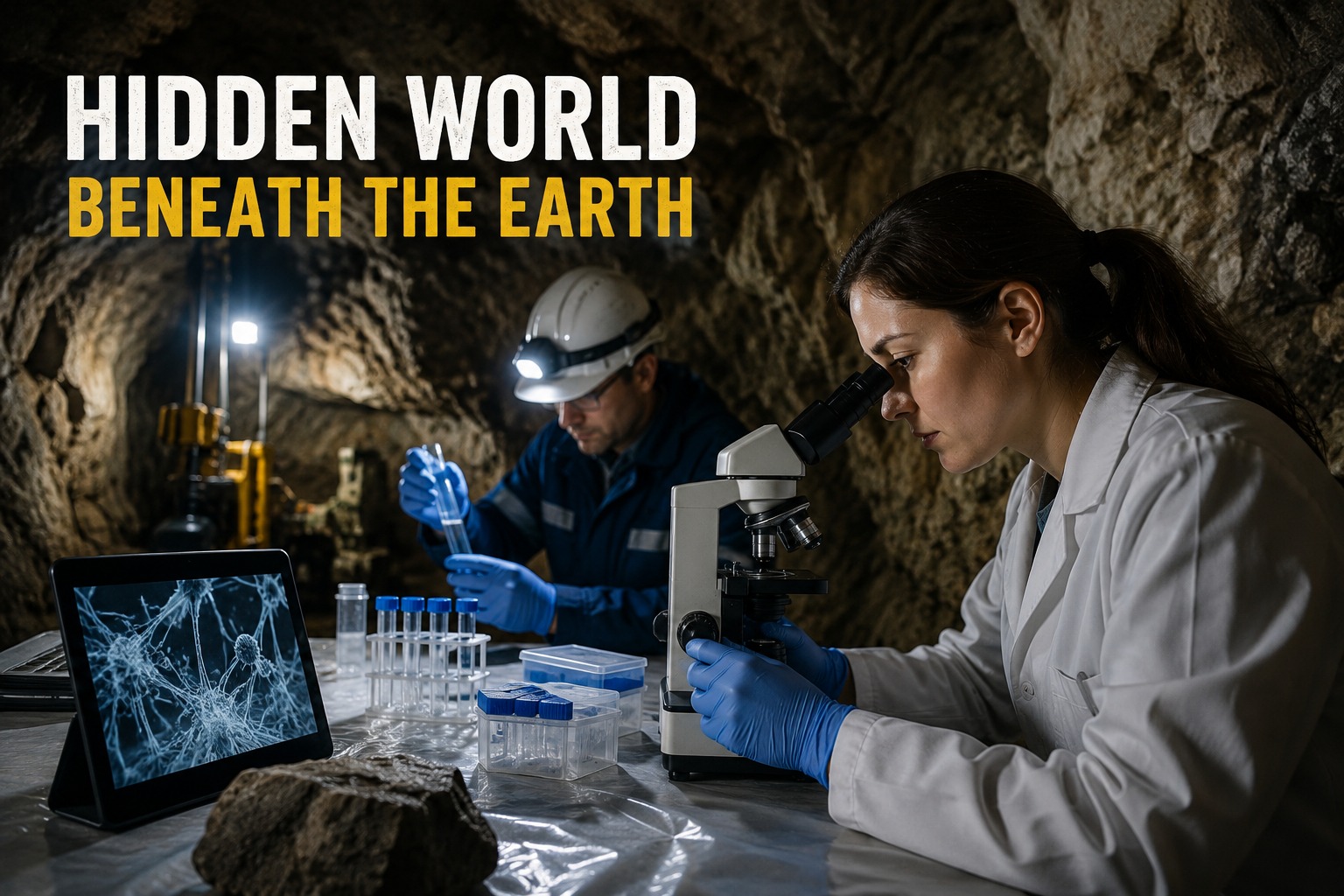
Hidden Ecosystem Deep Beneath the Earth: Scientists Discover a Thriving Underground World of Fungi
Deep beneath our feet, far below forests, rivers, and cities, an extraordinary world has been quietly thriving for millions of years. While most people associate life with sunlight, fresh air, and the Earth's surface, scientists are increasingly discovering that life can flourish in some of the planet's most extreme environments. A groundbreaking study from the University of Michigan has now revealed that deep underground ecosystems are far richer and more complex than previously believed.
Researchers examining water collected from natural gas wells approximately 1,640 feet (500 meters) below the Earth's surface found an unexpectedly large population of fungi living alongside bacteria and other microscopic organisms. The discovery challenges long-standing assumptions about underground life and suggests that Earth's deep subsurface hosts a highly interconnected ecosystem that scientists are only beginning to understand.
This remarkable finding not only expands our knowledge of life on Earth but could also reshape the search for life beyond our planet.
Scientists Explore Life Hidden Deep Underground
For decades, scientists believed that the Earth's deep underground contained only small numbers of microorganisms struggling to survive in harsh conditions. Unlike surface ecosystems powered by sunlight through photosynthesis, underground environments exist in complete darkness, often under immense pressure and with limited nutrients.
However, advances in molecular biology and environmental DNA analysis have allowed researchers to investigate these hidden ecosystems in unprecedented detail.
In the latest research led by University of Michigan doctoral student Quinn Moon, scientists analyzed water samples collected from gas wells drilled approximately 1,640 feet beneath the Earth's surface. Instead of finding only bacteria, the team discovered thriving fungal communities that appear to play a major role in maintaining the underground ecosystem.
The findings suggest that fungi are far more widespread in deep subsurface environments than scientists previously estimated.
Why This Discovery Is So Important
Fungi are often associated with forests, decaying wood, mushrooms, or agricultural soils. Yet they are among the most adaptable organisms on Earth.
Finding abundant fungi deep underground is important because fungi perform essential ecological functions. They break down organic materials, recycle nutrients, interact with bacteria, and influence the chemical composition of their environment.
Their presence indicates that underground ecosystems may be much more dynamic than previously believed rather than being isolated collections of dormant microorganisms.
This changes how scientists think about Earth's biosphere—the global network of living organisms that inhabit the planet.
A Hidden Ecosystem Without Sunlight
Surface ecosystems depend almost entirely on solar energy.
Plants capture sunlight through photosynthesis, producing oxygen and food that support nearly every other organism.
Deep underground, however, sunlight never reaches.
Instead, microorganisms rely on chemical energy produced through interactions between rocks, minerals, groundwater, and naturally occurring gases.
This process, known as chemosynthesis, allows certain microorganisms to obtain energy without sunlight.
The newly discovered fungal communities appear to participate in these underground chemical cycles, interacting with bacteria and other microbes to create stable ecosystems that have likely existed for extremely long periods.
How Researchers Conducted the Study
The research team collected groundwater samples from deep gas wells reaching nearly 500 meters beneath the Earth's surface.
Rather than relying solely on traditional microscopy, scientists used advanced genetic sequencing techniques to identify microscopic organisms based on their DNA.
This modern approach offers several advantages:
- It detects organisms that cannot easily be grown in laboratories.
- It identifies entire microbial communities rather than only individual species.
- It provides a more accurate picture of biodiversity in extreme environments.
The genetic analysis revealed surprisingly diverse fungal populations living alongside bacteria and other microorganisms.
Many of these fungal species had rarely been observed in such extreme underground habitats.
Fungi: Nature's Hidden Engineers
Fungi are among the most important organisms in Earth's ecosystems, although they often receive less attention than plants or animals.
They perform numerous ecological roles, including:
- Recycling dead organic matter.
- Breaking down complex minerals.
- Forming partnerships with microorganisms.
- Transporting nutrients through microscopic networks.
- Influencing groundwater chemistry.
Deep underground, these same abilities may help sustain entire microbial communities.
Scientists believe fungi could act as connectors within underground ecosystems, linking different organisms together through complex biological interactions.
Underground Life Is More Diverse Than Expected
One of the study's most surprising conclusions is the sheer diversity of life beneath the Earth's surface.
For many years, bacteria were thought to dominate underground habitats almost exclusively.
The new findings suggest fungi may represent a much larger proportion of underground life than previously recognized.
This discovery raises several new scientific questions:
- How many fungal species remain undiscovered?
- How long have these underground ecosystems existed?
- How do fungi survive with limited nutrients?
- What roles do they play in carbon and mineral cycling?
Future research will aim to answer these questions using deeper drilling projects and more sophisticated genetic technologies.
Understanding Earth's Deep Biosphere
Scientists often refer to underground microbial habitats as the "deep biosphere."
This enormous hidden ecosystem extends beneath continents and ocean floors and may contain a significant portion of Earth's total microbial biomass.
Despite covering vast areas, the deep biosphere remains one of the least explored environments on the planet.
Unlike rainforests or coral reefs, these ecosystems cannot be observed directly.
Instead, researchers depend on drilling operations, groundwater samples, and molecular analysis to investigate life hidden beneath the surface.
Every new discovery reveals that Earth's underground world is far more biologically active than previously imagined.
Implications for Climate and Carbon Cycling
Understanding underground ecosystems is not only important for biology but also for climate science.
Microorganisms influence how carbon moves through Earth's crust.
Some underground microbes consume methane or carbon dioxide, while others produce gases through natural biological processes.
Fungi may also contribute to:
- Carbon storage.
- Mineral weathering.
- Nutrient recycling.
- Groundwater chemistry.
Improved understanding of these underground biological processes could eventually help scientists refine climate models and better understand Earth's long-term carbon cycle.
What This Means for the Search for Extraterrestrial Life
Perhaps one of the most exciting aspects of the discovery is its relevance to astrobiology.
If complex microbial ecosystems can survive deep underground without sunlight on Earth, similar environments might exist on other planets or moons.
Scientists searching for extraterrestrial life have long focused on locations such as:
- Mars
- Europa (a moon of Jupiter)
- Enceladus (a moon of Saturn)
These worlds possess underground ice, liquid water, or rocky interiors where sunlight never reaches.
The newly discovered fungal ecosystems demonstrate that life does not necessarily require surface conditions to thrive.
Instead, chemical energy and liquid water may be sufficient to support microbial communities beneath planetary surfaces.
This significantly broadens the range of environments considered potentially habitable beyond Earth.
The Future of Underground Biology
The University of Michigan study represents only the beginning of a rapidly expanding field.
Researchers are planning deeper investigations into subsurface ecosystems using improved DNA sequencing, advanced drilling technologies, and sophisticated chemical analysis.
Future studies may reveal:
- Previously unknown fungal species.
- New forms of microbial cooperation.
- Novel biological adaptations.
- Potential industrial and medical applications.
Scientists are especially interested in enzymes produced by deep underground fungi, as organisms living under extreme pressure and limited nutrients often evolve unique biochemical properties.
These discoveries could eventually contribute to biotechnology, environmental cleanup, or pharmaceutical research.
Conclusion
The discovery of a thriving fungal ecosystem nearly 1,640 feet beneath the Earth's surface is transforming our understanding of life on Earth. Rather than being barren and biologically inactive, the deep underground hosts an intricate network of fungi, bacteria, and other microorganisms working together in complete darkness.
This hidden ecosystem demonstrates the remarkable adaptability of life and highlights how much of our own planet remains unexplored. Beyond expanding scientific knowledge, the findings have important implications for climate research, biotechnology, geology, and even the search for life elsewhere in the universe.
As researchers continue to explore Earth's deep biosphere, they are uncovering a fascinating reality: some of the planet's most important ecosystems have been quietly flourishing beneath our feet all along.