
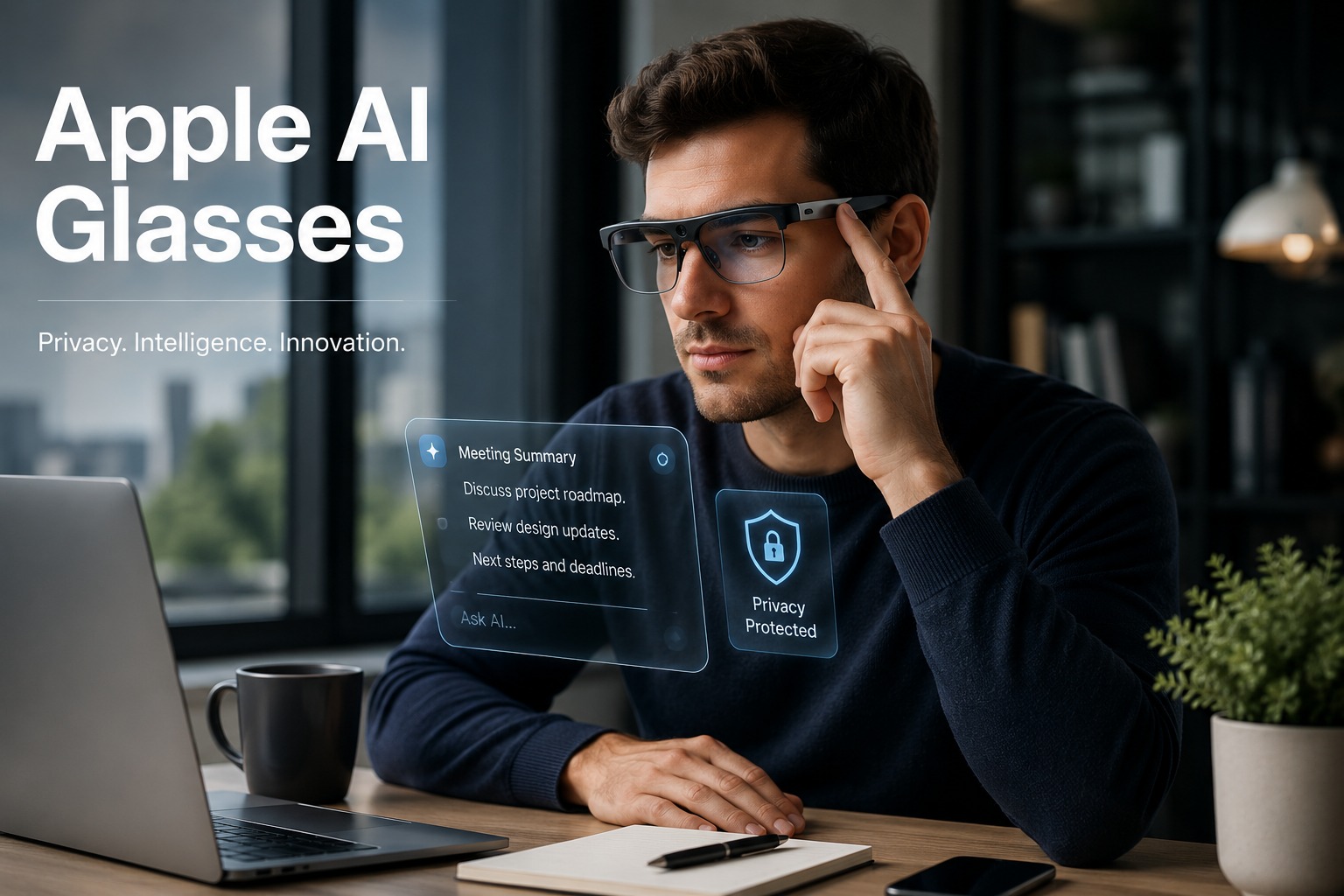
Apple Smart Glasses Put Privacy First as Launch May Slip to Late 2027
Apple is reportedly taking a slower and more cautious approach to its long-awaited AI-powered smart glasses, with privacy emerging as the company's top priority. While competitors have rushed to release wearable AI devices, Apple appears determined to avoid compromising user trust, even if that means delaying the product's launch.
According to recent reports, Apple is refining both the hardware and its privacy framework before introducing the product to the public. The company is expected to offer the first official preview of its smart glasses during the Worldwide Developers Conference (WWDC) in June next year, while commercial availability may not arrive until the end of 2027.
Apple's Different Approach to Smart Glasses
The race to build smart glasses has intensified over the past few years. Several technology companies have introduced wearable devices equipped with cameras, microphones, speakers, and AI assistants that allow users to interact with the digital world without reaching for a smartphone.
Apple, however, has consistently followed a different strategy. Instead of being the first company to launch a product, it typically enters a market after refining the technology and improving the overall user experience. The company's history with devices such as the iPhone, Apple Watch, and AirPods demonstrates this philosophy.
Reports suggest Apple is applying the same strategy to smart glasses. Rather than prioritizing speed, the company wants to ensure the device offers a seamless experience while protecting user privacy from day one.
Why Privacy Is Apple's Biggest Focus
Privacy has become one of the most important concerns surrounding AI-powered wearable devices.
Unlike smartphones, smart glasses can continuously observe the surrounding environment. Cameras may capture people nearby, microphones may pick up conversations, and AI systems may analyze what the wearer sees in real time.
These capabilities create significant privacy challenges.
Apple is reportedly redesigning parts of its software and hardware to minimize these risks. The company wants users—and the people around them—to clearly understand when recording or AI processing is taking place.
This approach aligns with Apple's long-standing privacy philosophy, which emphasizes keeping personal information secure and processing as much data as possible directly on the device rather than sending it to cloud servers.
AI Will Be at the Heart of Apple's Smart Glasses
Artificial intelligence is expected to power many of the smart glasses' most useful features.
Instead of functioning as a simple display, the glasses could understand the user's surroundings and provide contextual assistance. AI may recognize landmarks, translate signs, summarize notifications, answer questions, and help users complete everyday tasks without requiring them to constantly look at their phones.
The integration of Apple's AI platform is also expected to make interactions feel more natural through voice commands and visual intelligence.
However, delivering these capabilities while maintaining privacy requires sophisticated engineering. AI systems must balance speed, accuracy, battery efficiency, and data protection, making development considerably more complex.
Why the Launch May Be Delayed Until 2027
Developing wearable AI technology is far more challenging than building traditional consumer electronics.
Apple reportedly needs additional time to optimize several critical areas, including:
- AI performance and responsiveness
- Battery efficiency
- Lightweight hardware design
- Heat management
- Privacy protections
- Software integration across the Apple ecosystem
Rather than launching a product with unfinished features, Apple appears willing to extend development until these challenges are resolved.
Industry analysts believe this cautious approach could strengthen customer confidence, particularly at a time when concerns about AI data collection are increasing worldwide.
WWDC Could Offer the First Official Preview
Although consumers may have to wait until late 2027 to purchase the device, reports indicate Apple intends to showcase its smart glasses during next year's Worldwide Developers Conference (WWDC).
WWDC traditionally serves as Apple's platform for introducing new software technologies, developer tools, and occasionally new hardware.
An early preview would allow developers to begin creating applications optimized for the glasses while giving Apple additional time to refine the product before mass production.
This strategy has been used before, particularly with products requiring developers to build a supporting software ecosystem.
How Apple's Smart Glasses Could Differ from Competitors
Several companies already offer AI-enabled smart glasses, but Apple is expected to differentiate itself through ecosystem integration and privacy.
Rather than focusing solely on recording video or providing AI chat features, Apple's glasses may work closely with devices such as the iPhone, Apple Watch, AirPods, and Mac.
Potential advantages could include:
- Seamless synchronization with Apple devices
- On-device AI processing for improved privacy
- Intelligent notification management
- Voice-powered assistance
- Visual recognition with strong security protections
- Tight integration with Apple's software ecosystem
This interconnected experience has historically been one of Apple's strongest competitive advantages.
The Growing Importance of AI Wearables
The wearable AI market is evolving rapidly.
Consumers increasingly want technology that feels more natural and less intrusive than constantly checking a smartphone. Smart glasses represent one possible future where digital information appears exactly when needed.
Businesses could also benefit from wearable AI through navigation assistance, remote collaboration, industrial maintenance, education, healthcare, and accessibility.
However, widespread adoption depends on solving several major concerns, including battery life, comfort, affordability, and privacy.
Apple's reported development timeline suggests the company believes addressing these issues is more important than being first to market.
Challenges Apple Still Needs to Solve
Despite its resources, Apple faces several technical and regulatory hurdles.
Creating lightweight glasses with enough processing power for advanced AI is difficult. Adding cameras, displays, microphones, batteries, and wireless connectivity without making the glasses bulky requires significant engineering innovation.
Privacy regulations are also becoming stricter worldwide. Apple will likely need to comply with evolving laws governing AI systems, biometric information, and wearable cameras across multiple countries.
Consumer expectations also remain high. Apple's reputation means users will expect polished software, reliable AI performance, and premium hardware from the first generation.
What This Means for Consumers
For consumers, a delayed launch may actually be positive.
Instead of purchasing a first-generation product that feels unfinished, buyers could receive a more refined device with stronger privacy protections, better battery life, and improved AI capabilities.
Developers would also gain additional time to create useful applications, increasing the product's value when it eventually reaches the market.
If Apple successfully balances artificial intelligence with industry-leading privacy standards, its smart glasses could become one of the company's most significant product launches in years.
Conclusion
Apple's reported decision to prioritize privacy over speed highlights a broader shift in the AI industry. As wearable devices become increasingly capable of observing and interpreting the world around users, protecting personal data is becoming just as important as adding new features.
With an expected preview at WWDC next year and a possible consumer launch by the end of 2027, Apple's AI-powered smart glasses are shaping up to be more than just another wearable gadget. They represent Apple's vision of integrating artificial intelligence into everyday life without compromising the privacy that has become one of the company's defining principles.
If the company succeeds in delivering both powerful AI experiences and robust privacy safeguards, its smart glasses could set a new benchmark for the next generation of wearable technology.