
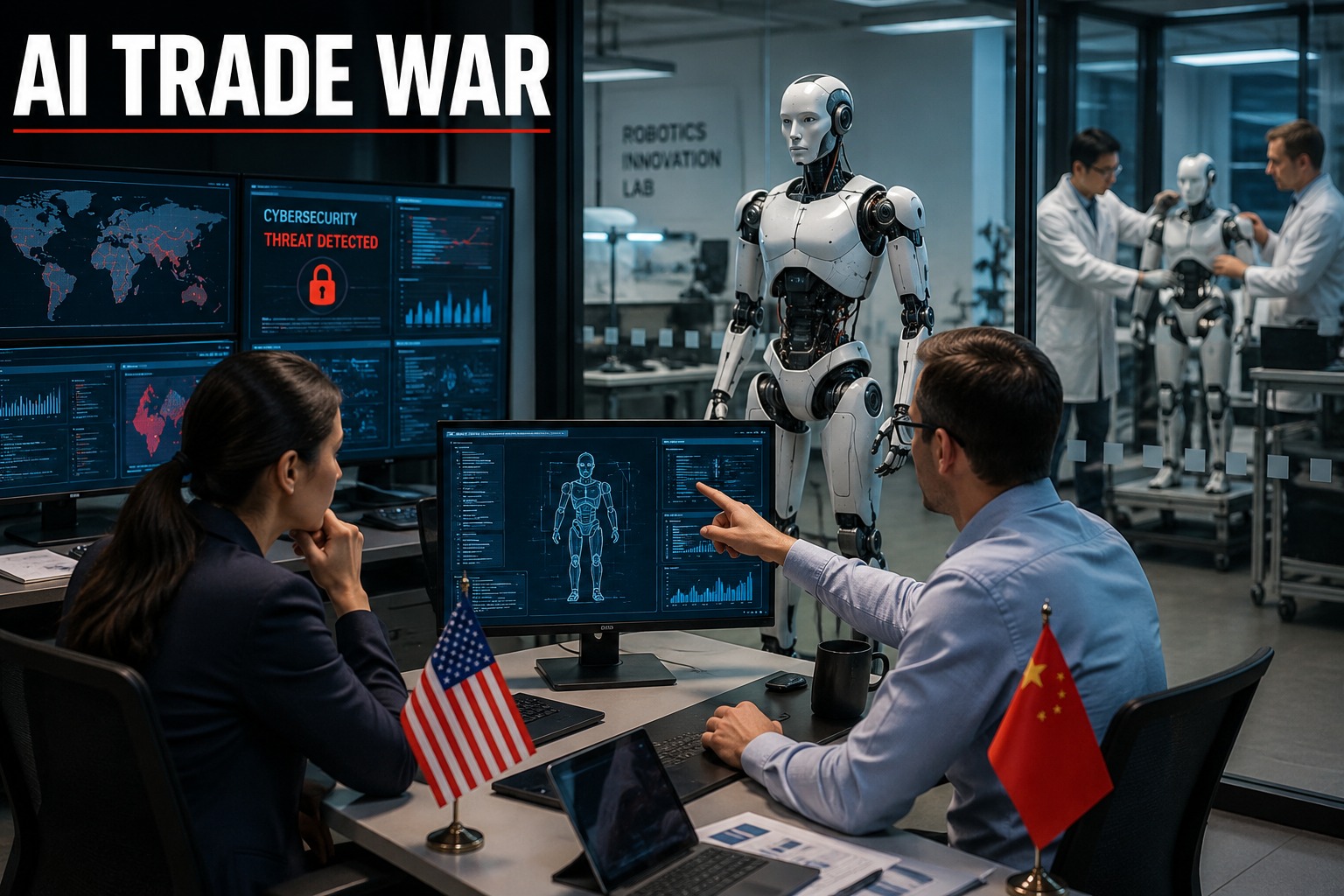
US Bans Chinese Humanoid Robots: How AI and Robotics Became the Center of a New Technology Trade War
Introduction
The global race for artificial intelligence has entered a new and more complex phase. While AI software has dominated headlines for the past few years, the spotlight is now shifting toward intelligent machines that can operate in the real world. Humanoid robots, robotic dogs, and AI-powered automation systems are becoming strategic technologies with the potential to reshape manufacturing, healthcare, defense, logistics, and public infrastructure.
Against this backdrop, the United States has announced restrictions on the import of newly developed Chinese-made humanoid robots, robotic dogs, and certain power inverter technologies, citing national security and cybersecurity concerns. The move reflects growing fears that advanced connected devices could introduce new risks to critical infrastructure while deepening dependence on foreign supply chains.
The decision also signals that the technology competition between the United States and China is expanding beyond semiconductors and AI chips into robotics, making intelligent machines the newest front in an increasingly intense technology trade war.
Why the United States Introduced the Restrictions
According to US officials, the primary motivation behind the new restrictions is national security. Modern humanoid robots are not simply mechanical devices. They rely on sophisticated AI models, multiple cameras, microphones, sensors, wireless communications, cloud connectivity, and continuous software updates.
Security experts argue that if such systems are compromised, they could potentially collect sensitive information or become entry points into critical digital infrastructure. Although there is no public evidence that every imported robot presents such risks, policymakers believe reducing dependence on foreign-made intelligent systems strengthens long-term security.
Another important factor is supply chain resilience. Recent global disruptions demonstrated how heavily industries depend on international manufacturing. By encouraging domestic production of advanced robotics, the US hopes to reduce strategic vulnerabilities in future technology supply chains.
Why Humanoid Robots Matter More Than Ever
Humanoid robots are no longer experimental machines designed only for research laboratories. Thanks to rapid improvements in artificial intelligence, computer vision, robotics engineering, and battery technology, they are gradually becoming capable of performing practical tasks.
Industries expect humanoid robots to assist with:
- Manufacturing and factory automation
- Warehouse logistics
- Healthcare support
- Elderly care
- Hospitality services
- Retail operations
- Hazardous industrial work
- Emergency response
Unlike traditional industrial robots that remain fixed in one location, humanoid robots are designed to move through environments created for humans, making them far more flexible for future workplaces.
This versatility explains why governments increasingly view robotics as both an economic opportunity and a strategic technology.
Cybersecurity Concerns Behind Connected Robots
Modern AI-powered robots continuously process enormous amounts of data. Cameras map surroundings, microphones detect commands, sensors monitor movement, and cloud-based AI systems improve performance over time.
These capabilities also introduce cybersecurity challenges.
If an attacker gained unauthorized access to connected robots, they might potentially:
- Access sensitive operational information.
- Monitor restricted environments.
- Disrupt automated facilities.
- Manipulate robot behavior.
- Exploit connected enterprise networks.
Because many robots operate within factories, energy facilities, research centers, and logistics hubs, governments are applying stricter scrutiny before allowing foreign-developed autonomous systems into critical sectors.
While manufacturers implement strong security measures, policymakers increasingly treat AI hardware as part of national cybersecurity planning.
China's Dominance in the Humanoid Robot Industry
China currently leads the global humanoid robotics market by a significant margin.
Mass manufacturing capabilities, strong government support, advanced electronics supply chains, and rapid AI development have enabled Chinese companies to scale production much faster than many international competitors.
Industry research indicates that thousands of humanoid robots were shipped globally during 2025, with Chinese manufacturers accounting for the majority of commercial deliveries. Companies such as Unitree and AGIBOT have become major suppliers, while American companies including Tesla and Figure AI remain in earlier stages of commercial deployment.
China's manufacturing advantage allows it to produce sophisticated robots at lower costs, making its products increasingly attractive to businesses worldwide.
Why the AI Trade War Is Expanding Beyond Computer Chips
For several years, global technology tensions focused primarily on advanced semiconductors, AI accelerators, and chip manufacturing equipment.
Today, the competition has broadened.
The future AI ecosystem includes:
- AI chips
- Cloud computing
- Large language models
- Industrial automation
- Autonomous vehicles
- Smart factories
- Intelligent robots
- Edge AI devices
Humanoid robots combine many of these technologies into a single platform. As a result, governments increasingly consider robotics a strategic industry with implications for economic competitiveness, defense capabilities, and technological leadership.
The latest restrictions illustrate that AI competition is no longer limited to software but now includes physical intelligent machines operating in real-world environments.
Impact on American Companies
The restrictions may create new opportunities for US robotics manufacturers.
Domestic companies could benefit from:
- Increased investment in robotics research.
- Stronger government procurement opportunities.
- Expanded manufacturing incentives.
- Greater venture capital interest.
- Accelerated commercialization.
However, developing competitive humanoid robots remains challenging. Building advanced robotics requires expertise in AI, mechanical engineering, battery systems, computer vision, precision manufacturing, and software integration.
Matching China's production scale will require sustained investment over many years.
Challenges for Chinese Robotics Manufacturers
Chinese robotics companies may face slower expansion in certain international markets if additional countries adopt similar security reviews.
Possible challenges include:
- Higher regulatory scrutiny.
- Additional compliance requirements.
- Export restrictions.
- Reduced access to government contracts.
- Increased pressure to demonstrate cybersecurity transparency.
At the same time, strong domestic demand within China and growing interest from emerging markets could continue supporting industry growth.
What This Means for Businesses
Companies considering AI-powered automation may need to evaluate more than price and performance.
Future purchasing decisions are likely to include questions such as:
- Where is the robot manufactured?
- How are software updates managed?
- What cybersecurity certifications exist?
- Where is operational data stored?
- Can systems operate without permanent cloud connectivity?
- Does the supplier meet local regulatory requirements?
These considerations are becoming increasingly important as governments introduce stricter rules for connected technologies.
Could Other Countries Follow?
Many technology analysts believe other governments may introduce similar reviews for advanced AI hardware, particularly when devices are intended for critical infrastructure.
Rather than banning products outright, many countries may adopt risk-based certification processes that evaluate:
- Software security
- Data protection
- Supply chain transparency
- Firmware integrity
- Remote access controls
- Update mechanisms
Such frameworks would aim to balance innovation with national security.
The Future of Global AI Competition
Artificial intelligence is rapidly becoming one of the defining technologies of the twenty-first century. While software breakthroughs continue at remarkable speed, intelligent hardware is emerging as an equally important battleground.
Countries that lead in robotics may gain significant advantages in manufacturing productivity, healthcare, logistics, defense, and economic growth.
At the same time, increasing geopolitical tensions could reshape global supply chains, encourage regional manufacturing, and accelerate investment in domestic AI industries.
The coming decade is likely to witness both unprecedented innovation and greater regulatory oversight as governments seek to balance technological progress with security concerns.
Conclusion
The United States' restrictions on certain Chinese-made humanoid robots represent more than a trade policy decision. They illustrate how artificial intelligence, robotics, cybersecurity, and national security are becoming deeply interconnected.
As intelligent machines move from research laboratories into factories, hospitals, warehouses, and public infrastructure, governments are placing greater emphasis on securing the technologies that power them. Meanwhile, China continues to strengthen its position as the world's leading producer of humanoid robots, ensuring that competition between the two largest economies will remain intense.
Whether these restrictions ultimately reshape the global robotics market remains uncertain. What is clear, however, is that the future of AI will not be determined solely by algorithms and software. Increasingly, it will also depend on who builds the intelligent machines that interact with the physical world, how securely they operate, and which nations establish the standards that govern this rapidly evolving industry.