
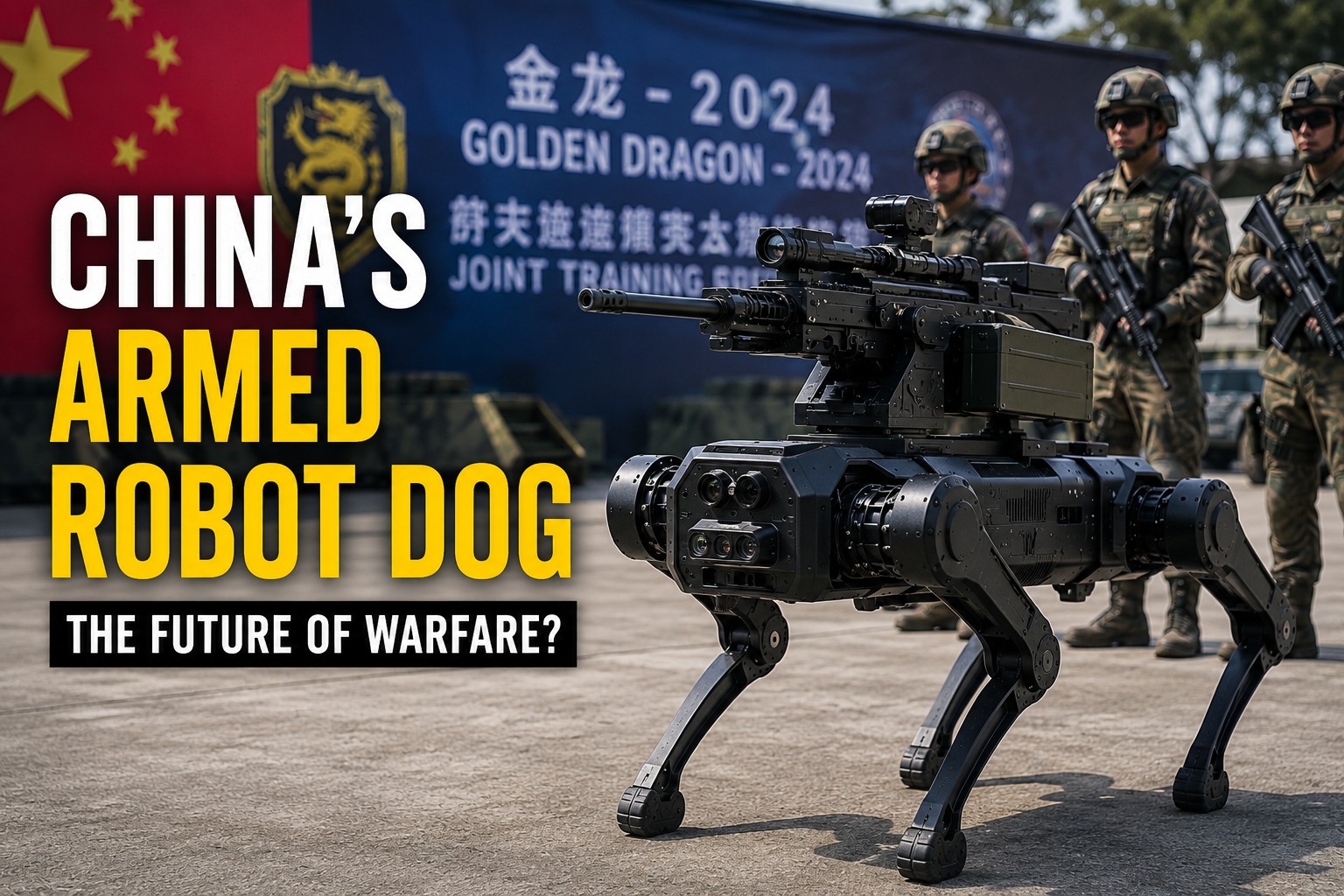
China’s Armed Robot Dog in Military Drills: A Glimpse Into the Future of Modern Warfare
Introduction
The future of warfare is rapidly evolving, and robotics is becoming one of the biggest driving forces behind this transformation. One of the latest developments attracting worldwide attention is China's deployment of an armed robotic dog during joint military exercises with Cambodia. The four-legged robotic platform, equipped with an automatic rifle, demonstrated how autonomous and remotely operated machines could assist soldiers in dangerous combat environments.
The appearance of the robot during the Golden Dragon military exercise has sparked discussions among military experts, technology analysts, and policymakers. While supporters believe such robots can reduce risks to human soldiers, critics argue that weaponized robots introduce serious ethical, legal, and security concerns.
This article explores China's armed robot dog, how it works, why militaries are investing in robotic systems, its potential battlefield applications, and what this development means for the future of global defense.
China Introduces an Armed Robot Dog During Military Exercises
China recently showcased an armed robotic dog during the annual Golden Dragon joint military exercise conducted with Cambodia. The demonstration featured a four-legged robotic platform carrying an automatic rifle mounted on its back.
According to military demonstrations released by Chinese state media, the robotic dog was designed to operate ahead of soldiers in urban combat scenarios. Instead of sending troops directly into dangerous buildings or narrow streets, commanders can deploy the robot to scout the area, identify enemy positions, and, in certain situations, engage hostile targets.
The demonstration reflects China's growing investment in integrating artificial intelligence, robotics, and unmanned systems into modern military operations.
What Is a Military Robot Dog?
A military robot dog is a four-legged unmanned ground vehicle (UGV) designed to move across rough terrain where wheeled vehicles may struggle.
Unlike traditional military robots used mainly for bomb disposal, modern robotic dogs are capable of:
- Navigating stairs and uneven terrain.
- Carrying surveillance equipment.
- Streaming live video to operators.
- Detecting obstacles using advanced sensors.
- Operating remotely or with varying levels of autonomous navigation.
Some experimental versions, including the one displayed by China, can also carry lightweight weapons.
Their movement resembles that of a real dog, allowing them to maintain balance while walking, running, or climbing over debris.
Why Robot Dogs Are Useful in Combat
One of the biggest challenges in military operations is gathering intelligence without exposing soldiers to unnecessary danger.
Urban warfare is especially dangerous because threats can hide behind walls, inside buildings, or around narrow streets.
An armed robot dog can enter these high-risk areas first.
Instead of risking human lives, commanders receive live video, environmental data, and enemy locations before troops advance.
This capability significantly improves battlefield awareness while reducing casualties.
How the Armed Robot Dog Works
Although exact technical specifications remain undisclosed, military robotic dogs generally combine several advanced technologies.
Artificial Intelligence
AI helps the robot recognize terrain, avoid obstacles, and maintain stability while walking.
Some systems also assist with object recognition, navigation, and target identification, though human operators typically remain responsible for decisions involving the use of force.
Cameras and Sensors
The robot carries multiple cameras that provide real-time video feeds.
Additional sensors may include:
- Thermal imaging
- Night vision
- Laser range finders
- GPS navigation
- Motion detection
These sensors enable operations during both day and night.
Remote Control
Most military robotic dogs remain under human supervision.
Operators can control movement, monitor video feeds, and issue commands from a safe distance using encrypted communication systems.
Weapon System
The Chinese demonstration featured an automatic rifle mounted on the robot's back.
While the weapon can be aimed remotely, experts note that public demonstrations do not necessarily reveal how much autonomy, if any, the firing system possesses.
Battlefield Roles Beyond Direct Combat
Although media attention has focused on the mounted rifle, robotic dogs have many other military applications.
Reconnaissance Missions
These robots can inspect enemy territory before troops arrive.
They collect valuable intelligence while minimizing risk to personnel.
Search and Rescue
Following explosions or building collapses, robotic dogs can enter unstable structures that may be unsafe for rescue teams.
Perimeter Security
Military bases can use robotic patrols to monitor restricted areas continuously.
Suspicious movement can immediately be reported to human operators.
Logistics Support
Some robotic platforms transport ammunition, medical supplies, communication equipment, or food across difficult terrain.
This reduces the physical burden on soldiers.
Chemical and Hazard Detection
Future versions may carry sensors capable of detecting hazardous chemicals, radiation, or biological threats.
Why Countries Are Investing in Military Robotics
China is not the only country exploring robotic warfare.
Many major military powers are investing heavily in unmanned systems.
Several reasons explain this trend.
First, robotic systems reduce risks to soldiers.
Second, robots can work continuously without fatigue.
Third, advances in artificial intelligence have made autonomous navigation more practical than ever before.
Finally, future battlefields are expected to combine traditional forces with drones, autonomous vehicles, and intelligent robotic systems.
Countries view robotics as a strategic advantage.
Global Competition in Military Robotics
China joins several nations developing robotic military technologies.
The United States has tested robotic dogs for reconnaissance and logistics missions.
European defense companies are experimenting with autonomous ground vehicles.
South Korea has developed robotic border surveillance technologies.
Russia has also invested in unmanned combat systems for specialized missions.
Although approaches differ, the overall trend is clear: robotics is becoming an increasingly important part of modern defense planning.
Ethical Questions Surrounding Armed Robots
The emergence of weaponized robots raises difficult ethical questions.
One major concern is accountability.
If an autonomous system makes a mistake, determining responsibility becomes complicated.
International experts generally emphasize that humans should retain meaningful control over decisions involving lethal force.
Another concern involves accidental escalation.
Autonomous systems operating in fast-moving combat environments may increase the risk of unintended incidents if not carefully supervised.
Cybersecurity also presents significant challenges.
Military robots rely on software and communication networks.
Any vulnerability could potentially expose these systems to hacking, signal interference, or electronic warfare.
Could Robot Dogs Replace Human Soldiers?
Despite impressive demonstrations, military experts generally agree that robotic dogs are unlikely to replace soldiers entirely.
Combat requires judgment, adaptability, communication, and complex decision-making that current robotic systems cannot fully replicate.
Instead, these machines are expected to function as force multipliers.
They handle dangerous, repetitive, or physically demanding tasks while human personnel remain responsible for command decisions and mission execution.
The relationship is likely to be one of cooperation rather than replacement.
What This Means for the Future of Warfare
The introduction of armed robotic dogs signals a broader shift toward intelligent battlefield systems.
Future military operations may involve coordinated teams consisting of:
- Human soldiers
- Ground robots
- Aerial drones
- Autonomous reconnaissance vehicles
- AI-assisted command systems
As these technologies mature, militaries will increasingly focus on integrating machines that enhance situational awareness, reduce casualties, and improve operational efficiency.
At the same time, governments and international organizations will face growing pressure to establish clear legal and ethical frameworks governing the use of autonomous weapons.
Conclusion
China's demonstration of an armed robot dog during the Golden Dragon military exercise highlights the rapid evolution of military technology. By combining mobility, advanced sensors, artificial intelligence, and remote weapon systems, robotic dogs have the potential to perform reconnaissance, surveillance, logistics, and other high-risk missions while reducing danger to human soldiers.
However, the rise of weaponized robots also raises important questions about accountability, cybersecurity, and the future role of humans in warfare. While these machines are unlikely to replace soldiers in the foreseeable future, they are expected to become valuable partners on the battlefield.
As military robotics continues to advance, the world will be watching not only how these technologies improve operational capabilities but also how nations balance innovation with ethical responsibility. The armed robot dog represents more than a technological achievement—it offers a glimpse into the next generation of modern warfare, where humans and intelligent machines are increasingly expected to operate side by side.