
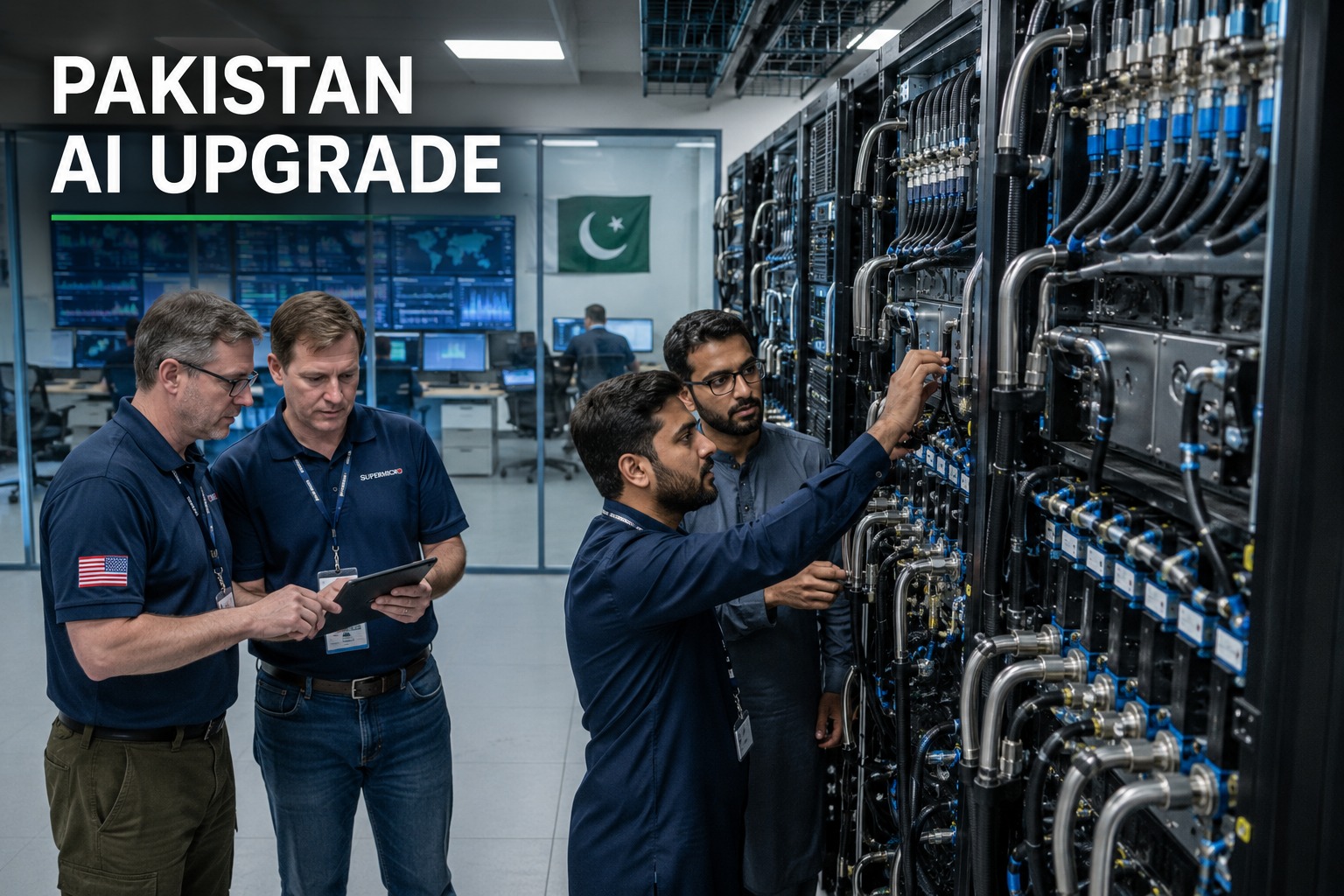
Pakistan Begins Deploying Advanced Liquid Cooling System for AI Data Vault to Support Next-Generation AI Chips
Artificial intelligence is rapidly transforming industries around the world, but behind every powerful AI model lies an equally powerful computing infrastructure. High-performance AI chips generate enormous amounts of heat, making advanced cooling technology a critical requirement for reliable and efficient operations. Recognizing this need, Pakistan has taken another step toward strengthening its AI infrastructure by beginning the installation of a modern liquid cooling system at its AI Data Vault facility.
The project represents more than a simple infrastructure upgrade. It reflects Pakistan's ambition to build data centers capable of supporting next-generation AI workloads, cloud computing services, and large-scale data processing. Once the liquid cooling system is fully installed, the facility will be prepared to host advanced AI chips that require far greater cooling efficiency than traditional air-cooled systems.
Pakistan's AI Infrastructure Takes a Major Step Forward
Pakistan's AI Data Vault has initiated work on installing a liquid-based cooling system with technical assistance from specialists associated with Super Micro Computer, a leading American company known for high-performance server technologies.
The experts recently visited the Data Vault facility in Karachi to assess the existing cooling infrastructure and determine the upgrades necessary for supporting modern AI hardware. Their evaluation focuses on converting the current air-based cooling mechanism into a liquid cooling architecture capable of handling significantly higher thermal loads.
This upgrade is expected to prepare the data center for installing advanced AI processors designed for machine learning, deep learning, and large-scale artificial intelligence applications.
Why AI Chips Need Advanced Cooling
Unlike conventional computer processors, AI accelerators perform billions or even trillions of calculations every second. These computations require enormous electrical power, which inevitably produces substantial heat.
If this heat is not removed efficiently, several problems can occur:
- Reduced processing performance due to thermal throttling.
- Higher energy consumption.
- Increased hardware failure rates.
- Shorter equipment lifespan.
- Greater maintenance costs.
Traditional air conditioning systems are often insufficient for the latest AI servers, especially those containing multiple GPUs or AI accelerators packed into high-density server racks.
Liquid cooling addresses these challenges by transferring heat much more efficiently than air.
Understanding Liquid Cooling Technology
Liquid cooling works by circulating specially designed coolant through cooling plates attached directly to processors or other high-performance components.
Instead of relying solely on chilled air moving around the servers, the liquid absorbs heat directly from the chips before carrying it away to external cooling units.
Compared to conventional cooling systems, liquid cooling offers several important advantages.
First, liquids transfer heat far more efficiently than air, allowing processors to operate at their maximum performance levels.
Second, the technology significantly reduces electricity consumption because fewer powerful air-conditioning systems are required.
Third, it enables much denser server installations, allowing more computing power within the same physical space.
Finally, lower operating temperatures improve hardware reliability and extend equipment life.
These advantages have made liquid cooling the preferred solution for AI-focused data centers worldwide.
The Role of Super Micro Experts
To ensure the infrastructure meets international standards, the Data Vault has engaged American specialists experienced in designing high-performance AI computing systems.
Their responsibilities include:
- Evaluating existing cooling infrastructure.
- Planning the transition to liquid cooling.
- Ensuring compatibility with future AI hardware.
- Optimizing energy efficiency.
- Supporting installation according to global best practices.
International collaboration allows Pakistan to benefit from proven expertise while reducing implementation risks.
Preparing for Next-Generation AI Chips
The liquid cooling installation is only the first phase of a broader modernization effort.
Once completed, the upgraded infrastructure will support the installation of advanced AI chips capable of powering:
- Large Language Models (LLMs)
- Computer Vision systems
- Speech recognition platforms
- Scientific simulations
- Medical AI research
- Financial analytics
- Cybersecurity solutions
- Intelligent automation
These processors demand continuous high-performance computing, making efficient thermal management essential.
Benefits for Pakistan's Technology Ecosystem
The upgraded AI Data Vault could have far-reaching implications for Pakistan's digital economy.
Researchers and universities may gain access to significantly more powerful computing resources for AI research.
Technology startups developing AI applications could utilize local infrastructure instead of relying entirely on expensive overseas cloud providers.
Government departments may deploy AI solutions for public services, while businesses can accelerate digital transformation through faster machine learning capabilities.
Improved local infrastructure may also encourage international technology companies to consider Pakistan as a destination for AI investments and cloud services.
Energy Efficiency and Sustainability
Modern AI data centers consume enormous amounts of electricity. As computing demands continue to rise, energy efficiency becomes increasingly important.
Liquid cooling contributes to sustainability by:
- Lowering electricity consumption.
- Reducing cooling-related power requirements.
- Improving overall data center efficiency.
- Supporting environmentally responsible computing practices.
Many of the world's largest cloud providers and AI companies have adopted liquid cooling to reduce operational costs while minimizing environmental impact.
Challenges Ahead
Although the project represents significant progress, several challenges remain.
Advanced cooling infrastructure requires substantial investment, specialized maintenance, and highly trained technical personnel.
The long-term success of the project will depend on reliable power infrastructure, continued investment in AI technologies, cybersecurity protections, and the development of local expertise capable of managing advanced computing facilities.
What This Means for Pakistan's AI Future
The installation of a liquid cooling system signals Pakistan's commitment to building modern digital infrastructure capable of supporting future AI innovation.
As artificial intelligence becomes increasingly important across healthcare, education, manufacturing, finance, agriculture, and public services, having local high-performance computing facilities will become a strategic national asset.
If successfully completed, the AI Data Vault could serve as a foundation for future AI research, cloud computing expansion, and advanced digital services while strengthening Pakistan's position in the rapidly evolving global AI landscape.
Conclusion
The launch of liquid cooling installation at Pakistan's AI Data Vault marks an important milestone in the country's technological development. By upgrading its infrastructure to accommodate next-generation AI chips, Pakistan is preparing for more advanced artificial intelligence applications, improved computing efficiency, and stronger digital capabilities.
While the project is still in its infrastructure phase, its successful completion could open new opportunities for researchers, businesses, startups, and government organizations seeking high-performance AI computing resources. As AI continues reshaping industries worldwide, investments in modern data center technologies such as liquid cooling will play a crucial role in determining future competitiveness and innovation.