
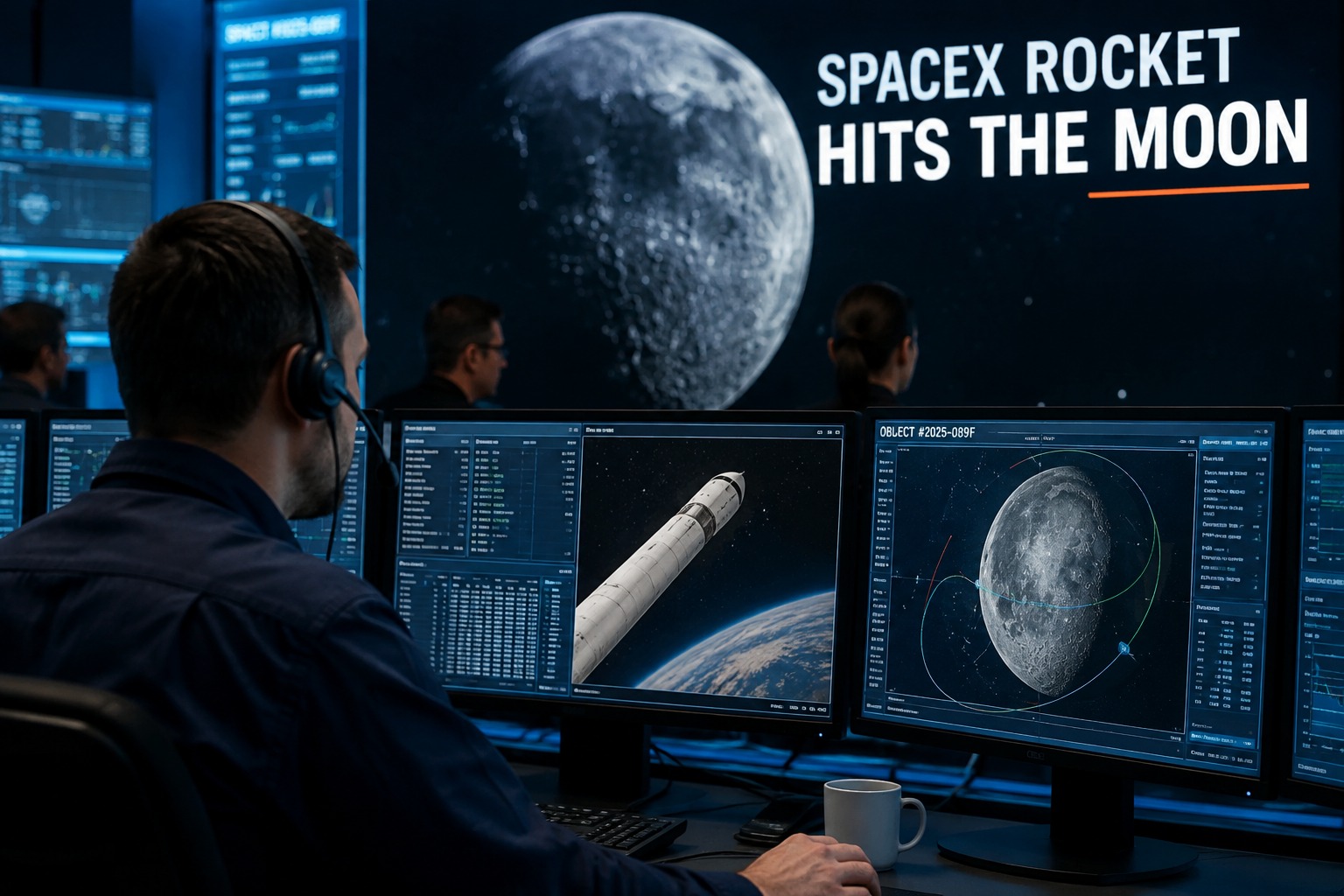
When Will SpaceX’s Defunct Rocket Hit the Moon? What Scientists Expect From the Historic Impact
Space exploration is often associated with successful launches, spectacular landings, and groundbreaking discoveries. However, not every spacecraft follows its intended path. Occasionally, abandoned rocket stages continue drifting through space for years before gravity pulls them toward another celestial body. One such object is a defunct SpaceX rocket stage that has attracted worldwide attention after astronomers predicted it would eventually collide with the Moon.
Although the event may sound alarming, scientists emphasize that it poses no danger to Earth or future lunar missions. Instead, it offers researchers a rare opportunity to observe how large impacts shape the Moon's surface and to improve our understanding of orbital dynamics in deep space.
In this article, we'll explore why the rocket is heading toward the Moon, how powerful the collision could be, what scientists hope to learn from it, and why this unusual event has become an important milestone in modern space science.
Why Is a SpaceX Rocket Heading Toward the Moon?
The object expected to collide with the Moon is the upper stage of a SpaceX Falcon 9 rocket that launched years ago on an interplanetary mission. After completing its job of sending its payload toward deep space, the rocket stage was left without enough fuel to return to Earth or move into a stable disposal orbit.
Instead, it entered a chaotic orbit influenced by the gravitational pull of both Earth and the Moon. Over time, repeated gravitational interactions slowly altered its path until astronomers determined that a lunar impact had become highly likely.
This situation highlights an increasingly important challenge in modern space exploration. While Earth orbit is closely monitored for space debris, objects that travel beyond Earth's orbit can remain largely untracked for years.
Understanding the Rocket's Journey
Unlike satellites operating around Earth, deep-space rocket stages often continue drifting through space after completing their mission. Since they are no longer under active control, their trajectories gradually change due to several factors.
These include:
- Earth's gravity
- The Moon's gravity
- The Sun's gravitational influence
- Solar radiation pressure
- Small uncertainties in previous orbital calculations
Because of these combined effects, predicting the exact future position of abandoned spacecraft becomes increasingly difficult over time.
Astronomers regularly monitor these objects using powerful telescopes and computer models to estimate their future paths. In this case, observations eventually showed that the rocket would likely strike the Moon.
How Powerful Will the Impact Be?
Although the rocket itself weighs only several tons, it is traveling at an extraordinary speed.
Scientists estimate that the impact energy is comparable to detonating more than three tons of TNT. While this sounds enormous by human standards, it is relatively small compared to the countless asteroid impacts the Moon has experienced throughout its 4.5-billion-year history.
The collision is expected to excavate a fresh crater measuring several meters across while throwing lunar dust and rocks high above the surface.
Unlike Earth, the Moon has almost no atmosphere.
This means:
- No air resistance slows incoming objects.
- No weather erodes new craters.
- Impact marks can remain visible for millions of years.
As a result, the new crater could become another permanent feature of the lunar landscape.
What Will Happen During the Collision?
When the rocket strikes the Moon, its enormous kinetic energy will instantly convert into heat and mechanical force.
Within fractions of a second:
- The rocket will be completely destroyed.
- Lunar rocks will vaporize.
- Dust and debris will be blasted outward.
- A new impact crater will form.
Scientists predict that the ejecta cloud could rise several kilometers above the lunar surface before slowly falling back due to the Moon's weak gravity.
Because there is no atmosphere, the dust will follow smooth ballistic trajectories instead of forming mushroom clouds like explosions on Earth.
Can People Watch the Impact From Earth?
Many people hope to witness the collision through telescopes.
Unfortunately, this is unlikely.
The impact is expected to occur on the far side or a poorly visible region of the Moon, making direct observation extremely difficult from Earth.
Even if the collision occurs on the visible side, the flash would probably last only a fraction of a second and could easily be missed.
Instead, scientists expect lunar orbiters to provide the best opportunity to confirm the impact.
Spacecraft such as NASA's Lunar Reconnaissance Orbiter may later photograph the newly formed crater and compare before-and-after images.
Why Scientists Are Excited
Although the impact is accidental, it represents a valuable scientific experiment.
Normally, researchers cannot deliberately crash large objects into the Moon whenever they want.
Here, nature—and orbital mechanics—have effectively created an unexpected experiment.
Scientists hope to learn more about:
Lunar Surface Composition
The impact will expose fresh material hidden beneath the Moon's weathered surface.
Studying this material helps researchers better understand lunar geology.
Crater Formation
Scientists use impact models to estimate crater size and debris distribution.
A real-world collision provides an opportunity to compare computer simulations with actual observations.
Orbital Prediction Accuracy
Tracking the rocket over many years also helps astronomers improve models used for predicting spacecraft trajectories.
Better predictions will become increasingly important as more missions travel to the Moon and beyond.
What Does This Say About Space Debris?
The event also raises important questions about space sustainability.
Most discussions about space debris focus on Earth's orbit, where thousands of inactive satellites and rocket parts threaten operational spacecraft.
However, deep-space debris is becoming another emerging concern.
As lunar exploration accelerates, abandoned spacecraft may increasingly occupy complex orbits around Earth and the Moon.
Future missions will likely need improved disposal strategies, including:
- Controlled impacts
- Escape trajectories
- Stable disposal orbits
- International tracking systems
These measures could reduce the chances of unexpected collisions in the future.
Is the Moon in Any Danger?
Absolutely not.
The Moon is constantly struck by natural meteoroids.
Every day, tiny rocks hit its surface.
Larger impacts occur less frequently but have shaped the Moon for billions of years.
Compared with many natural impacts, this rocket collision is relatively small.
It will create only a modest crater that represents an insignificant change to the Moon's enormous surface.
No existing lunar missions are expected to be affected.
Could Future Human Missions Be Impacted?
The impact itself poses virtually no risk to future astronauts.
NASA, private companies, and several international space agencies are planning long-term lunar exploration.
These missions already account for natural meteoroid impacts when designing habitats and equipment.
The rocket's collision simply becomes another small crater among millions already covering the Moon.
However, the event reinforces the importance of responsible mission planning.
Future spacecraft may increasingly include fuel reserves or disposal systems that prevent uncontrolled long-term drifting.
Lessons for Future Space Exploration
As humanity enters a new era of lunar exploration, more rockets than ever will travel between Earth and the Moon.
This means mission planners must think beyond launch success.
The entire life cycle of spacecraft—including disposal after missions end—has become an important engineering challenge.
International cooperation will likely play a growing role in tracking abandoned spacecraft, sharing orbital data, and developing standards for responsible deep-space operations.
Just as Earth orbit now requires careful debris management, the region surrounding the Moon may eventually require similar oversight.
Why Events Like This Matter
Although the collision is accidental, it reminds us that every space mission leaves a lasting footprint.
The Moon serves as a natural record of impacts stretching back billions of years. Unlike Earth, where weather and geological activity erase evidence, lunar craters preserve history almost indefinitely.
Each new impact—whether caused by an asteroid or a human-made object—adds another chapter to that story.
For scientists, these events provide rare opportunities to test theories about impact physics, crater formation, and orbital mechanics under real conditions.
Conclusion
The predicted collision between a defunct SpaceX rocket stage and the Moon is far more than an unusual headline. It represents a fascinating intersection of space exploration, orbital physics, planetary science, and the growing challenge of managing spacecraft after their missions end.
While the impact is expected to release energy comparable to more than three tons of TNT and create a new lunar crater, it poses no threat to Earth or future Moon missions. Instead, it offers researchers a unique natural experiment that could improve our understanding of the Moon's geology, refine spacecraft tracking techniques, and encourage better debris management practices for future deep-space exploration.
As humanity prepares for an era of permanent lunar exploration, even unexpected events like this can provide valuable lessons that help shape the future of space travel.