Smoking and Vaping May Raise the Risk of Serious Pneumococcal Pneumonia
🚨 Smoking and Vaping: A New Warning for Your Lungs — The Hidden Risk of Pneumococcal Pneumonia
By Admin | Health & Wellness
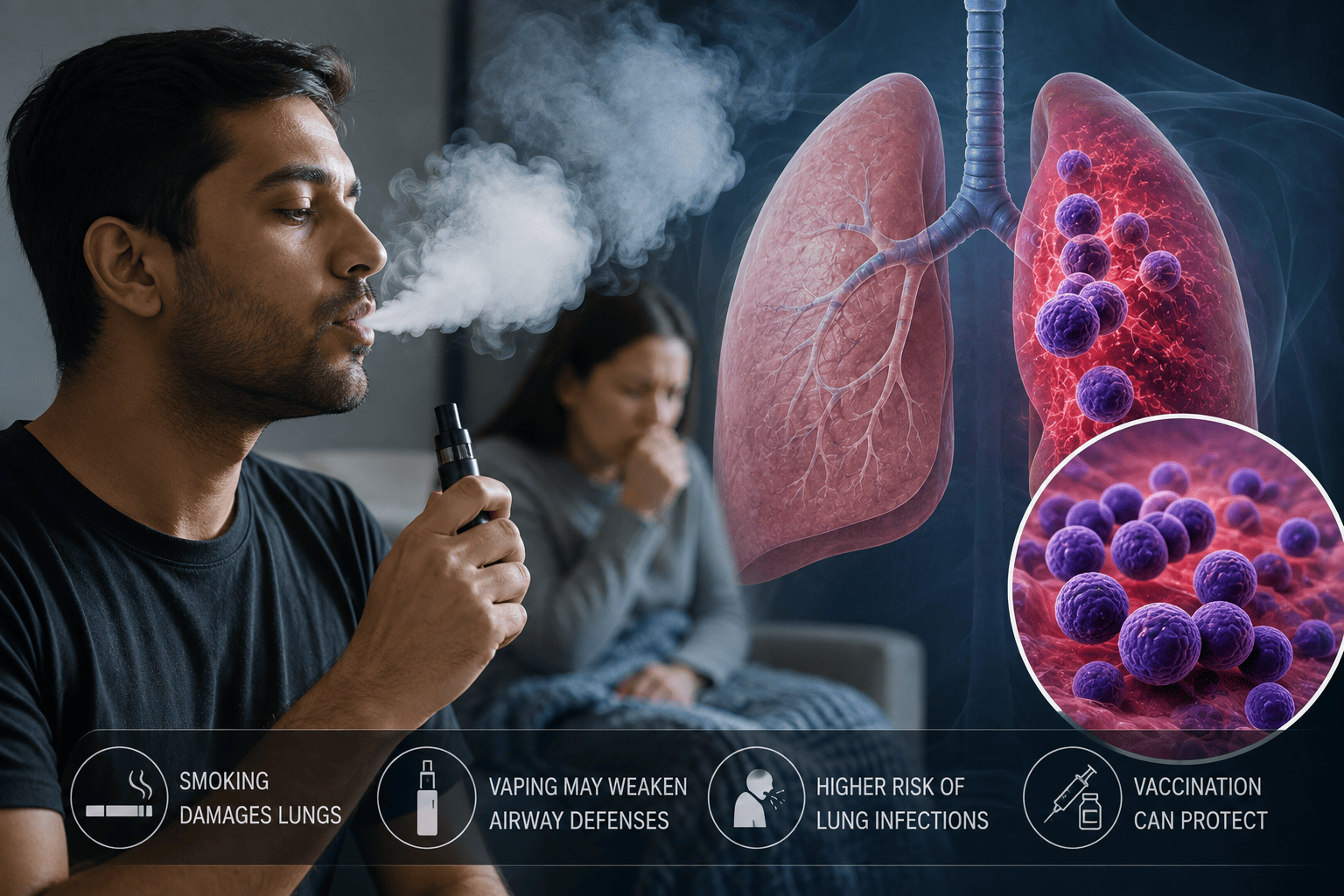
Cigarettes are already known to damage the lungs. But researchers are now paying closer attention to another potential danger: how smoking—and possibly vaping—can interfere with the respiratory system's natural defenses against serious bacterial infections.
There is a battle taking place inside your lungs every time you breathe.
Your airways are constantly exposed to dust, pollutants, viruses and bacteria. Fortunately, the respiratory system has its own sophisticated defense mechanism. Mucus traps unwanted particles, while microscopic hair-like structures called cilia move that material toward the throat so it can be cleared.
But what happens when that defense system is repeatedly exposed to cigarette smoke?
And what happens when someone switches to vaping, assuming that inhaling an aerosol is harmless?
Those questions have become increasingly important as researchers investigate the effects of inhaled tobacco products on the respiratory system.
One particular concern is pneumococcal disease, a bacterial infection caused by Streptococcus pneumoniae. Pneumococcal pneumonia can cause sudden fever, chills, cough, chest pain and difficulty breathing. In severe cases, the bacteria can spread into the bloodstream or reach the tissues surrounding the brain and spinal cord.
The evidence is strongest for cigarette smoking. Research has consistently linked smoking with increased pneumococcal disease risk. For vaping, the picture is newer and more complicated—but laboratory research has raised concerns about changes to airway defenses and the ability of pneumococcal bacteria to attach to airway cells.
🫁 The Lungs Have a Built-In Cleaning System
Your lungs are not simply empty tubes carrying air in and out.
The lining of the respiratory tract is equipped with a protective system known as mucociliary clearance.
Mucus traps particles and microorganisms, while cilia beat in a coordinated fashion to move that mucus out of the airways.
Think of it as a microscopic conveyor belt.
When the system works properly, potentially harmful material is continuously moved away from the deeper parts of the respiratory tract.
Smoking can disrupt this process.
And that matters because bacteria such as Streptococcus pneumoniae don't need to be especially aggressive if the body's first line of defense is already weakened.
The CDC identifies cigarette smoking as a risk factor for pneumococcal disease. Its evidence review found that smokers had approximately 2.8 to 4.1 times the risk of invasive pneumococcal disease compared with adults without underlying conditions that increase pneumococcal risk.
The key issue isn't just the smoke itself.
It is what repeated exposure can do to the environment inside the airways.
🚬 Why Cigarette Smoke Can Change the Equation
Cigarette smoke contains thousands of chemicals and exposes the respiratory system to a complex mixture of particles and gases.
Repeated exposure can damage airway tissues and interfere with normal respiratory defenses.
For pneumococcal bacteria, this creates an important opportunity.
Streptococcus pneumoniae can colonize the upper respiratory tract without necessarily causing serious illness. But under the right circumstances, it can move into the lungs and cause pneumonia or spread to other parts of the body.
Smoking has been associated with increased pneumococcal carriage and increased risk of invasive pneumococcal disease.
This helps explain why smoking is not merely a long-term cancer or heart-disease issue.
It can also influence how vulnerable the respiratory system is to infection.
💨 And Then There Is Vaping
This is where the story needs some careful explanation.
Vaping and cigarette smoking should not automatically be treated as medically identical exposures.
Cigarette smoking has decades of evidence demonstrating its enormous health risks. Vaping is comparatively newer, and researchers are still working to understand its long-term consequences.
But "less harmful than cigarettes" does not automatically mean "harmless."
Research has begun examining what happens when e-cigarette aerosol repeatedly reaches the airway lining.
A 2018 study found that e-cigarette vapor increased pneumococcal adherence to airway epithelial cells in laboratory experiments. The researchers also observed increased pneumococcal colonization in the nasal passages of mice exposed to nicotine-containing vapor.
That does not prove that vaping causes pneumococcal pneumonia in humans at a specific rate.
It does, however, provide a biological reason for scientists to investigate the possibility.
🔬 What New Research Is Revealing About Vaping
More recent laboratory research has focused on the cilia themselves.
A 2025 study using human airway epithelial models found that exposure to e-cigarette aerosols affected ciliary structure and reduced ciliary beat frequency in the experimental system. The researchers concluded that e-cigarette exposure could impair mucociliary clearance.
Another recent study reported that repeated exposure to nicotine-free vaping aerosol impaired airway cilia function and epithelial barrier integrity in laboratory models, with the authors suggesting that this could potentially increase susceptibility to infections.
There is an important scientific qualification here:
These are experimental findings—not proof that every person who vapes will develop pneumonia.
Human health outcomes are influenced by many factors, including frequency and duration of exposure, underlying diseases, age, immune function and other environmental exposures.
But the findings challenge the idea that vaping simply produces harmless "water vapor."
⚠️ The Warning Signs You Shouldn't Brush Off
Pneumococcal pneumonia can develop relatively suddenly.
A person may initially feel as though they have developed a severe respiratory infection, but symptoms can become significant quickly.
Common symptoms include:
Fever • chills • cough • chest pain • weakness • shortness of breath
Pneumococcal pneumonia can also produce rapid breathing and low oxygen levels, particularly when the illness is severe.
The type of cough can vary, but a productive cough with significant mucus can occur.
Older adults may sometimes present differently. Instead of dramatic respiratory symptoms, they may develop weakness or confusion.
That is why a sudden change in health should not always be dismissed as "just a cold."
🚨 When a Chest Infection Becomes an Emergency
Most coughs do not represent a medical emergency.
But certain combinations of symptoms deserve urgent attention.
If someone develops severe difficulty breathing, significant chest pain, confusion, blue or gray lips or skin, or rapidly worsening symptoms, they should seek urgent medical care.
Pneumococcal bacteria can sometimes move beyond the lungs.
When bacteria enter the bloodstream, the condition is called pneumococcal bacteremia. If the bacteria infect the membranes surrounding the brain and spinal cord, they can cause meningitis.
These invasive forms of pneumococcal disease can be life-threatening.
🧬 Who Is Most Vulnerable?
Smoking is only one part of the risk equation.
The danger can be greater when smoking or other respiratory exposures are combined with existing health problems.
People with chronic lung disease, chronic heart disease or diabetes are among those who may have increased risk of serious pneumococcal disease. The risk also rises with age and in people whose immune systems are weakened.
Consider someone who smokes and already has COPD.
Their lungs may already have reduced reserve and impaired respiratory defenses. If a serious bacterial infection develops on top of that, the consequences can be considerably more significant than they might be for an otherwise healthy person.
This is why the question shouldn't simply be:
"Do you smoke?"
It should be:
"What does your overall respiratory and health profile look like?"
🚭 What Happens If You Stop?
Stopping smoking removes the ongoing exposure to cigarette smoke and is one of the most important steps a smoker can take to improve long-term health.
The benefits extend far beyond pneumonia.
Smoking cessation reduces exposure to the substances responsible for tobacco-related lung and cardiovascular damage and lowers the long-term risk of numerous smoking-related diseases.
For people who vape, stopping also eliminates continued exposure to e-cigarette aerosol.
The situation can be more complicated for someone who currently smokes cigarettes and uses vaping as an alternative. Completely switching away from combustible cigarettes may reduce exposure to many harmful chemicals compared with continuing to smoke, but vaping is not risk-free, and dual use—smoking and vaping—does not eliminate the health risks of cigarette smoking.
The ultimate goal for health is to move away from dependence on inhaled tobacco or nicotine products.
💉 Could a Vaccine Help?
Yes.
Pneumococcal vaccination is an important tool for preventing serious disease caused by Streptococcus pneumoniae.
Under current U.S. CDC recommendations, pneumococcal vaccination is recommended for adults aged 50 and older, as well as younger adults who have certain underlying medical conditions or risk factors. Cigarette smoking is included among the risk factors considered in adult pneumococcal vaccination guidance.
The appropriate vaccine and schedule depend on a person's age, medical history and previous vaccination.
That means someone shouldn't simply search online for a vaccine schedule and assume it applies to them.
A healthcare professional can determine which pneumococcal vaccine, if any, is appropriate.
🧠 One Important Distinction: Smoking vs. Vaping
The debate around vaping often becomes unnecessarily polarized.
One side says vaping is completely safe.
The other sometimes presents vaping as though it has exactly the same health consequences as cigarette smoking.
Neither position accurately reflects the evidence.
What we know well
Cigarette smoking is strongly associated with serious respiratory disease and increased pneumococcal disease risk.
What researchers are still investigating
The long-term effects of vaping and the extent to which e-cigarette exposure increases the risk of specific respiratory infections in humans.
What emerging research suggests
Experimental studies indicate that e-cigarette aerosol can affect airway cilia, mucus clearance and epithelial defenses, while earlier research found increased pneumococcal adherence under certain experimental conditions.
That is enough to justify caution—but not enough to claim that vaping causes pneumococcal pneumonia in every user.
Good health journalism should make that distinction clear.
🫁 Your Lungs Don't Get a Day Off
Perhaps the most important part of this story is easy to overlook.
Your lungs are working every second of every day.
They don't get a break from the air around you.
They continuously encounter particles, microorganisms and chemicals while their defense mechanisms work to keep potentially harmful substances from reaching deeper tissues.
Repeated exposure to cigarette smoke clearly damages that system.
Research increasingly suggests that vaping can also affect components of the airway defense system, although the full long-term consequences are still being established.
So the question isn't whether one puff, one cigarette or one vaping session will cause pneumonia.
It is about repeated exposure and cumulative risk.
The Bottom Line
Pneumococcal pneumonia is more than an ordinary chest infection.
It can develop suddenly, cause significant breathing problems and, in severe cases, progress to invasive disease affecting the bloodstream or brain coverings.
For cigarette smokers, the evidence is clear: smoking increases the risk of pneumococcal disease, and quitting is an important step toward better respiratory health.
For vaping, scientists are still building the evidence base. But laboratory research has raised legitimate concerns about effects on cilia, airway defenses and pneumococcal interactions.
That doesn't mean smoking and vaping are identical.
It means neither should be casually described as harmless to the lungs.
And if you develop sudden fever, chills, persistent cough, chest pain or difficulty breathing—particularly if symptoms are severe or rapidly worsening—don't simply assume it will pass.
Your lungs may be telling you that something is wrong. Listen to them.
QUICK HEALTH TAKE
🚬 Smoking
Strong evidence: Increased risk of pneumococcal disease and respiratory infections.
💨 Vaping
Evidence developing: Experimental research shows effects on airway defenses and pneumococcal interactions, but the exact risk of pneumococcal pneumonia in humans remains uncertain.
💉 Vaccination
Important prevention tool: Eligibility depends on age, health conditions, risk factors and previous vaccination.
🫁 Most important step
Avoiding or quitting inhaled tobacco/nicotine products can reduce ongoing exposure to substances that affect the respiratory system.
Medical Disclaimer
This article is for general educational purposes and does not replace professional medical advice, diagnosis or treatment. The evidence linking cigarette smoking to pneumococcal disease is substantially stronger than the current evidence linking vaping specifically to pneumococcal pneumonia. If you experience severe breathing difficulty, significant chest pain, confusion, blue or gray lips/skin, or rapidly worsening symptoms, seek urgent medical attention.
Author: Admin