
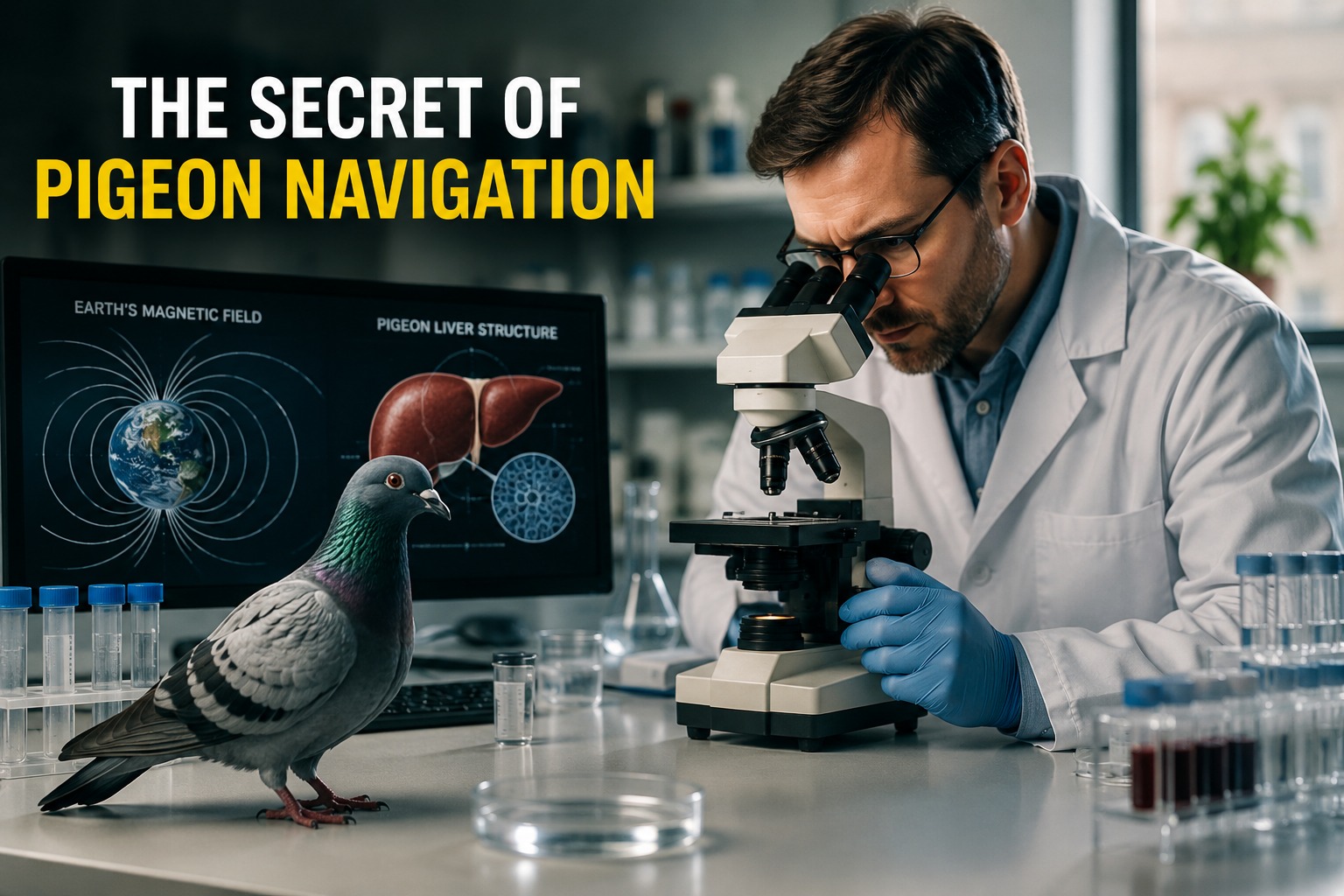
How Do Pigeons Find Their Way Home? Scientists Reveal a Surprising Secret Hidden in the Liver
For centuries, pigeons have amazed people with their incredible ability to find their way home from unfamiliar locations. Whether released dozens or even hundreds of kilometers away, these birds often return with remarkable accuracy. This mysterious skill has fascinated scientists, bird enthusiasts, and even military organizations that once relied on carrier pigeons to deliver important messages.
Despite decades of research, one fundamental question has remained unanswered: How do pigeons know where they are and which direction to travel?
A groundbreaking new study published in the prestigious journal Science suggests that the answer may lie in an unexpected place—the pigeon’s liver. Researchers from the University of Bonn and the Max Planck Institute of Animal Behavior in Germany have uncovered evidence that could reshape our understanding of animal navigation and magnetic sensing.
The Mystery of Pigeon Navigation
Homing pigeons possess one of the most impressive navigation systems in the animal kingdom. Unlike humans, who depend heavily on maps, landmarks, and technology, pigeons can travel across vast distances and still locate their home loft with astonishing precision.
Scientists have long suspected that pigeons use a combination of navigation tools, including:
- Visual landmarks
- The position of the sun
- Earth's magnetic field
- Smell and environmental cues
While evidence supported several of these methods, the exact mechanism that allows pigeons to detect Earth's magnetic field remained a scientific mystery.
The new research offers one of the strongest clues yet.
Earth's Magnetic Field: Nature's Invisible GPS
To understand the discovery, it is important to understand Earth's magnetic field.
The planet is surrounded by a vast magnetic field generated by movements within its molten core. This field creates invisible lines that stretch from the North Pole to the South Pole.
Many animals appear capable of sensing these magnetic signals. Sea turtles, salmon, migratory birds, bats, and even some insects use magnetic information to navigate across long distances.
Scientists call this ability magnetoreception.
The challenge has always been identifying exactly where the biological sensors responsible for magnetoreception are located and how they work.
For years, researchers searched in the brain, eyes, and beak of birds. Results were often conflicting, and no theory fully explained the phenomenon.
Now, attention is shifting toward a surprising organ.
The Unexpected Role of the Liver
The recent study suggests that the liver may contain specialized structures capable of helping pigeons detect magnetic fields.
At first glance, the liver seems like an unlikely candidate. Most people associate it with digestion, detoxification, and metabolism rather than navigation.
However, researchers discovered biological features within liver tissue that may interact with magnetic forces.
The team found evidence pointing toward microscopic iron-containing particles and specific cellular structures that could respond to Earth's magnetic field. These structures may function as biological sensors, allowing pigeons to gather directional information during flight.
Although the exact mechanism still requires further investigation, the findings provide a compelling explanation for how pigeons might perceive magnetic signals.
This shifts the focus away from traditional theories that emphasized only the brain or sensory organs.
Why This Discovery Matters
The implications of this research extend far beyond pigeons.
If scientists confirm that the liver plays a role in magnetoreception, it could fundamentally change our understanding of how animals interact with their environment.
Several important questions could be answered:
How Migratory Birds Travel Thousands of Kilometers
Every year, countless bird species migrate between continents. Some travel across oceans and deserts without getting lost.
Understanding the biological mechanisms behind magnetic sensing could explain how these journeys are possible.
How Animals Navigate in Darkness
Many animals navigate successfully at night or under cloudy conditions when visual landmarks are unavailable.
Magnetic sensing provides a reliable navigation system that works regardless of visibility.
New Insights into Evolution
If magnetoreception is linked to internal organs such as the liver, scientists may need to rethink how this ability evolved across different species.
It could reveal a shared evolutionary adaptation used by many animals.
The Long Search for Magnetic Sensors
The idea that animals can sense magnetic fields is not new.
Researchers have spent decades investigating possible magnetic receptors.
The Beak Theory
One popular theory suggested that iron-rich cells located in birds' beaks acted as magnetic sensors.
Initial studies seemed promising, but later research produced inconsistent results, leaving many scientists unconvinced.
The Eye Theory
Another hypothesis proposed that special proteins in the eyes, known as cryptochromes, help birds detect magnetic fields through light-dependent chemical reactions.
This theory remains influential and is supported by substantial evidence.
However, it may not fully explain all aspects of navigation.
A More Complex System
The new liver findings suggest that magnetoreception may not depend on a single organ.
Instead, pigeons may combine information from multiple sensory systems, including:
- Vision
- Sun position
- Smell
- Magnetic sensing through internal biological structures
This multi-layered approach would explain why pigeons are so remarkably reliable navigators.
Real-World Examples of Pigeon Navigation
The extraordinary abilities of homing pigeons are well documented.
Historically, pigeons carried military messages during wars when communication systems failed. Some birds traveled hundreds of kilometers through dangerous conditions and still reached their destinations.
One famous wartime pigeon reportedly delivered critical information that helped save hundreds of soldiers despite being severely injured during flight.
Modern pigeon races continue to demonstrate these abilities. Birds are transported far from their home lofts and released. Many successfully return within hours, even from unfamiliar locations.
Such performances have puzzled scientists for generations.
The new research may finally be bringing us closer to understanding how these feats are possible.
Could Humans Learn from Pigeons?
One of the most exciting aspects of this research is its potential technological impact.
Nature often inspires innovation.
Scientists study bird flight to improve aircraft design. They examine gecko feet to create advanced adhesives and observe shark skin to develop better materials.
Understanding pigeon navigation could lead to:
Improved Navigation Technologies
Future navigation systems may mimic biological magnetic sensors.
These systems could operate where GPS signals are weak or unavailable.
Advanced Robotics
Autonomous drones and robots might use magnetic sensing inspired by animals to navigate complex environments.
Medical Discoveries
Studying magnetic-sensitive biological structures could reveal previously unknown cellular processes within the body.
Although practical applications remain speculative, history shows that nature-inspired discoveries often lead to groundbreaking technologies.
What Scientists Still Need to Discover
While the findings are exciting, many questions remain unanswered.
Researchers still need to determine:
- Exactly how the liver detects magnetic fields.
- Whether similar mechanisms exist in other bird species.
- How magnetic information is transmitted to the brain.
- How magnetic sensing interacts with visual and environmental cues.
- Whether multiple organs contribute simultaneously to navigation.
Future studies will likely focus on these questions.
Scientific progress often occurs step by step, and this research represents an important piece of a much larger puzzle.
A New Chapter in Understanding Animal Intelligence
The study highlights how much remains unknown about animal abilities.
Humans often underestimate the sophistication of animal behavior. Yet pigeons, creatures commonly seen in city parks and urban environments, possess navigation skills that still challenge modern science.
The possibility that an internal organ such as the liver contributes to this remarkable ability demonstrates how complex and surprising biological systems can be.
As researchers continue investigating magnetoreception, pigeons may help unlock secrets that apply to countless species across the natural world.
Conclusion
The mystery of how pigeons find their way home has fascinated scientists for generations. Now, groundbreaking research from Germany suggests that the answer may be hidden in an unexpected place—the liver.
Published in Science, the study provides intriguing evidence that specialized structures within the liver may help pigeons detect Earth's magnetic field. While more research is needed, the discovery opens a promising new direction in the study of animal navigation.
If confirmed, these findings could transform our understanding of magnetoreception, reveal how migratory animals travel vast distances, and even inspire future technologies based on nature's remarkable navigation systems.
For now, one thing is clear: pigeons are far more extraordinary than they appear, and their hidden navigational talents continue to surprise the scientific world.