
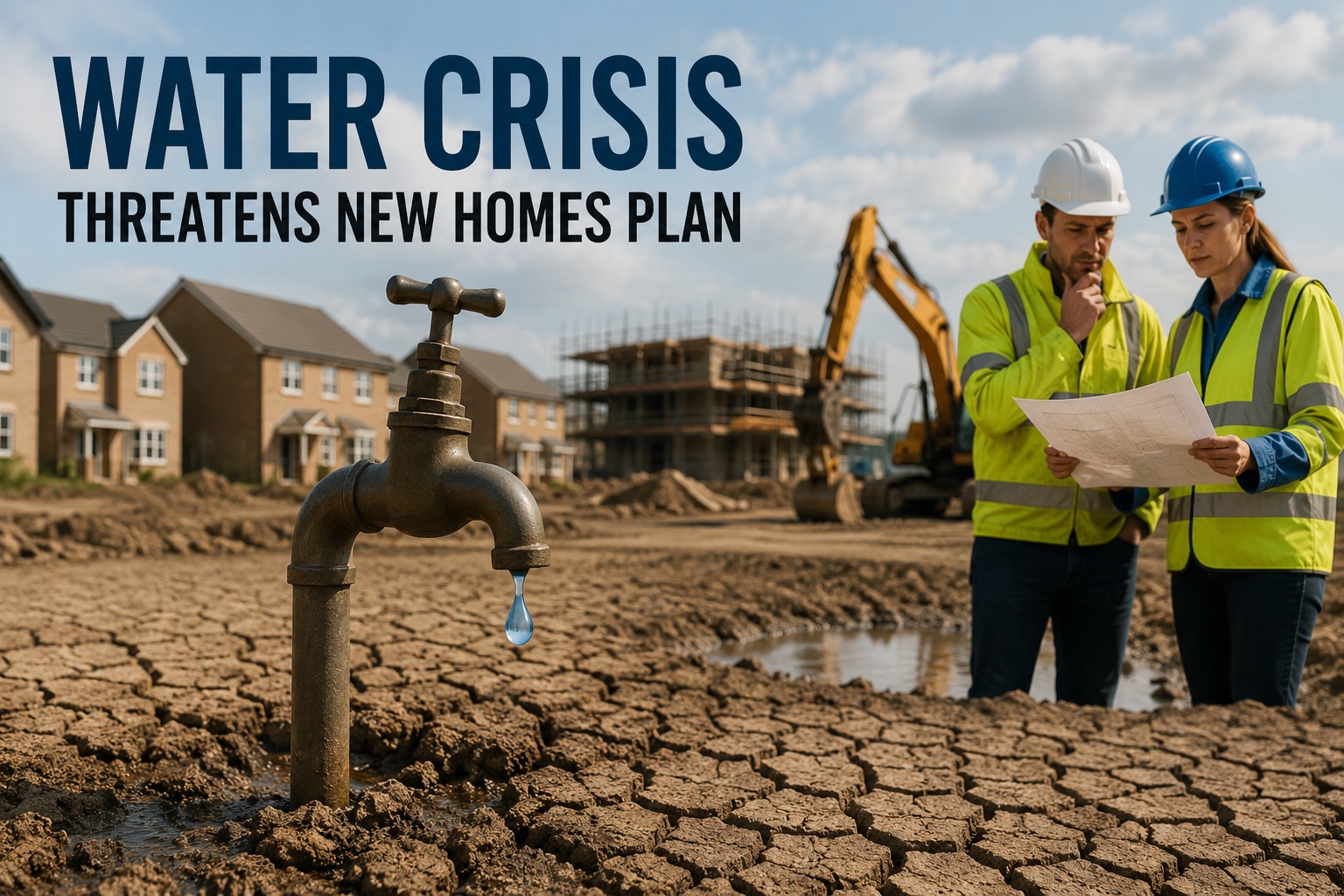
England's Water Shortage Crisis Puts 1.5 Million New Homes Plan at Risk
Introduction
England's ambitious plan to build 1.5 million new homes is facing a serious obstacle that has nothing to do with construction costs or labor shortages. Instead, the challenge lies in one of the country's most essential natural resources: water.
A recent report has warned that limited water supplies across parts of England could significantly delay or even halt major housing developments. The warning comes at a critical time, as the Labour government, led by Prime Minister Sir Keir Starmer, has made increasing housing availability one of its key priorities. Before the 2024 general election, Labour promised to deliver 1.5 million new homes within five years, aiming to tackle Britain's long-standing housing shortage.
However, experts now argue that unless England rapidly improves its water infrastructure and secures new water resources, many planned developments may struggle to obtain approval. The situation highlights how climate change, population growth, and aging infrastructure are becoming closely linked with the country's housing crisis.
Why Water Is Becoming a Major Issue in England
Although England is often associated with rainy weather, the country is experiencing increasing pressure on its freshwater resources. Rising temperatures, changing rainfall patterns, population growth, and higher water demand have created significant challenges.
Many regions, particularly in southern and eastern England, are already classified as water-stressed areas. These regions receive relatively low rainfall while supporting large and growing populations.
Experts believe that climate change will make the situation even more difficult over the coming decades by increasing the frequency of droughts and reducing reliable water supplies.
As more homes are built, demand for drinking water, sanitation, and everyday household use also rises. Without expanding water resources, existing systems may struggle to meet future demand.
The Government's Housing Promise
Housing affordability has become one of the biggest political and social issues in the UK. High property prices and rising rents have made home ownership increasingly difficult for many families.
To address this challenge, the Labour Party included housing among its top national priorities before the 2024 election. The government pledged to:
- Build 1.5 million new homes during its first five years in office.
- Speed up planning approvals.
- Increase affordable housing.
- Encourage economic growth through large-scale construction.
The plan aims to reduce housing shortages while supporting employment and infrastructure development across the country.
However, water availability has now emerged as a major obstacle that was not fully anticipated.
What the New Report Warns
The latest report suggests that limited water resources could prevent thousands of planned homes from receiving approval, especially in regions where water companies cannot guarantee sufficient long-term supplies.
Planning authorities are increasingly required to consider environmental sustainability before approving large housing developments. If local water infrastructure cannot safely support additional households, projects may be delayed until new solutions become available.
The report emphasizes that solving the housing crisis requires more than building materials and construction workers. Essential services—including water supply, wastewater treatment, electricity, transportation, and healthcare—must expand alongside new communities.
Without these supporting systems, rapid housing growth may create serious environmental and public service challenges.
Climate Change Is Increasing the Pressure
Climate scientists have repeatedly warned that England will likely experience:
- Longer periods of dry weather.
- More frequent droughts.
- Higher summer temperatures.
- Greater pressure on rivers and reservoirs.
These changes reduce the reliability of existing water sources while increasing demand from households, agriculture, and businesses.
Even though heavy rainfall occasionally occurs, much of it arrives during short, intense storms that produce flooding rather than replenishing reservoirs and underground aquifers effectively.
As a result, water companies must invest in better storage systems and long-term resource planning.
Aging Infrastructure Adds to the Problem
England's water supply challenges are not caused solely by climate change.
Much of the country's water infrastructure is decades old. Aging pipes continue to lose billions of liters of treated water every day through leaks.
Environmental organizations have repeatedly argued that reducing leakage could recover substantial amounts of water without requiring entirely new sources.
However, repairing nationwide infrastructure requires significant investment and years of engineering work.
Water companies are also under pressure to improve wastewater treatment, reduce river pollution, and modernize aging facilities simultaneously.
How Water Shortages Affect Housing Development
Building a new neighborhood involves far more than constructing houses.
Every development requires:
- Safe drinking water.
- Reliable sewage systems.
- Fire protection.
- Environmental impact assessments.
- Long-term infrastructure planning.
If local water companies cannot guarantee sustainable supplies, planning authorities may refuse or postpone approval.
This means developers could face increased costs, longer timelines, and additional regulatory requirements before construction can begin.
For buyers waiting for affordable homes, such delays could further reduce housing availability.
Economic Consequences
Housing construction plays an important role in the UK's economy.
Large development projects create employment opportunities for:
- Construction workers.
- Engineers.
- Architects.
- Surveyors.
- Material suppliers.
- Local businesses.
If major projects are delayed because of water shortages, economic growth could also slow.
Reduced housing supply may continue pushing property prices higher while making rental markets even more competitive.
Businesses relocating to expanding communities may also reconsider investment if essential infrastructure remains uncertain.
Possible Solutions
Experts believe there is no single solution. Instead, England will likely require a combination of approaches.
Building New Reservoirs
Several new reservoir projects have already been proposed to increase long-term water storage.
Although reservoirs require years of planning and construction, they can significantly improve regional water security.
Reducing Water Leakage
Fixing leaking pipelines remains one of the quickest ways to increase available water supplies.
Many environmental groups argue that reducing leakage should become a national priority.
Water Recycling
Advanced wastewater recycling technologies can safely treat and reuse water for certain industrial and agricultural purposes, reducing pressure on drinking water supplies.
Some countries already rely heavily on treated recycled water during periods of drought.
Encouraging Water Efficiency
Modern homes can be designed with:
- Water-efficient toilets.
- Low-flow showers.
- Efficient washing machines.
- Smart water meters.
- Rainwater harvesting systems.
These technologies reduce household consumption without affecting quality of life.
The Importance of Sustainable Urban Planning
The current situation demonstrates why future housing projects must consider environmental sustainability from the earliest planning stages.
Simply building more homes is no longer enough.
Governments must ensure that communities have sufficient:
- Water supplies.
- Energy infrastructure.
- Public transportation.
- Schools.
- Healthcare facilities.
- Green spaces.
Integrated planning helps create communities that remain livable for decades rather than creating new infrastructure problems later.
Balancing Housing Needs and Environmental Protection
The government now faces a difficult balancing act.
On one hand, millions of people need affordable housing.
On the other, overusing limited water resources could damage rivers, wetlands, wildlife habitats, and ecosystems.
Environmental regulations are designed to protect these natural resources while ensuring future generations continue to have reliable water supplies.
Finding the right balance will require cooperation between government departments, water companies, environmental agencies, local councils, and private developers.
What Happens Next?
Meeting the target of 1.5 million homes will likely depend on how quickly England can expand its water infrastructure.
Water companies are expected to increase investment in reservoirs, pipelines, treatment plants, and conservation programs over the coming years.
Meanwhile, local planning authorities may continue requiring stronger evidence that proposed housing developments can operate sustainably without placing excessive pressure on regional water supplies.
The success of the government's housing strategy may therefore depend as much on environmental planning as on construction itself.
Conclusion
England's water shortage is emerging as one of the biggest hidden challenges facing the country's housing ambitions. While the Labour government's promise to build 1.5 million new homes addresses an urgent need for affordable housing, the availability of reliable water supplies has become a critical limiting factor.
The situation highlights an important lesson for modern infrastructure planning: housing, environmental sustainability, and public utilities cannot be treated as separate issues. They are deeply interconnected.
If England successfully invests in new reservoirs, repairs aging infrastructure, improves water efficiency, and strengthens long-term planning, it can move closer to achieving both its housing goals and environmental responsibilities. Without these measures, however, water scarcity may become one of the defining obstacles to solving the UK's housing crisis.