
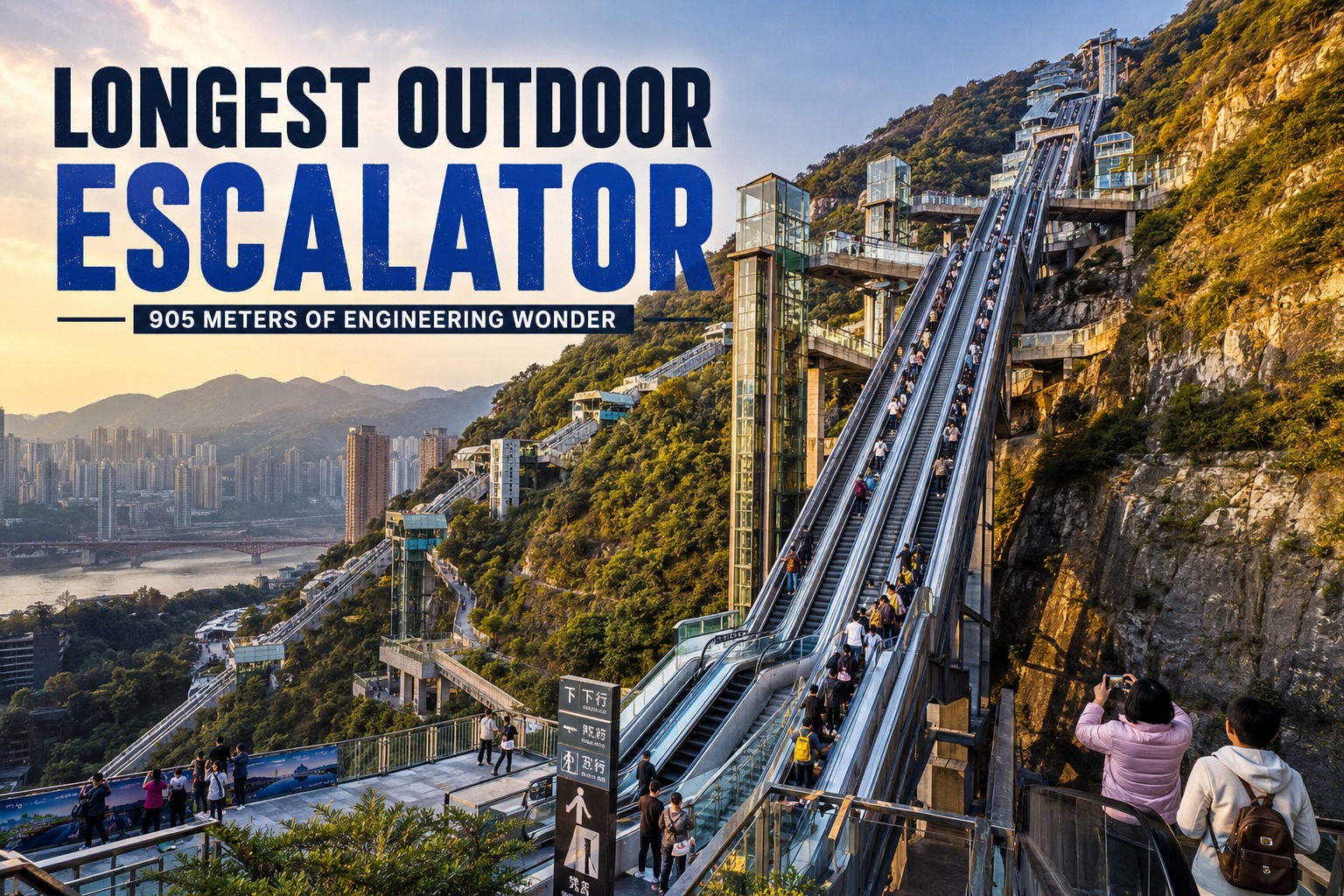
China’s 905-Meter Outdoor Escalator: The Engineering Marvel Transforming Urban Mobility
Introduction
Modern cities face a constant challenge: how to move people efficiently through complex landscapes. While elevators, subways, and bridges have long helped solve transportation problems, some locations require truly extraordinary solutions. One such example can now be found in Chongqing, China, a city already famous for its dramatic terrain and innovative infrastructure.
Chongqing has once again captured global attention with the completion of the Wushan Goddess Escalator System, recognized as the world's longest outdoor escalator network. Stretching an astonishing 905 meters (2,969 feet), this massive transportation system is more than just a tourist attraction. It represents a practical response to the unique geographical challenges of one of China's most mountainous urban regions.
The project demonstrates how modern engineering can transform difficult landscapes into accessible spaces while enhancing tourism, improving mobility, and creating a unique urban experience.
Why Chongqing Is Known for Extraordinary Infrastructure
To understand why such a massive outdoor escalator exists, it is important to understand Chongqing itself.
Located in southwestern China, Chongqing is often called the "Mountain City." Unlike many major cities built on relatively flat terrain, Chongqing is characterized by steep hills, deep valleys, and dramatic elevation changes. The city's geography has forced engineers and urban planners to develop creative transportation solutions that would seem unusual elsewhere.
Over the years, Chongqing has become famous for several remarkable engineering achievements. The city is home to one of the world's deepest subway stations, where passengers travel long distances underground before reaching train platforms. It is also known for a monorail line that passes directly through a residential building, an infrastructure feature that regularly amazes visitors.
The Wushan Goddess Escalator continues this tradition of innovative urban design by addressing one of the region's most significant challenges: vertical transportation.
The Scale of the Wushan Goddess Escalator
At first glance, describing the structure as an escalator may seem misleading. Most people imagine a single moving staircase found in shopping malls or airports. The Wushan Goddess Escalator, however, is an integrated transportation network.
The system spans approximately 905 meters and connects areas separated by a vertical height difference of around 242 meters. To put that into perspective, the elevation change is roughly equivalent to climbing an 80-story skyscraper.
Instead of forcing residents and visitors to navigate hundreds of stairs or steep mountain roads, the escalator system provides a convenient and energy-efficient alternative.
The project consists of:
- 21 individual escalators
- 8 elevators
- 4 moving walkways
- Multiple pedestrian bridges
Traveling through the entire system takes approximately 21 minutes, creating a seamless journey from the lower section of the mountain to the upper areas.
This makes it one of the most ambitious pedestrian transportation systems ever constructed.
Solving a Real Urban Mobility Problem
Many iconic engineering projects attract attention because they are visually impressive. However, the true value of the Wushan Goddess Escalator lies in its practicality.
Mountainous cities often face accessibility challenges. Elderly residents, children, tourists, and people with mobility limitations may struggle to navigate steep slopes and long staircases. Traditional transportation options such as buses and taxis are not always efficient when roads are narrow, winding, or heavily congested.
The escalator system addresses these issues by providing a direct, reliable, and comfortable route between different elevation levels.
For local residents, this means reduced travel time and less physical effort. For visitors, it creates easier access to scenic viewpoints, cultural attractions, and commercial areas.
By transforming a difficult climb into a smooth journey, the system enhances both convenience and quality of life.
Engineering Challenges Behind the Project
Building a standard escalator inside a shopping center is relatively straightforward compared to constructing a massive outdoor transportation network on mountainous terrain.
Engineers faced numerous challenges during development.
Terrain and Stability
Mountain environments require extensive geological analysis. Engineers needed to ensure that the supporting structures could withstand varying soil conditions, erosion risks, and long-term environmental pressures.
Special foundation systems were likely incorporated to maintain structural stability across different elevation levels.
Weather Exposure
Unlike indoor escalators, outdoor systems must operate under constantly changing weather conditions.
Rain, humidity, temperature fluctuations, wind, and sunlight can affect mechanical components over time. To maintain reliability, engineers had to use durable materials and weather-resistant technologies capable of long-term outdoor operation.
Passenger Safety
Safety becomes increasingly important as system size increases.
The network includes multiple transitions between escalators, elevators, walkways, and bridges. Designers had to ensure smooth passenger flow while minimizing congestion and maintaining accessibility standards.
Emergency systems, monitoring equipment, and maintenance protocols are essential components of such a large transportation installation.
A New Tourist Attraction
While the escalator was built with practical goals in mind, it has quickly become a destination in its own right.
Travelers are often fascinated by infrastructure projects that showcase human ingenuity. Just as visitors travel to see famous bridges, tunnels, and railways, many tourists are now adding the Wushan Goddess Escalator to their travel itineraries.
The journey itself offers a unique experience. As passengers move upward through the system, they can enjoy changing views of the surrounding landscape, urban developments, and mountain scenery.
Unlike traditional sightseeing attractions, the escalator combines transportation and tourism into a single experience.
This dual purpose makes it particularly valuable for regional economic development.
Economic Benefits for the Region
Infrastructure investments often produce benefits that extend far beyond transportation.
Improved accessibility encourages tourism, which can increase spending at local restaurants, hotels, retail shops, and cultural attractions. Areas that were previously difficult to reach become more attractive to visitors and investors.
The escalator system may also contribute to:
Increased Tourism Revenue
Unique engineering landmarks often generate media attention and social media exposure. As more travelers visit the site, local businesses benefit from increased customer activity.
Better Urban Connectivity
Improved movement between different parts of the city encourages economic interaction and supports local commerce.
Enhanced Property Values
Infrastructure improvements frequently increase the attractiveness of surrounding neighborhoods, potentially raising residential and commercial property values.
These economic effects demonstrate how transportation projects can serve as catalysts for broader regional development.
Comparing the Escalator to Traditional Transportation Solutions
When discussing large-scale mobility projects, comparisons with alternative transportation systems are inevitable.
Traditional mountain transportation often relies on cable cars, funicular railways, or shuttle buses. Each option offers advantages, but the Wushan Goddess Escalator presents several unique benefits.
Unlike cable cars, passengers can board and exit at various points along the route. Compared with buses, the system operates continuously without traffic delays. Unlike long staircases, it requires minimal physical effort.
The result is a transportation solution that combines accessibility, reliability, and user convenience.
This approach may inspire similar projects in other mountainous cities around the world.
What This Project Says About the Future of Urban Design
Cities are growing larger, denser, and more complex. As urban populations increase, planners must find innovative ways to overcome geographical limitations.
The Wushan Goddess Escalator reflects a broader trend toward infrastructure that prioritizes accessibility and user experience rather than simply expanding road networks.
Future cities may increasingly adopt specialized mobility systems tailored to local conditions. Rather than forcing landscapes to conform to standard transportation models, engineers are designing solutions that work with natural geography.
This philosophy can lead to more sustainable, efficient, and human-centered urban environments.
The Chongqing project serves as an example of how infrastructure can simultaneously solve practical problems, enhance tourism, and create memorable experiences.
Conclusion
The Wushan Goddess Escalator is far more than a record-breaking attraction. Stretching 905 meters across a mountainous landscape and overcoming a height difference of approximately 242 meters, it represents a remarkable achievement in modern engineering and urban planning.
By integrating 21 escalators, eight elevators, four moving walkways, and multiple pedestrian bridges into a single transportation network, Chongqing has created an innovative solution to a complex geographical challenge.
The project improves accessibility for residents, enhances the visitor experience, stimulates local economic activity, and demonstrates how infrastructure can adapt to unique environmental conditions.
As cities around the world search for smarter ways to move people efficiently, the world's longest outdoor escalator may offer an inspiring glimpse into the future of urban mobility.