China’s 800 km/h Flying Train: How It Reached 800 km/h in 5.3 Seconds
🚄 China’s 800 km/h “Flying Train”: The Technology That Could Change Transportation Forever
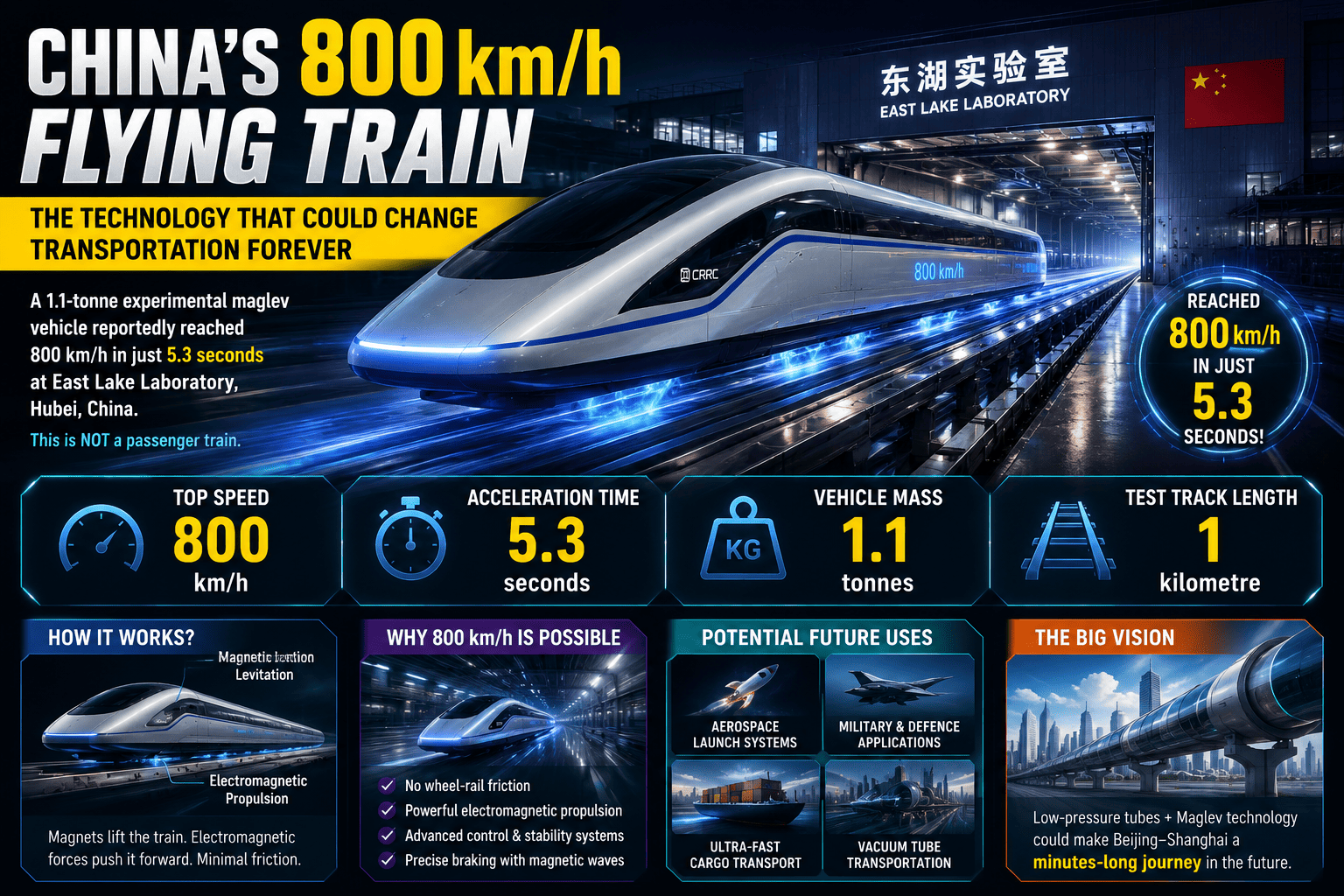
A 1.1-tonne experimental maglev vehicle reportedly reached 800 km/h in just 5.3 seconds. But this is NOT a passenger train — and the real purpose of the technology may be far more interesting.
⚡ 800 KM/H… IN JUST 5.3 SECONDS?
What if a train could accelerate from 0 to 800 km/h in just 5.3 seconds?
That sounds less like a railway and more like a rocket launch.
But China has achieved exactly that with an experimental magnetic-levitation test vehicle at East Lake Laboratory in Hubei.
And here's the first thing you need to know:
This is not a train you can board.
The vehicle was an approximately 1.1-tonne experimental platform, tested on a track of around 1 kilometre.
According to reports, it reached 800 km/h after travelling approximately 600 metres and was then brought to a controlled stop, completing the test in around eight seconds.
THE NUMBERS ARE WILD
| Test | Reported Figure |
|---|---|
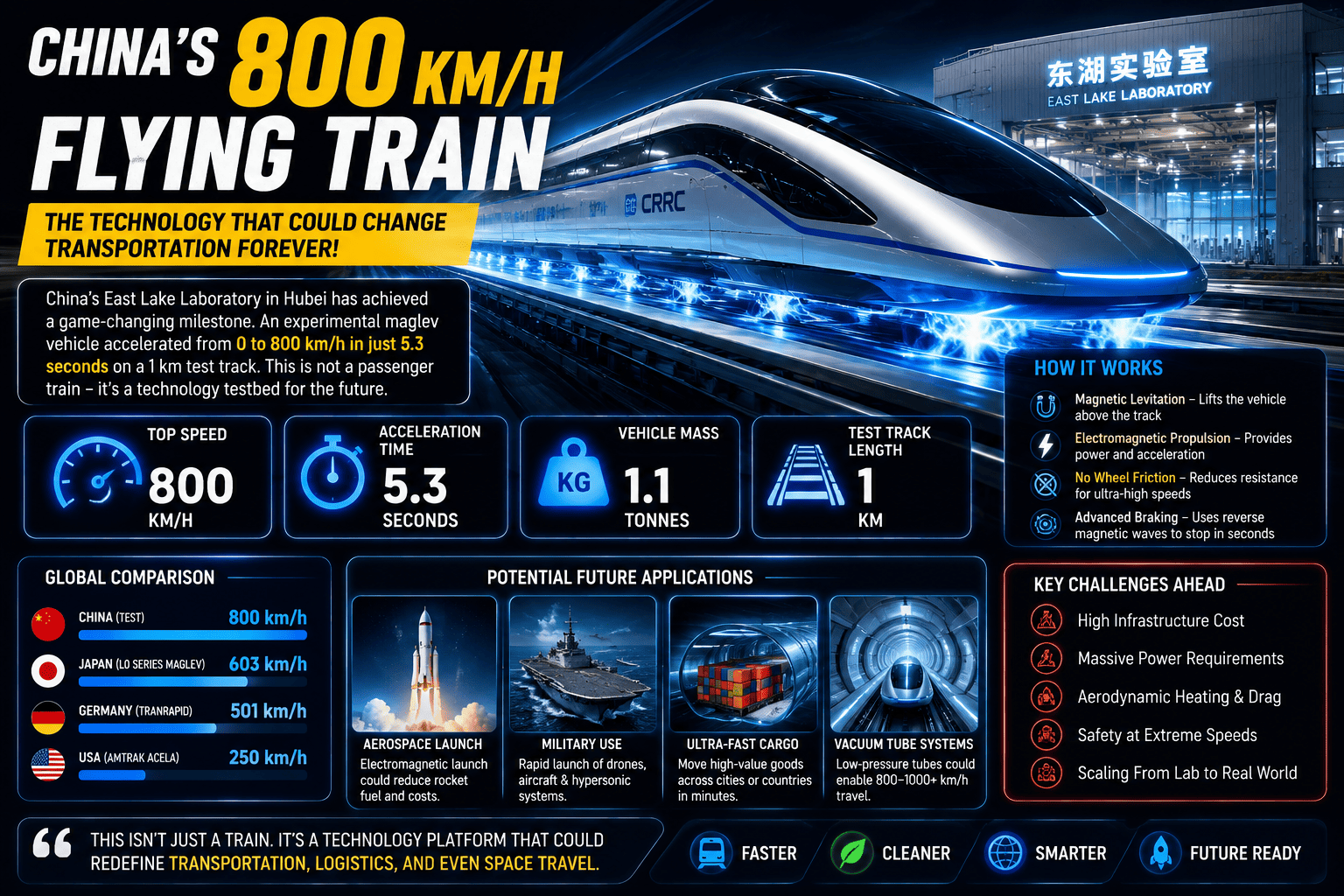
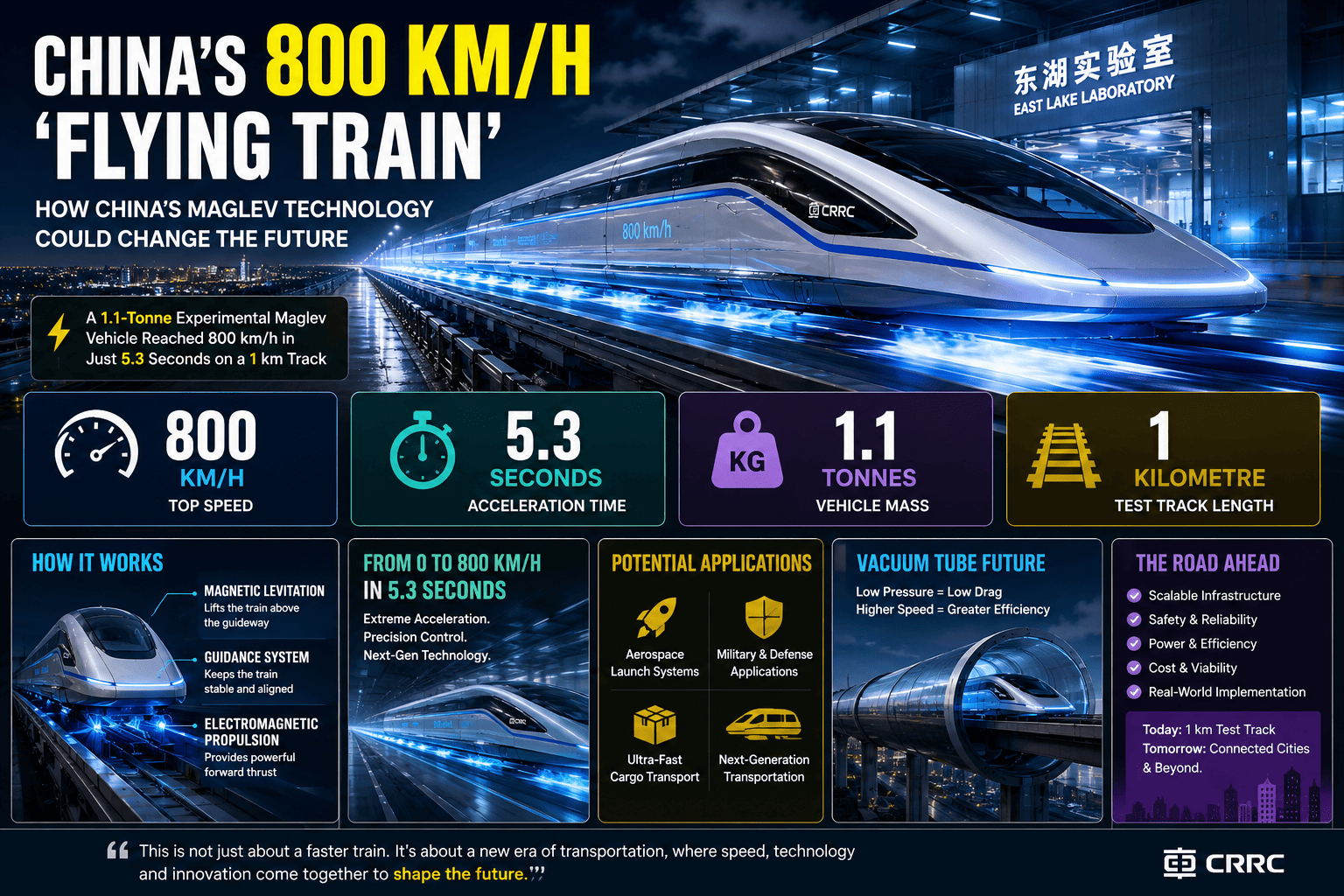
| 🚄 Top speed | 800 km/h |
| ⏱️ Acceleration time | 5.3 seconds |
| 🛤️ Test-track length | ~1 kilometre |
| ⚙️ Vehicle mass | ~1.1 tonnes |
| 📍 Location | Hubei, China |
| 🧲 Technology | Magnetic levitation + electromagnetic propulsion |
The achievement is important not because passengers can travel at this speed today, but because it demonstrates how rapidly electromagnetic propulsion technology is advancing.
🧲 IT DOESN’T RUN LIKE A NORMAL TRAIN
A conventional train depends on wheels.
Steel wheels make physical contact with steel rails, allowing the train to move forward.
But that contact also creates friction.
At extremely high speeds, friction becomes a major obstacle.
Maglev technology takes a completely different approach.
Instead of relying entirely on wheels, electromagnetic forces can levitate, guide and propel the vehicle.
In simple terms:
🧲 MAGNETS LIFT IT
⚡ ELECTROMAGNETS PUSH IT
🚄 THE VEHICLE MOVES WITHOUT CONVENTIONAL WHEEL-RAIL CONTACT
This is why the vehicle is often described in popular media as a “flying train.”
It is not literally flying like an aircraft.
It is magnetically suspended above the guideway.
🔥 WHY 800 KM/H IS SUCH A BIG DEAL
Reaching 800 km/h is not simply a matter of adding more power.
At that speed, engineers have to fight several enormous problems simultaneously.
1️⃣ AERODYNAMIC DRAG
At 800 km/h, the vehicle is travelling at roughly 222 metres per second.
At these speeds, air itself becomes a major obstacle.
Even if wheel friction is dramatically reduced, the vehicle still has to push through the atmosphere.
This is one reason researchers are interested in combining maglev technology with low-pressure or vacuum tubes.
2️⃣ ELECTROMAGNETIC PROPULSION
The vehicle needs extremely powerful and precisely controlled electromagnetic propulsion.
The system has to accelerate the vehicle rapidly while maintaining accurate control over its position.
That means researchers need advanced:
- Linear motors
- Electromagnetic systems
- Position sensors
- High-speed control systems
- Communication systems
- Braking technologies
3️⃣ STABILITY
At 800 km/h, even a small instability can become a serious engineering problem.
Researchers therefore have to control:
Speed + position + levitation + guidance + aerodynamics
all at the same time.
East Lake Laboratory has specifically identified high-speed aerodynamic stability and precision control of linear motors among the challenges involved in the system.
💥 THE 5.3-SECOND ACCELERATION
Here's where the numbers become particularly impressive.
Going from:
0 → 800 km/h
in:
5.3 seconds
means an average acceleration of roughly 4.3 times Earth's gravitational acceleration (4.3g) if the acceleration were constant.
That is an enormous average acceleration.
However, it is important not to confuse this calculation with the viral claim that passengers would automatically experience 13G.
The 800 km/h experiment did not carry passengers, and the publicly reported information does not establish a 13G passenger load.
So claims that a human body would instantly be crushed or that bones would turn into powder should be treated as sensational claims rather than demonstrated facts from this experiment.
🚫 NO, HUMANS CANNOT RIDE THIS TRAIN
This is probably the biggest misunderstanding surrounding the viral story.
The experimental vehicle was built to test technology.
It was not designed as a passenger service.
Why?
Because reaching extreme speeds and accelerating extremely rapidly are two very different things from transporting humans comfortably.
A future passenger maglev could theoretically travel at very high speeds while using a much more gradual acceleration profile.
The goal of passenger transportation is not simply:
“How quickly can we reach 800 km/h?”
The real question is:
“How quickly can we reach 800 km/h while keeping passengers safe, comfortable and economically viable?”
That is a much harder engineering problem.
🌏 CHINA DIDN’T START AT 800 KM/H
The 800 km/h experiment was part of a rapid progression.
Researchers at East Lake Laboratory had already demonstrated speeds around 650 km/h with a roughly 1.1-tonne vehicle in 2025.
The project subsequently progressed through higher-speed tests before reaching the 800 km/h milestone.
According to reports, the 800 km/h achievement was the laboratory's third world-record-level achievement in six months.
This suggests that the headline speed is only one part of a broader research programme.
🚀 BUT HERE IS WHERE THE STORY GETS REALLY INTERESTING
Why would researchers build a system capable of accelerating a 1.1-tonne vehicle to 800 km/h on a tiny test track?
The answer may have little to do with passenger trains.
China has identified several potential areas for this technology, including:
🚄 Next-generation transportation
🚀 Aerospace electromagnetic launch
🛰️ High-speed aerospace systems
⚡ Electromagnetic propulsion
📦 Ultra-fast cargo transportation
And one of the most fascinating possibilities involves launching objects using electromagnetic acceleration.
🚀 COULD MAGLEV TECHNOLOGY HELP LAUNCH SPACECRAFT?
A conventional rocket has a major problem.
It must carry the fuel required to accelerate itself.
An electromagnetic launch system could theoretically provide part of the initial acceleration from the ground.
Imagine a very long electromagnetic track.
Instead of a vehicle starting from zero speed using only its own engines, electromagnetic forces could accelerate it before it enters the next phase of its journey.
China's research programme has explicitly connected high-speed maglev research with aerospace electromagnetic launch technology.
But there is an important distinction:
❌ China has NOT replaced rockets with this system.
✅ Researchers are investigating electromagnetic launch as a potential future technology.
Launching an actual spacecraft into orbit would require vastly greater speeds and would involve enormous additional engineering challenges.
🛩️ WHAT ABOUT MILITARY APPLICATIONS?
This is where the original viral story becomes much more dramatic.
Some reports and commentators have suggested that electromagnetic launch technology could eventually be relevant to:
- Aircraft launching systems
- Drone launch systems
- High-speed projectiles
- Hypersonic technology
- Naval electromagnetic launch systems
There is a genuine technological basis for investigating electromagnetic launch systems.
But the claim that China's 800 km/h experimental vehicle is secretly a new military weapon is not established by the publicly available evidence.
So the responsible conclusion is:
The underlying technology may have aerospace and defence applications, but the specific “secret weapon” claims remain speculation.
🌪️ THE NEXT BIG STEP: VACUUM TUBES
Now imagine removing one of the biggest obstacles facing high-speed transportation:
AIR.
At extreme speeds, air resistance becomes enormous.
But what happens if you put the train inside a tube and remove most of the air?
The resistance could be dramatically reduced.
This is the basic principle behind low-pressure or vacuum-tube transportation.
Researchers have studied low-pressure maglev systems designed for speeds in the range of 800–1,000 km/h and potentially beyond.
Such a system could combine:
Magnetic levitation
↓
Electromagnetic propulsion
↓
Low-pressure environment
↓
Extremely high-speed transportation
This is where the concept starts to resemble the futuristic transportation systems people often imagine when they hear the word Hyperloop.
📦 WHAT IF THE TRAIN CARRIED CARGO INSTEAD OF PEOPLE?
This could be one of the most commercially interesting applications.
Instead of transporting hundreds of passengers, an ultra-high-speed system could potentially carry:
📦 High-value cargo
💻 Electronics
🧠 Semiconductor components
🏭 Critical industrial equipment
🛰️ Sensitive technology
⏱️ Time-sensitive shipments
Imagine a high-value shipment travelling between major cities in a fraction of today's journey time.
For some industries, saving hours could be worth far more than saving money.
🇨🇳 BEIJING TO SHANGHAI IN MINUTES?
This is where futuristic transportation becomes truly fascinating.
China already has one of the world's largest high-speed rail networks.
But conventional rail has physical limits.
An ultra-high-speed maglev system operating inside a low-pressure environment could potentially push journey times much lower.
The vision is simple:
TODAY
Hours
FUTURE ULTRA-HIGH-SPEED SYSTEM
Potentially minutes for some routes
But this remains a long-term possibility, not a transportation service currently operating between Chinese cities.
🇯🇵 JAPAN vs 🇩🇪 GERMANY vs 🇺🇸 USA vs 🇨🇳 CHINA
The viral version of this story presents China's experiment as though it has completely defeated every other country's railway technology.
Reality is more complicated.
🇯🇵 JAPAN
Japan has decades of experience with high-speed rail and advanced maglev research.
Its conventional Shinkansen network is famous worldwide.
🇩🇪 GERMANY
Germany played a major role in the development of Transrapid maglev technology, which influenced modern maglev research.
🇺🇸 UNITED STATES
The United States has comparatively limited conventional high-speed passenger rail infrastructure, but it remains a major technological power in aerospace, electromagnetics and advanced transportation research.
🇨🇳 CHINA
China has invested heavily in high-speed rail and maglev research and is now demonstrating experimental systems capable of extraordinary acceleration and speed.
So this is not simply a story about one country “destroying” the others.
It is part of a much broader global race to develop the next generation of transportation.
⚡ THE MOST IMPORTANT NUMBER ISN'T 800
It may sound strange, but the most important part of this story isn't actually:
800 km/h
It is:
800 km/h + 5.3 seconds + 1.1 tonnes + 1 km track
That combination demonstrates a remarkable level of control over electromagnetic propulsion.
The experiment shows researchers are moving beyond theoretical discussions and testing how these systems behave at extremely high speeds.
That is what makes the experiment important.
🧠 THREE POSSIBLE FUTURES
The technology could eventually develop in three major directions.
🚄 FUTURE #1 — ULTRA-FAST PASSENGER TRANSPORT
Maglev could eventually allow passenger vehicles to travel significantly faster than conventional high-speed trains.
But comfort, safety and infrastructure costs would determine whether such systems become commercially practical.
📦 FUTURE #2 — HIGH-SPEED CARGO NETWORKS
Cargo may actually be an easier early application.
A system does not need to worry about passenger comfort when transporting high-value goods.
This could make ultra-fast cargo transportation particularly attractive for electronics, semiconductors and other time-sensitive products.
🚀 FUTURE #3 — ELECTROMAGNETIC AEROSPACE LAUNCH
The most futuristic possibility is using electromagnetic acceleration to give aerospace vehicles an initial boost before conventional propulsion takes over.
If successful, such systems could potentially reduce some of the energy requirements of future launches.
But this remains a major engineering challenge.
⚠️ THE CHALLENGES ARE HUGE
The technology sounds almost perfect.
But building a real-world network is another story.
Engineers still need to solve:
💰 COST
Ultra-high-speed electromagnetic infrastructure would be extremely expensive.
🏗️ INFRASTRUCTURE
A kilometre-long laboratory track is very different from a transportation network hundreds of kilometres long.
⚡ POWER
Rapid acceleration requires enormous amounts of electrical power.
🌪️ AERODYNAMICS
Air resistance becomes increasingly difficult as speed rises.
🧲 MAGNETIC CONTROL
The vehicle must remain stable while travelling at extreme speeds.
🛡️ SAFETY
A failure at 800 km/h would have consequences far more serious than a conventional railway incident.
🌡️ HEAT
Aerodynamic effects and electromagnetic equipment can create substantial thermal challenges.
🔧 MAINTENANCE
A system involving precision magnets, linear motors, control electronics and possibly vacuum tubes would require highly specialised maintenance.
🔬 FROM “FLYING TRAIN” TO FUTURE TRANSPORTATION PLATFORM
This is why calling China's experiment simply a “flying train” doesn't tell the whole story.
It is better understood as a high-speed electromagnetic technology platform.
The same basic research can potentially contribute to multiple industries.
TRANSPORTATION
Faster trains.
LOGISTICS
Rapid cargo movement.
AEROSPACE
Electromagnetic launch research.
ENGINEERING
High-speed control systems.
INFRASTRUCTURE
Low-pressure transportation networks.
The train is therefore only one possible application.
🏁 THE FINAL QUESTION: WILL HUMANS EVER TRAVEL AT 800 KM/H?
Probably the most interesting question is not whether the technology can reach 800 km/h.
We now know that experimental systems can reach that range.
The real question is whether engineers can make it:
Safe.
Comfortable.
Reliable.
Affordable.
Scalable.
If they can, then the future railway may look nothing like the trains we know today.
Instead of wheels touching rails, vehicles could float magnetically.
Instead of fighting massive aerodynamic resistance, they could travel through controlled low-pressure environments.
And instead of taking hours to cross huge distances, future passengers or cargo could potentially move between major cities at speeds once considered impossible.
🌍 FINAL VERDICT: A TRAIN TODAY — OR A TECHNOLOGY FOR TOMORROW?
China has not unveiled an 800 km/h passenger train.
It has demonstrated something potentially more important: an experimental maglev vehicle capable of reaching an extraordinary speed over a very short distance.
The experiment shows that electromagnetic propulsion can push a roughly 1.1-tonne vehicle to 800 km/h in about 5.3 seconds.
The more dramatic claims — such as passengers being instantly destroyed by 13G, the vehicle being a secret military weapon, or China already having a replacement for rockets — should not be presented as established facts.
But the underlying technology is real.
And its potential is enormous.
The railway of the future may not run on wheels.
It may float on magnets.
It may travel inside low-pressure tubes.
And one day, the same technology could help launch vehicles toward space.
For now, China's 800 km/h experiment remains a research milestone.
But if researchers can successfully scale this technology from a 1-kilometre laboratory track to a reliable transportation network, the definition of “high-speed travel” could change forever.
❓ Frequently Asked Questions
Is China's 800 km/h flying train real?
Yes, the reported 800 km/h achievement involved a real experimental maglev test vehicle. However, it was not a passenger train.
Can passengers travel on it?
No. The tested vehicle was an experimental platform designed for technology research.
How fast did it accelerate?
It reportedly reached 800 km/h in approximately 5.3 seconds.
How heavy was the vehicle?
The experimental vehicle was approximately 1.1 tonnes.
How long was the test track?
The test track was approximately 1 kilometre long.
Does it use normal train wheels?
The system uses magnetic levitation/guidance and electromagnetic propulsion rather than relying on conventional wheel-to-rail contact.
Is China building a secret military weapon?
There is no reliable public evidence establishing that the 800 km/h test vehicle itself is a secret weapon. Electromagnetic launch technology can have potential aerospace and defence applications, but specific military claims should be treated cautiously.
Could this technology launch rockets?
Electromagnetic aerospace launch is one of the research directions associated with this technology. However, the 800 km/h experiment itself was not an orbital launch system.
Could humans eventually travel at 800 km/h?
Potentially, but a future passenger system would need a much more passenger-friendly acceleration profile, along with major advances in safety, infrastructure, economics and reliability.
What is the biggest challenge?
Reaching 800 km/h is only one challenge. Scaling the technology to a commercially viable system while controlling aerodynamics, power requirements, stability, safety and infrastructure costs may be much harder.
🚄 ONE FINAL THOUGHT
800 km/h may not be the destination.
It may simply be the first major milestone on the road toward a completely different transportation system.
The question is no longer:
“Can a train go this fast?”
The bigger question is:
“What happens when trains no longer have to behave like trains?”