
800-Year-Old Medieval Castle Discovered Beneath a British Court Using Only a Smartphone Light
Introduction
In a remarkable archaeological discovery, experts have uncovered part of an approximately 800-year-old medieval castle beneath Chester Crown Court in northwest England. What makes this finding particularly fascinating is not only the age of the structure but also the surprisingly simple tool that led to its identification—a smartphone flashlight.
The discovery highlights how modern technology, even something as ordinary as a mobile phone, can play an unexpected role in revealing hidden chapters of history. It also sheds new light on Chester's medieval past, offering historians and archaeologists valuable clues about one of England's most important historic cities.
A Hidden Castle Beneath Chester Crown Court
Archaeologists investigating underground areas beneath Chester Crown Court made an exciting breakthrough when they identified a section of a long-lost medieval castle hidden behind later construction.
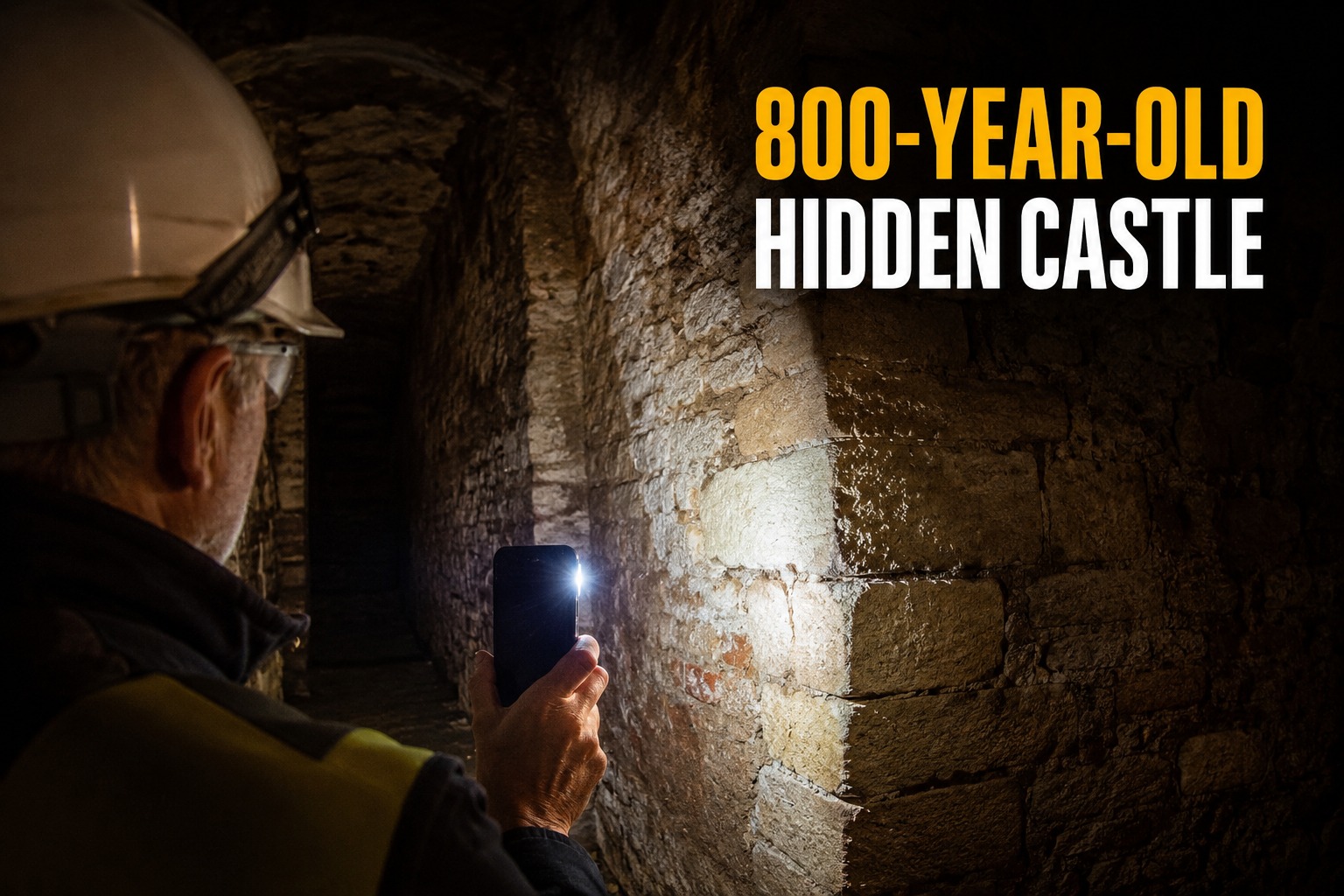
The discovery was made by archaeologist Stuart Ainsworth, who entered a dark underground passage beneath the courthouse. While examining the walls, he used the flashlight on his smartphone to improve visibility. The additional light revealed a noticeable difference in the stonework that had previously gone unnoticed.
According to Ainsworth, the wall suddenly changed direction at a right angle before disappearing into an area too narrow to explore further. This unusual construction immediately suggested that the masonry belonged to an earlier structure buried beneath later buildings.
Why the Smartphone Light Made the Difference
Although archaeologists often rely on advanced equipment such as laser scanners, drones, and ground-penetrating radar, discoveries sometimes begin with careful observation.
The smartphone's LED light illuminated subtle variations in the texture, alignment, and construction of the stones. These differences indicated that the visible wall was not simply part of the courthouse's foundations but belonged to a much older medieval building.
The discovery serves as a reminder that archaeological expertise remains just as important as sophisticated technology. A trained eye can recognize historical clues that others might easily overlook.
The History Behind Chester's Medieval Castle
Chester has played a significant role in British history for nearly two thousand years. Originally established as a Roman fortress, the city later became one of medieval England's most strategically important settlements because of its location near the Welsh border.
Following the Norman Conquest in 1066, powerful castles were built across England to strengthen royal control. Chester Castle became one of these major defensive strongholds.
Constructed in the 11th century and expanded during the 12th and 13th centuries, the castle protected the surrounding region, housed military forces, and served as an important administrative center.
Over the centuries, large portions of the original castle disappeared as newer government buildings, prisons, and courts replaced medieval structures. Historians believed much of the original architecture had been lost forever, making this latest discovery particularly significant.
Why This Discovery Matters
Finding a surviving section of the castle beneath a modern courthouse provides valuable evidence about the castle's original design and construction.
Archaeologists can now compare the newly discovered masonry with historical records, medieval drawings, and previous excavations to better understand how the fortress evolved over hundreds of years.
The discovery may help answer several long-standing questions, including:
- How extensive the original castle complex was.
- Which construction phases belong to different medieval rulers.
- How later buildings incorporated or buried older structures.
- What defensive features once protected the castle.
Each newly identified wall, corridor, or foundation helps historians reconstruct a more accurate picture of medieval Chester.
Archaeology Hidden Beneath Modern Cities
One of the most fascinating aspects of archaeology is that important historical remains often survive beneath modern cities.
As towns expanded over centuries, older buildings were demolished, buried, or incorporated into newer construction. Instead of removing every foundation, builders frequently constructed directly above existing structures.
This creates layers of history beneath today's streets, offices, homes, and public buildings.
The Chester discovery demonstrates that even active government buildings may conceal remarkable archaeological treasures waiting to be identified.
The Importance of Careful Observation
The discovery also highlights the value of patient investigation.
Rather than relying solely on expensive equipment, archaeologists carefully study every visible surface, looking for differences in stone type, construction methods, mortar, and wall alignment.
In this case, the smartphone flashlight simply provided enough illumination for an experienced archaeologist to notice details that natural lighting had failed to reveal.
It is a powerful example of how scientific knowledge and attention to detail often lead to major discoveries.
Challenges Facing the Excavation
Although the discovery is exciting, investigating the site presents several practical challenges.
Because the remains lie beneath an operational courthouse, archaeologists cannot freely excavate large areas without considering the safety and function of the building above.
Engineers, conservation specialists, and heritage authorities must work together to ensure that any future investigations preserve both the historic remains and the modern structure.
The narrow underground passages also limit access, making exploration slower and more technically demanding.
What Researchers Hope to Learn Next
The newly identified wall may represent only a small portion of what survives beneath the courthouse.
Future investigations could include:
- Detailed laser scanning.
- Three-dimensional digital mapping.
- Structural analysis of the masonry.
- Limited archaeological excavations where possible.
Researchers hope these studies will reveal additional castle walls, towers, gateways, or defensive features that have remained hidden for centuries.
Every new discovery contributes valuable information to the historical record and helps preserve Britain's medieval heritage for future generations.
Preserving Britain's Medieval Heritage
Britain is home to hundreds of medieval castles, but many have been altered or partially destroyed through centuries of redevelopment.
Archaeological discoveries like this remind us that history often survives in unexpected places. Protecting these remains allows future generations to better understand medieval engineering, architecture, military strategy, and daily life.
Preservation also supports education and tourism, helping local communities appreciate the rich heritage beneath their cities.
Conclusion
The discovery of an 800-year-old medieval castle beneath Chester Crown Court is a remarkable reminder that history is often hidden just below our feet. What began as a simple inspection in a dark underground corridor turned into an important archaeological breakthrough thanks to the trained observation of an expert and the light from an ordinary smartphone.
Beyond its novelty, the find offers historians a rare opportunity to better understand one of England's most significant medieval castles. As further research continues, the hidden remains beneath Chester may reveal even more secrets about Britain's rich medieval past, proving that extraordinary discoveries sometimes begin with the simplest tools.