
3D-Printed Contact Lenses in Just 20 Minutes: A Breakthrough That Could Transform Eye Care
Introduction
For millions of people worldwide, contact lenses offer a convenient alternative to glasses. However, getting the perfect fit has always been a challenge. Traditional contact lenses are manufactured in standard sizes, while custom-made lenses often require specialized laboratories and days or even weeks to produce. This delay can be inconvenient, especially for patients with unique eye shapes or complex vision needs.
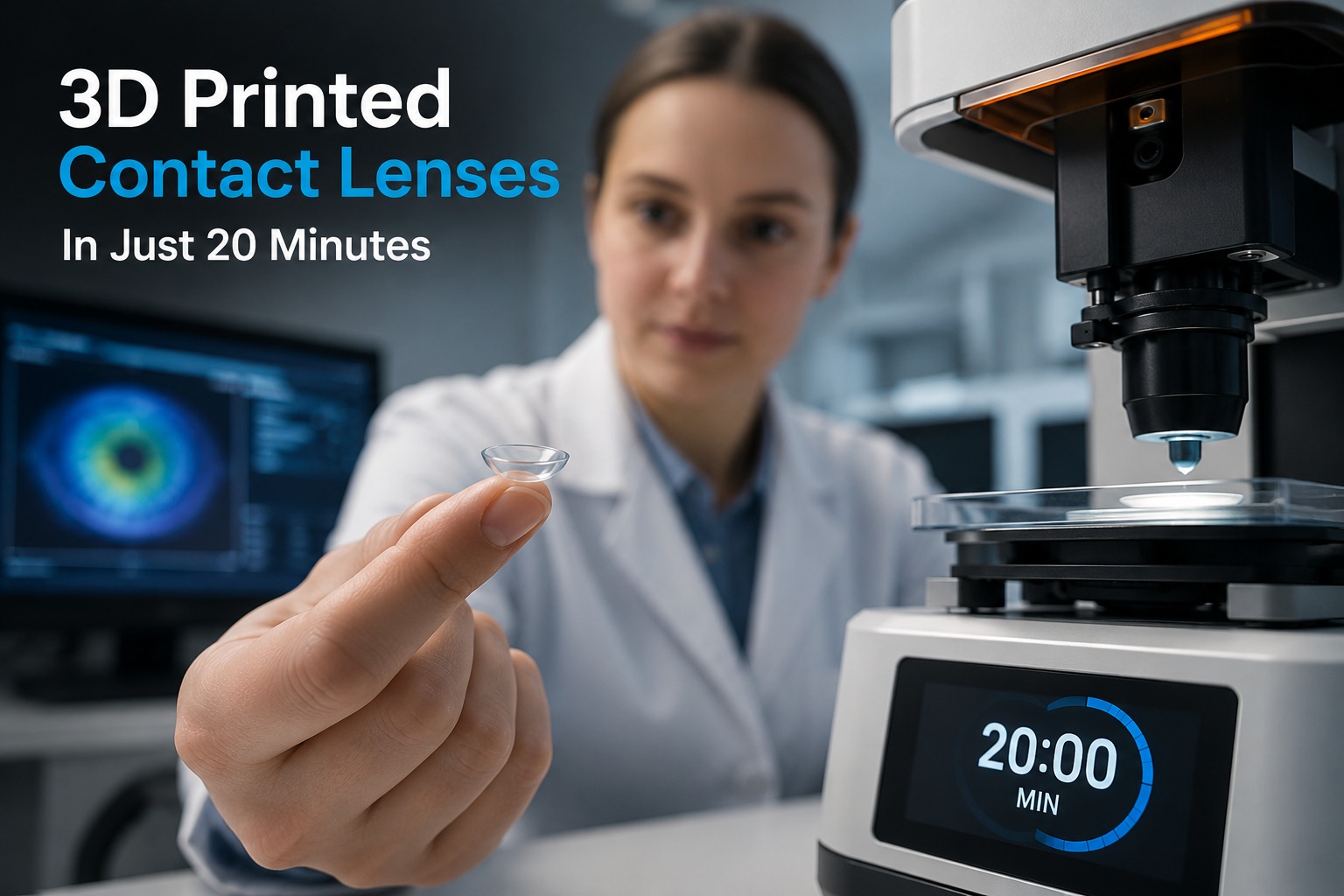
A team of researchers at the University of Waterloo in Canada has developed a promising technology that could dramatically change this process. Their newly developed 3D-printing technique can create customized contact lenses in approximately 20 minutes. Published in the journal Materials & Design, the research suggests that future patients could have lenses designed, manufactured, and fitted during a single visit to their optometrist.
If successfully commercialized, this innovation could revolutionize personalized eye care by making custom contact lenses faster, more affordable, and more accessible than ever before.
Why Traditional Contact Lens Manufacturing Has Limitations
Modern contact lenses have come a long way, but the manufacturing process still follows methods developed decades ago. Most soft contact lenses are mass-produced in standardized shapes and sizes to accommodate the majority of users. While these lenses work well for many people, they are not ideal for everyone.
Patients with irregular corneas, severe astigmatism, keratoconus, or unique eye anatomy often require customized lenses. Producing these lenses involves detailed measurements, laboratory manufacturing, quality inspections, shipping, and multiple appointments before the final fitting.
This traditional workflow creates several challenges:
- Longer waiting times for patients.
- Higher manufacturing costs.
- Multiple clinic visits.
- Limited flexibility if adjustments are needed.
- Difficulty achieving a perfect fit for complex eye conditions.
The new 3D-printing approach aims to eliminate many of these obstacles.
A New Era of Personalized Contact Lenses
Researchers at the University of Waterloo have developed an advanced manufacturing process that combines precise eye measurements with rapid 3D printing. Instead of producing generic lenses in large factories, the technology allows each lens to be individually designed based on the patient's eye.
The entire process can potentially be completed in about 20 minutes, allowing patients to receive customized lenses during the same appointment in which their eyes are examined.
This represents a major shift from mass production toward personalized medical devices manufactured on demand.
How the 3D Printing Process Works
The technology begins with a detailed scan of the patient's eye. Modern diagnostic equipment maps the exact shape of the cornea and surrounding eye surface with exceptional precision.
These measurements are then converted into a digital model that serves as the blueprint for the contact lens.
Using specially developed transparent materials suitable for eye use, a high-precision 3D printer fabricates the lens layer by layer. Researchers have focused on ensuring that the printed material maintains the characteristics required for comfortable vision correction, including:
- High optical clarity
- Smooth surface quality
- Proper flexibility
- Mechanical durability
- Accurate dimensions
- Comfortable fit
After printing, the lens undergoes finishing and preparation before it can be fitted to the patient.
Because the manufacturing process is digital, modifications can be made immediately if adjustments are required.
Why Speed Matters in Eye Care
Producing a customized contact lens in only 20 minutes is more than a technological achievement—it could significantly improve patient care.
Instead of waiting days or weeks for a custom lens to arrive, patients may eventually leave the clinic wearing lenses specifically designed for their eyes.
This rapid turnaround offers several practical advantages:
Patients can immediately determine whether the lens feels comfortable.
Eye care professionals can make quick adjustments without repeating lengthy manufacturing processes.
Clinics may reduce inventory because lenses are produced only when needed.
Emergency or specialized vision cases could receive faster treatment.
Overall patient satisfaction may improve because the fitting process becomes much more efficient.
Better Comfort Through Personalized Design
One of the biggest advantages of custom-made contact lenses is improved comfort.
Even small differences in eye shape can affect how a lens sits on the eye. A poorly fitting lens may move excessively, cause irritation, reduce oxygen flow, or produce blurry vision.
By designing each lens according to the individual's corneal measurements, researchers hope to achieve a much more natural fit.
A customized lens can:
- Reduce irritation.
- Improve stability during blinking.
- Increase wearing comfort.
- Deliver more consistent vision.
- Lower the risk of complications caused by poor fitting.
This could be especially valuable for patients who previously struggled to wear conventional contact lenses.
Maintaining Commercial-Grade Optical Quality
One concern surrounding 3D-printed optical products has always been image quality. Tiny imperfections created during printing can affect how light passes through a lens.
According to the research, the newly developed manufacturing method maintains commercial-grade optical transparency while also providing sufficient strength for daily use.
Lead researcher Dr. Shirley Tang explained that the team is excited because the technology brings them closer to truly personalized contact lenses that match each patient's eye structure while preserving visual clarity and durability.
Achieving this balance between customization and optical performance is one of the most significant aspects of the research.
Potential Benefits for Eye Care Clinics
The technology could eventually reshape how optometry clinics operate.
Rather than sending measurements to external laboratories, clinics equipped with specialized 3D printers could manufacture lenses on-site.
This approach could reduce:
- Shipping delays
- Manufacturing queues
- Inventory storage
- Material waste
- Overall production costs
Digital manufacturing also allows clinics to archive patient designs electronically, making replacement lenses much easier to produce in the future.
Real-World Applications Beyond Standard Vision Correction
Although everyday vision correction is an obvious application, the technology may have even greater value in specialized eye care.
Patients with conditions such as keratoconus often require highly customized contact lenses because standard soft lenses cannot provide adequate vision.
Similarly, individuals recovering from eye surgery or suffering from corneal injuries sometimes need therapeutic lenses designed specifically for healing.
Rapid custom manufacturing could improve treatment for:
- Keratoconus patients
- Irregular corneas
- Post-surgical recovery
- Therapeutic contact lenses
- Specialty vision correction
- Research applications
As materials continue to improve, the technology could expand into even more advanced medical uses.
Challenges Before Commercial Availability
Despite the exciting results, the technology is still in the research stage.
Several hurdles must be addressed before patients begin receiving 20-minute printed contact lenses in clinics.
Manufacturers and regulators will need to verify:
- Long-term safety of printing materials.
- Durability during daily wear.
- Oxygen permeability.
- Regulatory approval.
- Sterilization procedures.
- Manufacturing consistency.
- Large-scale clinical testing.
Medical devices that come into direct contact with the eye must meet extremely strict safety standards.
Researchers will likely conduct additional clinical studies before widespread adoption becomes possible.
The Future of Personalized Eye Care
Healthcare is increasingly moving toward personalized medicine, where treatments are tailored to each individual rather than relying on one-size-fits-all solutions.
The development of rapid 3D-printed contact lenses perfectly reflects this trend.
As digital scanning, artificial intelligence, advanced biomaterials, and precision manufacturing continue to evolve together, eye care could become significantly more personalized than it is today.
In the future, patients may visit an optometrist, have their eyes scanned, receive customized lenses within minutes, and leave with improved comfort and vision—all in a single appointment.
The same technology may eventually inspire customized production of other medical devices, including dental appliances, hearing devices, prosthetics, and surgical implants.
Conclusion
The University of Waterloo's breakthrough in rapid 3D-printed contact lenses represents a significant step toward the future of personalized vision care. By combining detailed eye scanning with advanced additive manufacturing, researchers have demonstrated the possibility of producing custom contact lenses in approximately 20 minutes.
Although further research, clinical testing, and regulatory approvals are still required before the technology becomes widely available, its potential is enormous. Faster production, better comfort, improved fitting accuracy, reduced waiting times, and on-demand manufacturing could fundamentally transform how contact lenses are designed and delivered.
As 3D printing continues to reshape healthcare, personalized contact lenses may soon become a practical reality rather than a distant vision—bringing patients closer to more comfortable, precise, and convenient eye care than ever before.