
🧠 Why Humans Forget Things — And How Your Brain Decides What to Remember
🌌 Forgetting a name, losing your train of thought, or walking into a room and forgetting why you went there — almost everyone experiences it. But memory is far more mysterious than most people realize.
By Admin
Human memory feels simple on the surface.
You experience something.
Your brain stores it.
Later, you remember it.
But modern neuroscience shows that memory is actually one of the most complex systems in the human body.
The brain is constantly deciding what information matters, what should be ignored, what deserves long-term storage, and what should slowly disappear.
In other words, forgetting is not always a mistake.
Sometimes, forgetting is part of how the brain protects itself from overload.
Scientists now believe memory is not like a video recording stored perfectly inside the mind.
Instead, memory is dynamic.
Flexible.
Emotional.
And surprisingly unreliable.
That is why two people can experience the exact same event yet remember it very differently years later.
The human brain does not simply store reality.
It interprets it.
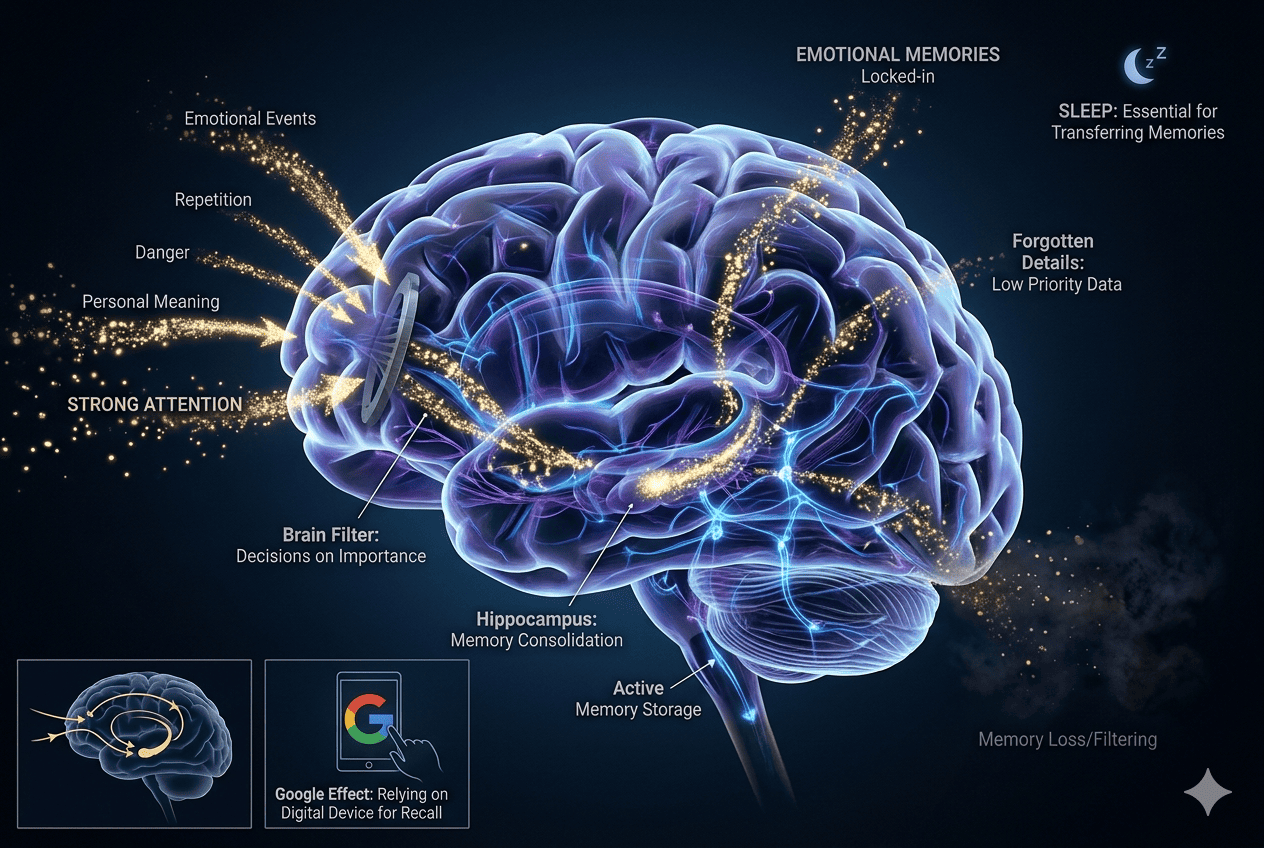
🔬 Your Brain Is Constantly Filtering Information
Every second, the human brain receives enormous amounts of information.
Sounds.
Colors.
Faces.
Smells.
Conversations.
Movements.
Emotions.
If the brain tried to store everything permanently, it would become overwhelmed.
So the brain filters information continuously.
Most details never reach long-term memory at all.
For example, you probably do not remember every single face you passed on the street last week.
Your brain decided that information was not important enough to preserve.
Memory works partly like a survival system.
The brain prioritizes information connected to:
- Emotion
- Danger
- Repetition
- Personal meaning
- Novel experiences
- Strong attention
This is why emotionally intense moments often feel unforgettable.
The brain treats emotional experiences as important for future survival.
😨 Why Emotional Memories Feel So Powerful
Strong emotions activate parts of the brain involved in memory formation.
Fear, happiness, embarrassment, excitement, grief, and shock can all strengthen memory encoding.
This is why people often remember:
- Their first school day
- A car accident
- A wedding
- A major argument
- A frightening experience
- An important achievement
Emotion acts almost like a “high-priority” signal.
The brain interprets emotional intensity as something worth remembering.
However, emotional memories are not always perfectly accurate.
People often remember the feeling of an event more strongly than the exact details.
Stress can even distort memory.
This is one reason eyewitness testimony is sometimes unreliable despite sincere confidence.
The brain reconstructs memories rather than replaying them exactly like a recording.
💤 Sleep Plays a Huge Role in Memory
One of the most fascinating discoveries in neuroscience is how important sleep is for memory formation.
While you sleep, the brain organizes and strengthens information collected throughout the day.
Researchers believe sleep helps transfer short-term memories into longer-term storage.
This process is called memory consolidation.
Without enough sleep, the brain struggles to store and organize information efficiently.
That is why sleep-deprived students often find it harder to concentrate, learn, and recall information.
Ironically, staying awake all night studying may actually reduce memory performance.
Sleep is not “inactive” time for the brain.
It is one of the brain’s busiest maintenance periods.
📱 Modern Technology Is Changing Human Memory
Smartphones and the internet have dramatically changed how people use memory.
Today, humans rely heavily on digital devices to store information.
Phone numbers.
Directions.
Birthdays.
Passwords.
Appointments.
Photos.
Facts.
Instead of memorizing information naturally, many people now depend on instant digital access.
Some researchers call this the “Google Effect” or digital memory outsourcing.
The brain becomes less likely to store information deeply when it knows the information can easily be searched later.
This does not necessarily mean technology is making humans less intelligent.
But it may be changing how memory functions in everyday life.
Humans are increasingly remembering where to find information rather than remembering the information itself.
🤔 Why Do We Forget Names So Easily?
Forgetting names is extremely common.
And there is a scientific reason behind it.
Names are often considered “weak associations” inside the brain.
Unlike descriptive information, names usually have little natural meaning attached to them.
For example, if someone says:
“John is a doctor who loves mountain climbing and owns a black dog.”
Your brain naturally forms stronger associations around the interesting details.
The name itself may not connect emotionally or visually to anything memorable.
Attention also matters.
Many people forget names because they are distracted during introductions.
Instead of focusing fully, the brain may already be thinking about what to say next.
Without proper attention, memory encoding becomes weaker.
⚡ Stress and Anxiety Can Disrupt Memory
Short-term stress can sometimes improve focus temporarily.
But chronic stress often damages memory performance.
When stress hormones remain elevated for long periods, concentration becomes more difficult.
Mental fatigue increases.
Attention weakens.
The brain becomes overloaded.
Anxiety can create similar effects.
People experiencing high anxiety often report:
- Forgetfulness
- Difficulty concentrating
- Mental fog
- Trouble recalling information
- Reduced focus
This happens partly because anxious thoughts compete for the brain’s attention.
The brain struggles to prioritize information properly when constantly dealing with stress signals.
🧓 Why Memory Changes With Age
Memory naturally changes as people grow older.
Processing speed may become slower.
Retrieving information may take longer.
Names and details may feel harder to recall instantly.
However, normal aging is very different from serious neurological diseases.
Many older adults continue maintaining strong intelligence, wisdom, vocabulary, emotional understanding, and long-term knowledge.
In fact, some forms of thinking improve with experience.
The brain also remains adaptable throughout life.
Scientists call this neuroplasticity.
The brain can continue forming new connections, learning skills, and adapting even during older adulthood.
Mental stimulation, social activity, physical exercise, healthy sleep, and lifelong learning may all help support cognitive health over time.
🧩 False Memories Are More Common Than People Think
One of the strangest discoveries in psychology is that humans can sometimes remember things that never actually happened.
These are called false memories.
False memories are not usually intentional lies.
The brain can accidentally reconstruct details incorrectly over time.
Memories may become influenced by:
- Suggestions from others
- Media exposure
- Emotional interpretation
- Repeated storytelling
- Imagination
In some experiments, researchers successfully convinced participants to “remember” events that never occurred.
This demonstrates how flexible human memory can be.
Memory feels reliable because it feels personal.
But scientifically, memory is far more reconstructive than most people realize.
🎵 Why Music Can Trigger Powerful Memories
Music has an unusually strong connection to memory and emotion.
A single song can instantly transport someone back to a specific moment in life.
Scientists believe music activates multiple brain regions simultaneously, including areas connected to emotion, movement, and memory.
This is why songs often become deeply linked to personal experiences.
Researchers studying neurological conditions have even observed that music sometimes helps patients reconnect with memories that seemed unreachable.
The relationship between music and memory remains one of the most fascinating areas of neuroscience research.
🏃 Exercise and Physical Health Affect the Brain Too
The brain is not separate from the body.
Physical health strongly influences cognitive function.
Exercise improves blood flow to the brain and may support memory performance over time.
Healthy sleep, balanced nutrition, hydration, stress management, and social interaction all contribute to brain health.
Scientists increasingly view memory as part of an interconnected biological system rather than an isolated mental ability.
This means lifestyle habits matter more than many people realize.
🔮 Could Humans Improve Memory in the Future?
Researchers continue studying ways to improve memory and treat neurological disorders.
Advances in neuroscience, brain imaging, artificial intelligence, and medical technology may eventually transform understanding of memory completely.
Scientists are exploring:
- Brain-computer interfaces
- Memory-related treatments
- Neurostimulation technologies
- Alzheimer’s research
- Cognitive enhancement therapies
However, the brain remains incredibly complex.
Even today, scientists still do not fully understand consciousness itself.
Human memory remains one of the greatest mysteries in neuroscience.
🌍 Why Memory Makes Humans Human
Memory shapes identity.
It influences personality, relationships, learning, emotions, and decision-making.
Without memory, humans could not build experiences, maintain relationships, or develop personal history.
Every conversation, lesson, success, mistake, and emotional moment contributes to who a person becomes.
In many ways, memory is the foundation of human life itself.
And perhaps that is why forgetting can feel so emotional.
People fear losing memories because memories connect them to meaning.
To family.
To love.
To identity.
To time.
✅ Conclusion
Human memory is far more complex than simply “remembering” and “forgetting.”
The brain constantly filters information, strengthens emotional experiences, removes unnecessary details, and reconstructs memories over time.
Sleep, stress, technology, emotion, aging, and lifestyle all influence how memory works.
Scientists continue discovering surprising truths about the brain, yet many mysteries remain unsolved.
The more researchers study memory, the clearer one reality becomes:
The human brain is one of the most extraordinary and complicated systems in the known universe.
And every forgotten name, emotional flashback, childhood memory, or sudden moment of recognition is part of that incredible system silently working inside us every day.