
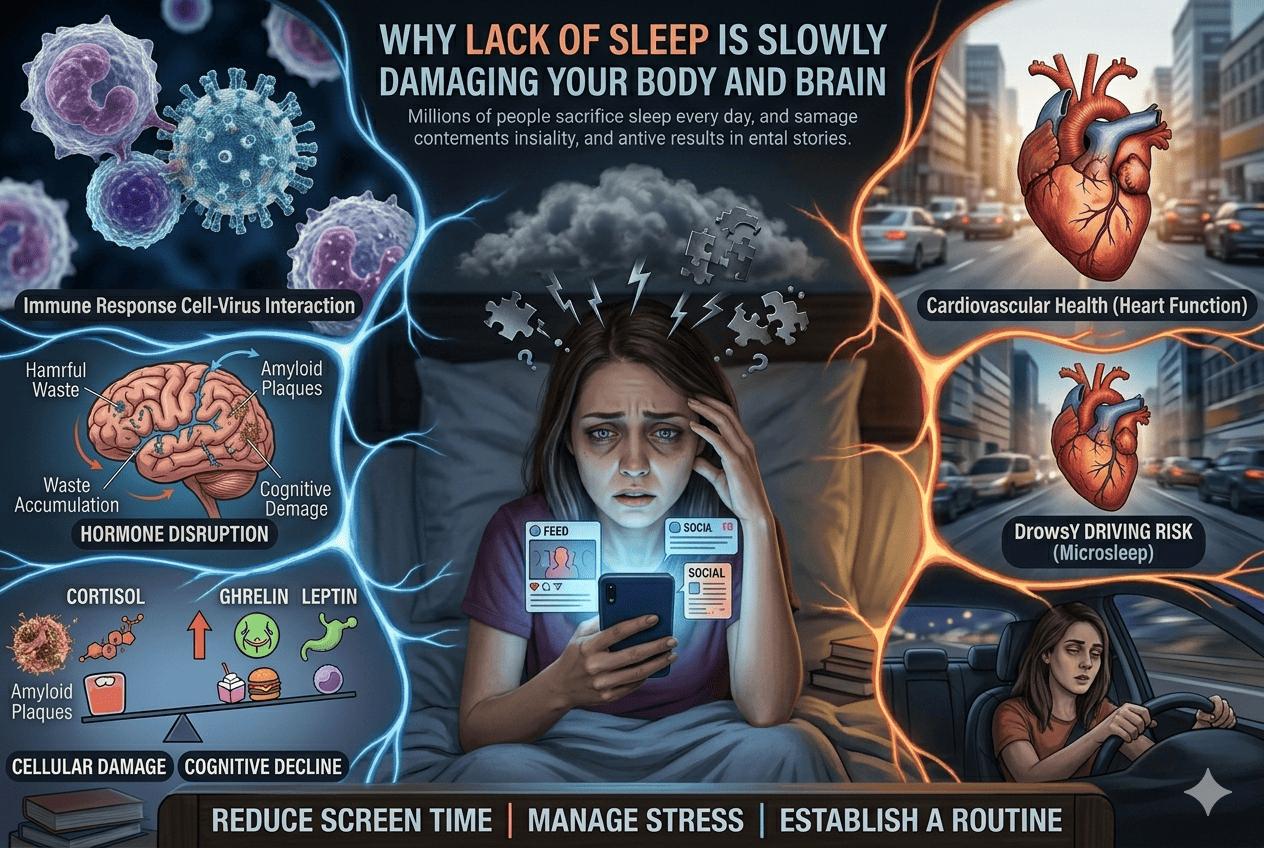
😴 Why Lack of Sleep Is Slowly Damaging Your Body and Brain
🌙 Millions of people sacrifice sleep every day — without realizing what it’s truly doing to their health.
For many people, sleeping less has become normal.
Some stay awake scrolling through social media late at night. Others work long hours, binge-watch shows, study for exams, or struggle with stress and anxiety. Modern life often treats sleep like an optional luxury rather than a biological necessity.
But science says otherwise.
Sleep is not simply “rest.”
It is one of the most important survival functions of the human body.
While you sleep, your brain repairs itself, hormones rebalance, memory strengthens, immunity improves, muscles recover, and organs perform essential maintenance. Without proper sleep, the body slowly begins to malfunction in ways many people never notice immediately.
The dangerous part is that sleep deprivation usually does not feel serious at first.
A person may simply feel tired, irritated, or mentally slow.
But over time, chronic sleep loss can affect the heart, brain, metabolism, immune system, mental health, and even lifespan.
That is why medical experts now consider poor sleep one of the biggest hidden health problems of the modern world.
🧠 What Actually Happens Inside Your Brain During Sleep?
Most people think the brain “shuts down” during sleep.
In reality, the brain becomes extremely active.
During deep sleep, the brain processes memories, clears waste products, repairs neural connections, and regulates emotional balance.
Scientists have even discovered a special cleaning system in the brain called the glymphatic system.
This system becomes more active during sleep and helps remove harmful waste substances that build up throughout the day.
Some researchers believe poor sleep may contribute to long-term neurological problems because the brain does not get enough time to perform this cleaning process properly.
Sleep also plays a major role in learning.
When you study something new, your brain strengthens those memories while you sleep.
That is why people who sleep properly often remember information better than people who stay awake all night studying.
Ironically, sacrificing sleep for productivity often reduces productivity itself.
❤️ Your Heart Suffers When You Don’t Sleep Enough
One of the biggest medical concerns linked to sleep deprivation is cardiovascular health.
When the body does not get enough sleep, stress hormones remain elevated for longer periods.
Blood pressure may increase.
Inflammation levels rise.
The heart works harder.
Over time, this can increase the risk of:
- ❤️ High blood pressure
- ❤️ Heart disease
- ❤️ Stroke
- ❤️ Irregular heartbeat
- ❤️ Poor circulation
Several studies have shown that people who regularly sleep less than six hours per night may face a significantly higher risk of heart-related problems.
Sleep is essentially part of the body’s repair cycle.
Without enough recovery time, physical stress slowly accumulates.
⚠️ Sleep Deprivation Affects Mental Health More Than People Realize
Poor sleep and mental health are deeply connected.
A single night of inadequate sleep can affect mood, patience, concentration, and emotional control.
But long-term sleep deprivation can become far more serious.
Research shows strong links between poor sleep and conditions such as:
- Anxiety
- Depression
- Chronic stress
- Mood disorders
- Emotional instability
People who sleep poorly often become more emotionally reactive.
Small problems feel bigger.
Stress becomes harder to manage.
Negative thoughts become more intense.
This happens because sleep helps regulate emotional processing inside the brain.
Without proper rest, the brain struggles to manage emotions efficiently.
This creates a vicious cycle.
Stress causes poor sleep, and poor sleep increases stress.
🍔 Lack of Sleep Can Make You Gain Weight
Many people focus only on diet and exercise when trying to lose weight.
But sleep plays a surprisingly important role in metabolism.
When you do not sleep enough, hormones related to hunger and appetite become disrupted.
The body produces more ghrelin — the hormone that increases hunger — while reducing leptin, the hormone that helps you feel full.
As a result, sleep-deprived people often crave:
- Sugary foods
- Fast food
- High-calorie snacks
- Caffeine
- Late-night meals
At the same time, tiredness reduces motivation for physical activity.
This combination can gradually lead to weight gain and metabolic problems.
Some studies also suggest that poor sleep may increase the risk of insulin resistance and type 2 diabetes.
That means sleep affects far more than energy levels.
It directly influences how the body manages calories, sugar, and fat.
📱 Smartphones and Screens Are Making Sleep Worse
Technology has dramatically changed sleeping habits.
Many people now spend hours looking at phones, tablets, or laptops before bed.
The problem is not only mental stimulation.
Screens emit blue light, which can interfere with melatonin production.
Melatonin is the hormone that helps regulate sleep.
When blue light exposure remains high late at night, the brain may become confused and delay sleep signals.
Social media also keeps the brain mentally active.
Scrolling endlessly, watching videos, reading news, or checking notifications prevents the mind from fully relaxing.
This is one reason sleep problems have become increasingly common worldwide.
Modern technology has extended waking hours far beyond what the human body naturally evolved for.
☕ Why Caffeine and Energy Drinks Can Create a Dangerous Cycle
Millions of people depend on caffeine to survive sleep deprivation.
Coffee, tea, energy drinks, and stimulants temporarily improve alertness by blocking adenosine — a chemical that makes the body feel sleepy.
But excessive caffeine consumption can create a cycle:
- Poor sleep causes fatigue
- Fatigue increases caffeine intake
- Caffeine disrupts sleep further
- Worse sleep leads to more exhaustion
Over time, this cycle can damage sleep quality significantly.
Energy drinks may be especially problematic because many contain extremely high caffeine levels combined with sugar and stimulants.
Some people consume them late in the evening without realizing how strongly they affect the nervous system.
🦠 Your Immune System Weakens Without Sleep
Sleep is critical for immune function.
During sleep, the body produces and regulates immune cells that help fight infections and inflammation.
People who consistently sleep poorly often become sick more frequently.
Recovery from illness may also become slower.
Several studies have shown that sleep deprivation can weaken immune responses and increase vulnerability to viruses and infections.
This became especially important during global health crises when researchers emphasized the role of sleep in maintaining immune resilience.
A healthy immune system depends on more than vitamins and exercise.
It also depends heavily on proper rest.
🚗 Sleep Deprivation Can Be as Dangerous as Alcohol
One of the most shocking facts about sleep deprivation is how severely it affects reaction time and decision-making.
Severe fatigue can impair the brain in ways similar to alcohol intoxication.
Drowsy driving has become a major public safety concern worldwide.
Tired drivers may experience:
- Delayed reactions
- Poor concentration
- Microsleep episodes
- Reduced judgment
- Memory lapses
Microsleep is especially dangerous.
A person may fall asleep for just a few seconds without realizing it.
At highway speeds, even a few seconds can become deadly.
Many people underestimate fatigue because it develops gradually.
Unlike alcohol, there is no simple test that instantly reveals how impaired someone may actually be.
🌙 How Much Sleep Do Humans Really Need?
Sleep needs vary slightly between individuals, but most adults generally require around 7 to 9 hours of quality sleep per night.
Teenagers and children typically need even more because their brains and bodies are still developing.
Unfortunately, many people consistently sleep far below healthy levels.
Modern work culture often glorifies exhaustion and “hustle.”
But chronically sacrificing sleep for productivity eventually harms both physical and mental performance.
Rest is not laziness.
It is biological maintenance.
💡 Simple Habits That Can Improve Sleep Naturally
Improving sleep quality does not always require medication.
Small lifestyle changes can often make a significant difference.
✅ Maintain a Consistent Sleep Schedule
Going to bed and waking up at similar times helps regulate the body’s internal clock.
✅ Reduce Screen Time Before Bed
Limiting phone and laptop usage before sleeping may help melatonin production normalize.
✅ Avoid Heavy Meals Late at Night
Large meals before bed can disrupt sleep quality and digestion.
✅ Keep the Bedroom Cool and Dark
A calm sleeping environment supports deeper and more comfortable sleep.
✅ Limit Late-Night Caffeine
Avoiding caffeine several hours before bedtime can improve sleep quality substantially.
These habits may sound simple, but consistency matters more than perfection.
🔬 Scientists Are Still Discovering New Things About Sleep
Despite decades of research, sleep remains one of the most fascinating mysteries in medicine.
Scientists continue studying how sleep affects aging, memory, emotional regulation, immunity, hormone balance, and neurological diseases.
New research increasingly suggests that sleep may influence nearly every major system in the human body.
That is why doctors today take sleep problems much more seriously than in the past.
Poor sleep is no longer viewed as a minor inconvenience.
It is increasingly recognized as a major public health issue.
✅ Conclusion
Sleep is not wasted time.
It is one of the body’s most powerful recovery systems.
Without enough sleep, the brain struggles to function properly, the immune system weakens, stress increases, metabolism changes, and long-term health risks rise significantly.
The modern world constantly encourages people to stay awake longer, work harder, and remain connected 24/7.
But the human body still operates according to biological limits.
Ignoring sleep may seem harmless for a while.
Eventually, however, the body keeps score.
And in many cases, proper sleep may be one of the most powerful forms of medicine available — completely free.