
Dark Oxygen: How Deep-Sea Rocks Are Challenging Everything We Know About Life on Earth
Introduction: A Discovery That Shouldn’t Exist
For decades, one scientific principle seemed almost unshakable: oxygen production requires sunlight. From school textbooks to advanced research, the idea was simple—life-supporting oxygen is created through light-driven processes, mainly photosynthesis.
But what if that assumption is incomplete?
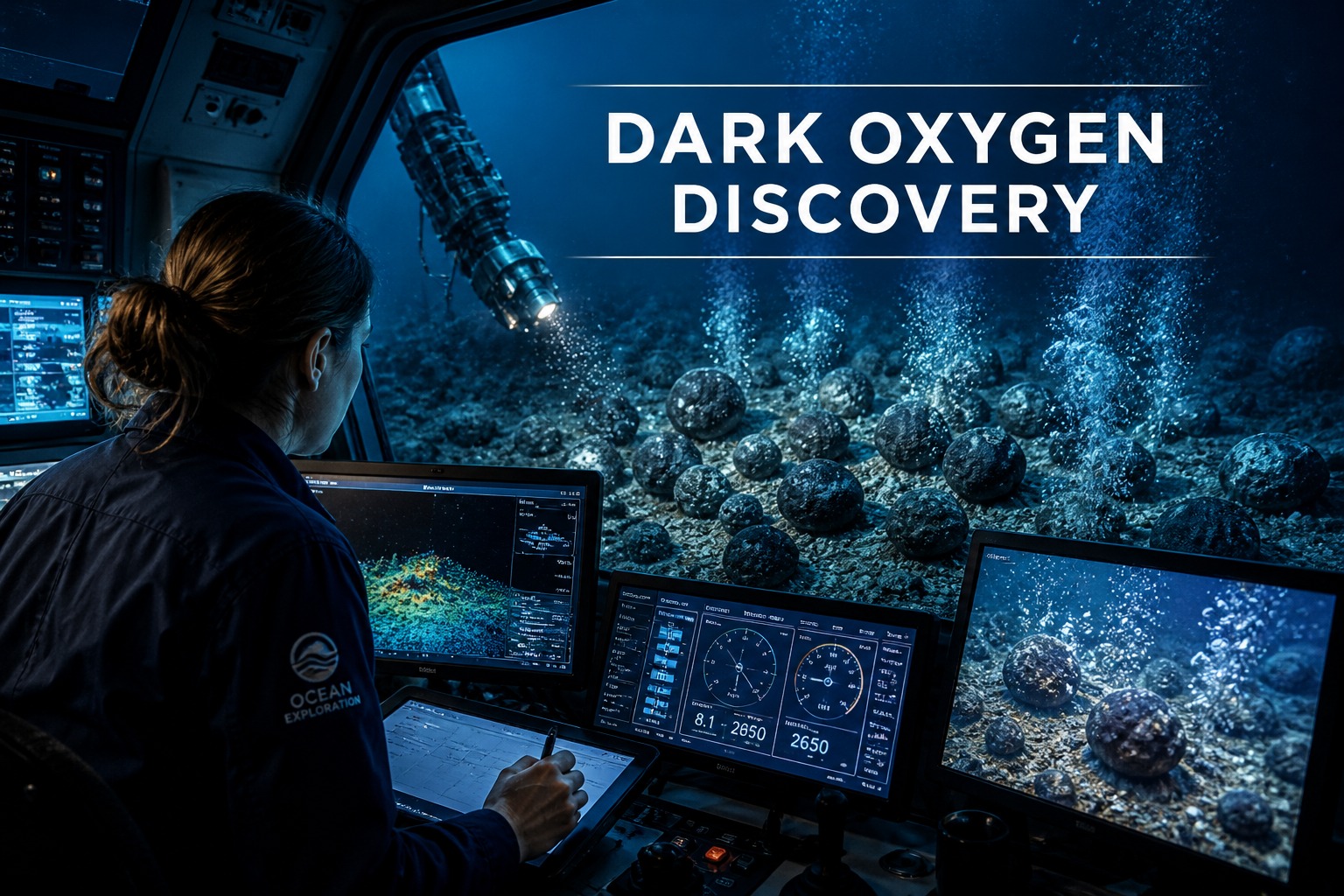
Deep beneath the ocean’s surface—far beyond the reach of sunlight—scientists have uncovered something extraordinary. During a deep-sea expedition, researchers observed that small, black, rock-like formations known as manganese nodules appear to be producing oxygen in total darkness. This phenomenon, now referred to as “dark oxygen,” is forcing scientists to rethink not only how oxygen forms, but also how life itself might begin and survive in extreme environments.
This is not just another scientific curiosity. It’s a discovery with the potential to reshape our understanding of Earth—and even the possibility of life beyond it.
The Hidden World of the Deep Ocean
To understand the significance of this discovery, it helps to first imagine the environment where it occurs.
The deep ocean floor is one of the most extreme places on Earth. At depths of 4,000 to 6,000 meters, sunlight completely disappears. Temperatures hover near freezing, and pressure is so intense it would crush most surface-level life forms instantly. For a long time, scientists believed such conditions limited biological activity, especially processes related to oxygen production.
Yet, the deep sea continues to surprise us.
Scattered across vast stretches of the ocean floor are manganese nodules—small, rounded lumps made of metals like manganese, iron, nickel, and cobalt. These nodules grow extremely slowly, sometimes taking millions of years to form. Because they contain valuable materials used in batteries and electronics, they have also attracted attention from deep-sea mining companies.
Until recently, these nodules were viewed mainly as mineral resources. Now, they may be something far more important.
What Is “Dark Oxygen”?
The term “dark oxygen” refers to oxygen that is produced without the presence of sunlight. This directly contradicts the long-standing belief that oxygen generation depends on light-driven biological processes.
During a deep-sea mining study, researchers deployed sensors to measure oxygen levels near the seabed. Instead of finding stable or decreasing oxygen concentrations—as expected—they detected a surprising increase. Something on the ocean floor was actively producing oxygen.
Further investigation pointed toward manganese nodules as the likely source.
This raised a critical question: how can oxygen form in complete darkness?
The Science Behind the Phenomenon
The most widely discussed explanation involves electrochemical reactions occurring on the surface of these nodules.
Manganese nodules contain a mix of conductive metals. Under certain conditions, they may behave like natural batteries, generating small electrical currents. These currents could drive a process similar to electrolysis, where water molecules (H₂O) are split into hydrogen and oxygen.
In simple terms, the nodules may be using naturally occurring chemical energy to separate water into its basic components—releasing oxygen as a byproduct.
This idea connects strongly with principles studied in geochemistry, where interactions between minerals, water, and energy sources can lead to unexpected reactions.
While research is still ongoing, the evidence suggests that these rocks are not passive objects. Instead, they are actively participating in chemical processes that were once thought impossible in such environments.
Why This Discovery Matters So Much
At first glance, this might seem like a niche scientific finding. But its implications are far-reaching.
Rethinking the Origin of Oxygen on Earth
Traditionally, scientists believed that oxygen in Earth’s atmosphere began accumulating after photosynthetic organisms evolved. This was a major turning point in the planet’s history, often referred to as the “Great Oxidation Event.”
However, if oxygen can be produced without sunlight, it raises the possibility that small amounts of oxygen may have existed even before photosynthesis became widespread. This could change how scientists understand the timeline of life’s evolution.
Expanding the Possibility of Life Beyond Earth
One of the most exciting implications lies in space exploration.
Moons like Europa (orbiting Jupiter) and Enceladus (orbiting Saturn) are believed to have vast oceans beneath their icy surfaces. These environments are completely cut off from sunlight, making traditional oxygen production unlikely.
But if dark oxygen processes exist, then oxygen—and potentially life—could exist in these hidden oceans as well.
This idea has significant implications for astrobiology, the field dedicated to studying life beyond Earth.
Challenging Assumptions in Marine Science
For experts in marine biology, this discovery introduces a new factor in understanding deep-sea ecosystems.
If oxygen is being produced locally on the seafloor, it could support microbial communities in ways scientists hadn’t previously considered. Entire ecosystems may depend on these subtle chemical processes.
The Deep-Sea Mining Dilemma
While this discovery is exciting, it also introduces a serious concern.
Manganese nodules are a major target for deep-sea mining due to their high metal content. Companies see them as a potential solution to growing demand for materials used in renewable energy technologies, such as electric vehicle batteries.
However, if these nodules play a role in oxygen production, removing them could disrupt delicate deep-sea ecosystems before we fully understand their function.
This creates a difficult balance between economic development and environmental protection.
On one hand, the world needs sustainable energy solutions. On the other, disturbing an ecosystem we barely understand could have unintended consequences that are difficult—or impossible—to reverse.
A Real-World Perspective: Why It Feels So Surprising
Part of what makes this discovery so fascinating is how deeply it challenges intuition.
Most people associate oxygen with plants, trees, and sunlight. It’s a concept we learn early in life: sunlight powers plants, and plants produce oxygen. Simple and logical.
But the universe rarely follows simple rules.
Just as deep-sea hydrothermal vents revealed ecosystems thriving without sunlight—relying instead on chemical energy—dark oxygen suggests that nature has multiple pathways to achieve similar outcomes.
In a way, it reminds us that scientific knowledge is not fixed. It evolves as new evidence emerges.
What Scientists Still Don’t Know
Despite the excitement, many questions remain unanswered.
Researchers are still trying to determine:
- Exactly how much oxygen these nodules produce
- Whether the process is continuous or occurs under specific conditions
- How widespread this phenomenon is across the global ocean floor
- What role it plays in supporting life in deep-sea environments
Answering these questions will require more advanced instruments, longer-term studies, and careful observation.
This is not a closed case—it’s the beginning of a new area of research.
Could This Change Our Everyday Lives?
At the moment, dark oxygen is more of a scientific breakthrough than a practical application. However, history shows that fundamental discoveries often lead to unexpected innovations.
Understanding natural electrochemical processes could inspire new technologies in energy production or water treatment. It might also influence how scientists design systems for long-term space missions, where generating oxygen without sunlight could be crucial.
While it may take years—or decades—for practical applications to emerge, the potential is there.
A Broader Insight: The Limits of What We Know
Perhaps the most powerful takeaway from this discovery is not just the science itself, but what it represents.
Even on our own planet, in places we have studied for decades, there are still phenomena that can surprise us. The deep ocean remains one of the least explored environments on Earth, and discoveries like this highlight how much remains unknown.
It also serves as a reminder to approach science with curiosity rather than certainty. Assumptions, even widely accepted ones, can be overturned by new evidence.
Conclusion: A New Chapter in Understanding Life
The discovery of dark oxygen from manganese nodules is more than just a scientific anomaly—it is a turning point in how we think about oxygen, life, and the environments that can support it.
It challenges long-held beliefs, opens new possibilities for life beyond Earth, and raises important questions about how we interact with fragile ecosystems.
Most importantly, it reminds us that Earth still holds secrets—hidden in its deepest, darkest corners—that have the power to change everything we thought we knew.
And in a world where knowledge often feels complete, discoveries like this prove that we are still just beginning to understand the planet we call home.