
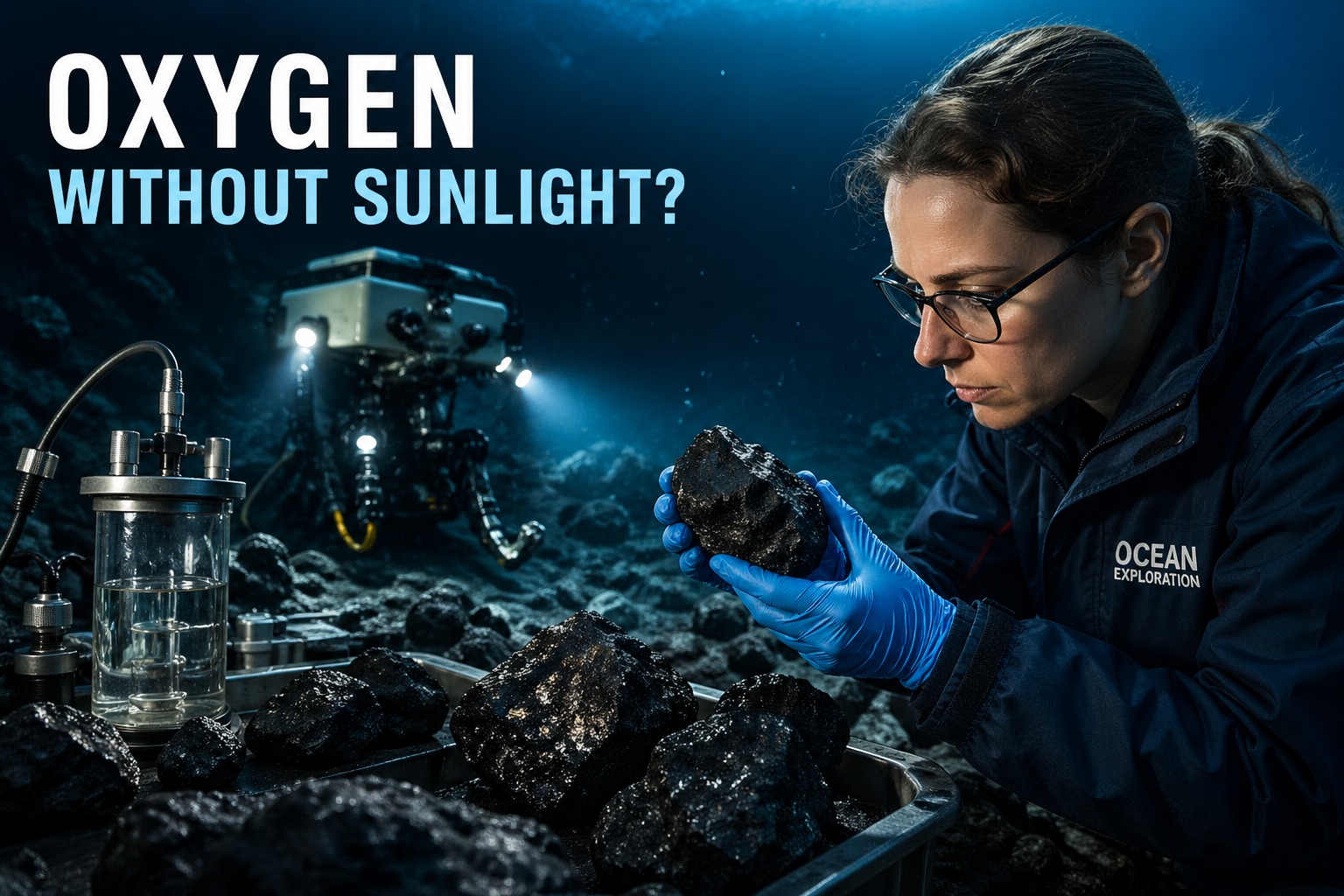
Oxygen Without Sunlight? The Mystery of Deep-Sea “Breathing” Stones
Introduction: A Discovery That Challenges Everything We Thought We Knew
For decades, we’ve understood one simple rule of life on Earth: oxygen comes from sunlight. Plants, algae, and certain bacteria use light to produce oxygen through photosynthesis, forming the very foundation of life as we know it. But what if this rule isn’t as absolute as we believed?
Deep beneath the ocean’s surface—far beyond the reach of sunlight—scientists have uncovered something astonishing. Strange, dark stones resting on the ocean floor appear to be producing oxygen in complete darkness. This discovery doesn’t just add a new chapter to marine science—it has the potential to rewrite the entire story.
What exactly are these “breathing” stones? How do they work without sunlight? And why has their discovery created unexpected problems for the very people who found them? Let’s explore.
The Problem: Life Without Light
The deep ocean is one of the most extreme environments on Earth. At depths of thousands of meters, sunlight completely disappears. Temperatures drop, pressure increases dramatically, and life becomes scarce and unusual.
For a long time, scientists assumed that oxygen-dependent life in these regions relied on oxygen produced elsewhere—mainly near the ocean’s surface—before slowly sinking down. In other words, deep-sea ecosystems were seen as dependent, not self-sustaining.
But this idea raises a critical question:
How do certain deep-sea ecosystems survive and even thrive in places where oxygen supply should be extremely limited?
This mystery has puzzled researchers for years. And now, these newly discovered stones might hold the answer.
The Discovery: Stones That Produce Oxygen
During an exploration mission aimed at deep-sea mining, researchers stumbled upon unusual black stones scattered across the ocean floor. These weren’t ordinary rocks. They were rich in metals like manganese, nickel, and cobalt—materials highly valuable for modern technologies such as batteries.
But something unexpected happened during testing.
Scientists noticed that oxygen levels around these stones were slightly higher than the surrounding environment. At first, this seemed like a measurement error. After all, oxygen production without sunlight shouldn’t be possible.
Yet repeated experiments confirmed the same result:
These stones were somehow generating oxygen in complete darkness.
This phenomenon has been informally described as “dark oxygen production”—a process that challenges the long-standing belief that light is essential for oxygen generation.
How Is This Even Possible?
At the heart of this mystery lies chemistry—not biology.
Unlike plants that rely on sunlight, these stones appear to trigger chemical reactions that split water molecules into hydrogen and oxygen. This process is somewhat similar to electrolysis, where electricity is used to break water apart.
But here’s the surprising part:
There’s no external power source.
Scientists believe that the metals within the stones may act like tiny natural batteries. When these metals interact with seawater, they create small electrical currents. These currents could be strong enough to drive the chemical reactions needed to release oxygen.
In simple terms, the stones may be functioning like microscopic energy systems—quietly generating oxygen in the dark.
While research is still ongoing, this explanation opens the door to a completely new understanding of how oxygen can be produced in extreme environments.
Why This Discovery Matters
This isn’t just an interesting scientific curiosity—it has far-reaching implications.
Rethinking the Origins of Life
If oxygen can be produced without sunlight, it raises an intriguing possibility:
Life might exist in environments we previously thought were impossible.
For example, moons like Europa (orbiting Jupiter) and Enceladus (orbiting Saturn) have vast subsurface oceans but no sunlight. If similar chemical processes occur there, they could potentially support life.
This discovery, therefore, expands the boundaries of where scientists might search for extraterrestrial life.
A New Understanding of Earth’s Ecosystems
Closer to home, this finding could reshape how we understand deep-sea ecosystems.
If oxygen is being generated locally on the ocean floor, it means these ecosystems may be more self-sufficient than previously believed. This could change how scientists study marine life, food chains, and environmental balance in the deep ocean.
Environmental Implications
Here’s where things get complicated.
The stones responsible for this phenomenon are also the target of deep-sea mining operations. Companies are eager to extract them because they contain valuable metals essential for electric vehicles and renewable energy technologies.
But if these stones play a critical role in producing oxygen and supporting deep-sea life, removing them could have unintended consequences.
This creates a conflict between economic interests and environmental protection.
The Irony: A Discovery That Creates Its Own Problem
Perhaps the most fascinating—and slightly ironic—part of this story is how the discovery was made.
The stones were found by a mining company searching for valuable resources. Their goal was simple: extract metals and generate profit.
But instead, they uncovered something that could stop them from mining altogether.
Governments and environmental organizations are now paying close attention. If these stones are proven to be essential for maintaining deep-sea ecosystems, regulations could be introduced to protect them.
In other words, the company may have unintentionally created a barrier to its own operations.
It’s a rare situation where scientific discovery directly conflicts with business interests—and it highlights the complex relationship between progress and preservation.
What We Still Don’t Know
As groundbreaking as this discovery is, many questions remain unanswered.
Scientists are still investigating:
- How much oxygen these stones can actually produce
- Whether this process is widespread or limited to specific regions
- How deep-sea organisms depend on this oxygen
- What would happen if these stones were removed
Research is ongoing, and it may take years before we fully understand the implications.
What’s clear, however, is that this is just the beginning of a much larger conversation.
A Broader Perspective: Nature Still Has Secrets
One of the most powerful takeaways from this discovery is a simple reminder:
We don’t know everything about our own planet.
Despite advanced technology and decades of research, the deep ocean remains largely unexplored. Every expedition has the potential to reveal something unexpected—something that challenges our assumptions.
These “breathing” stones are a perfect example.
They remind us that nature often operates in ways that are more complex and creative than we imagine.
Conclusion: A Discovery That Changes the Narrative
The idea that oxygen can be produced without sunlight once seemed impossible. Yet here we are, facing evidence that challenges one of the most fundamental principles of life science.
Deep-sea stones quietly generating oxygen in total darkness may not just be a scientific curiosity—they could represent a shift in how we understand life, ecosystems, and even the search for life beyond Earth.
At the same time, this discovery forces us to confront difficult questions. How do we balance scientific curiosity, environmental protection, and economic development? And how do we ensure that in our quest for resources, we don’t destroy something far more valuable?
In the end, these mysterious stones offer more than just oxygen.
They offer a new way of thinking.
And sometimes, that’s even more powerful.