
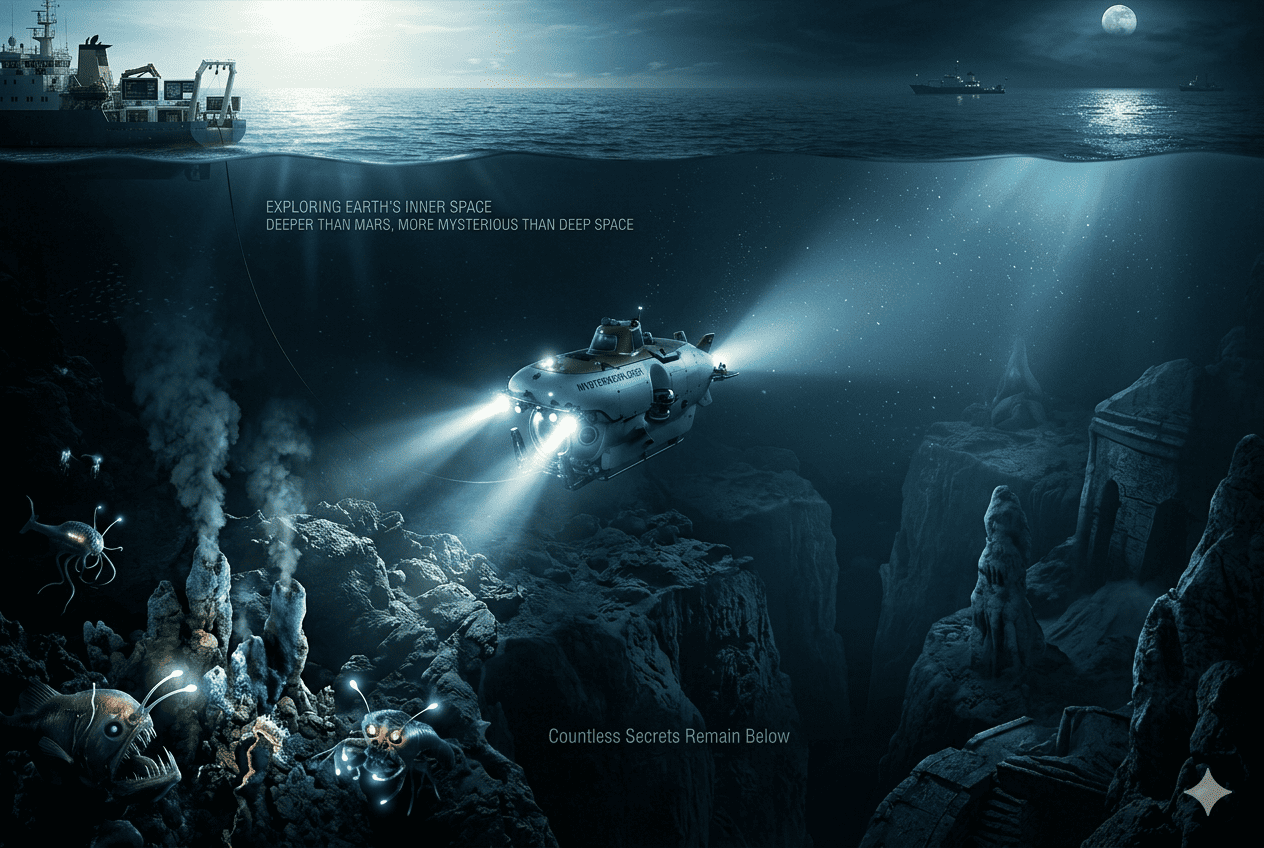
🌊 The Ocean Is Still More Mysterious Than Space — And Scientists Still Don’t Know What’s Hiding Deep Below
🌍 Humans have walked on the Moon, sent probes beyond the solar system, and photographed distant galaxies — yet most of Earth’s oceans remain unexplored.
By Admin
When people think about the greatest mysteries of the universe, they usually imagine distant planets, black holes, alien life, or deep space.
But one of the biggest unknown worlds is actually much closer.
Right here on Earth.
The ocean covers more than 70% of our planet, shapes global climate, produces much of the oxygen we breathe, feeds billions of people, and controls weather systems worldwide.
Yet despite all modern technology, scientists estimate that humans have explored only a very small percentage of the deep ocean in detail.
In simple words: humanity understands the surface of Mars better than the deepest parts of Earth’s oceans.
That fact alone sounds unbelievable.
But it is true.
And the deeper scientists go beneath the ocean surface, the stranger things become.
🧭 Why Exploring the Deep Ocean Is So Difficult
Many people assume exploring the ocean should be easier than exploring space.
After all, the ocean is right here on Earth.
But the reality is surprisingly different.
The deep ocean is one of the most hostile environments humans have ever encountered.
A few hundred meters below the surface, sunlight begins disappearing completely.
At extreme depths, pressure becomes enormous.
In some ocean trenches, the pressure is more than 1,000 times greater than atmospheric pressure at sea level.
That amount of force can crush ordinary equipment instantly.
Temperatures near the deep seafloor are also extremely cold, often close to freezing.
Communication becomes difficult.
Navigation becomes difficult.
Visibility becomes nearly impossible.
Unlike space, where radio communication works relatively well, water interferes heavily with signals.
This makes deep-sea exploration incredibly expensive, technically challenging, and dangerous.
That is one reason scientists have explored only a small fraction of the ocean in detail.
🌌 The Ocean Contains Entire Worlds Humans Rarely See
Most people imagine the ocean as fish, coral reefs, and beaches.
But the deep sea is completely different.
Far below sunlight, scientists have discovered strange ecosystems that seem almost alien.
Some deep-sea creatures produce their own light through a process called bioluminescence.
Others survive near hydrothermal vents where superheated water rich in minerals erupts from beneath the seafloor.
These environments are so extreme that scientists once believed life could not survive there.
Yet entire ecosystems thrive around them.
Some creatures discovered in the deep ocean look unlike anything found near the surface.
Transparent animals.
Giant squid.
Fish with glowing bodies.
Creatures with enormous jaws and needle-like teeth.
Some species remain so rarely seen that scientists still know very little about their behavior or population sizes.
Every major deep-sea expedition continues revealing new organisms never documented before.
That means there may still be thousands — perhaps millions — of unknown marine species waiting to be discovered.
🦑 The Giant Squid Was Once Considered a Myth
For centuries, sailors told stories about enormous tentacled sea monsters attacking ships.
Many people dismissed these stories as exaggerated myths.
But eventually, scientists confirmed the existence of the giant squid.
Some giant squids can grow longer than a bus.
Because they live deep underwater, humans rarely encounter them naturally.
For many years, scientists had only dead specimens washed onto beaches.
It was not until modern underwater cameras and deep-sea technology improved that researchers captured footage of giant squids alive in their natural environment.
This is an important reminder:
Sometimes the ocean sounds fictional simply because humans know so little about it.
🌋 The Ocean Floor Is Geologically Alive
The seafloor is not calm or inactive.
In fact, it is constantly changing.
Deep beneath the oceans, tectonic plates move slowly across Earth’s surface.
This movement creates underwater volcanoes, earthquakes, mountain ranges, and massive trenches.
Most people do not realize that the longest mountain range on Earth is actually underwater.
It is called the Mid-Ocean Ridge system, stretching roughly 65,000 kilometers across the planet.
Volcanic activity beneath the ocean also plays a major role in shaping Earth’s geology and climate over long periods.
Some underwater eruptions are powerful enough to create entirely new islands.
Others trigger tsunamis capable of devastating coastal regions.
The deep ocean is not a silent empty space.
It is a dynamic living system constantly reshaping the planet.
🌡️ The Ocean Controls Earth’s Climate More Than Most People Realize
The ocean acts like a giant planetary engine.
It absorbs heat, stores carbon dioxide, moves weather systems, and helps regulate global temperatures.
Ocean currents transport warm and cold water around the world, influencing rainfall, storms, and seasonal climate patterns.
Without oceans, Earth’s climate would become far more unstable.
Scientists also study the deep ocean to better understand climate change.
Large amounts of heat trapped by greenhouse gases are absorbed by the oceans.
This affects marine ecosystems, sea levels, and weather behavior globally.
Melting polar ice, warming waters, and changing ocean chemistry are already impacting fish populations and coral reefs in many regions.
Understanding the oceans is therefore not only about curiosity.
It is essential for understanding the future of human civilization itself.
🛰️ Why Scientists Compare Ocean Exploration to Space Exploration
Deep-sea missions often resemble space missions in surprising ways.
Researchers use specialized submarines, robotic vehicles, advanced cameras, pressure-resistant equipment, and remote-operated systems.
Some deep-sea vehicles are engineered with technology similar to spacecraft.
Astronauts and deep-sea explorers even face similar psychological challenges:
- Isolation
- Extreme environments
- Limited communication
- Dependence on life-support systems
- High operational risk
In many ways, the deep ocean is Earth’s “inner space.”
Both environments remain dangerous, expensive, and difficult to study.
That is why ocean exploration continues attracting scientists, engineers, and researchers from around the world.
🐠 Entire Species May Disappear Before Humans Discover Them
One of the saddest realities of marine science is that some ocean species may go extinct before humans even know they exist.
Pollution, overfishing, plastic waste, deep-sea mining, and climate change are increasingly affecting marine ecosystems.
Many deep-sea habitats remain poorly studied.
Scientists worry that industrial activity could damage sensitive ecosystems long before researchers fully understand them.
Plastic pollution has become especially widespread.
Microplastics have now been detected in deep ocean environments, marine animals, and even remote regions once considered untouched.
This highlights an uncomfortable truth:
Human activity now affects parts of Earth that humans rarely even see.
🔦 Some Ocean Sounds Still Confuse Scientists
Over the years, underwater microphones have captured mysterious sounds deep in the ocean.
Some were eventually explained as ice movement, volcanic activity, or marine animals.
Others remained unexplained for years.
One famous example was a mysterious sound known as “The Bloop,” detected in the Pacific Ocean during the 1990s.
The sound was so powerful that some people speculated about unknown sea creatures.
Scientists later concluded it was most likely caused by ice-related geological activity.
Still, stories like these capture public imagination because the deep ocean remains so mysterious.
People are naturally fascinated by places humans rarely reach.
🚢 The Future of Ocean Exploration Could Change Science Forever
Technology is improving rapidly.
Artificial intelligence, autonomous underwater drones, advanced sonar systems, and robotic submarines are helping scientists explore deeper and more efficiently than ever before.
Future discoveries could reshape understanding of:
- Marine biology
- Climate science
- Medicine
- Earth’s geology
- Evolution
- Extreme life environments
Some researchers even believe studying deep-sea organisms may help scientists develop future medicines, antibiotics, and biotechnology.
Creatures living under extreme pressure and darkness have evolved unique biological systems that science is only beginning to understand.
The deep ocean may hold scientific discoveries humanity has not even imagined yet.
🤯 Why Humans Are So Fascinated by the Deep Sea
Part of the fascination comes from mystery itself.
Humans are naturally curious about unknown places.
The deep ocean represents one of the last truly unexplored frontiers on Earth.
Unlike mountains, deserts, forests, or cities, most people will never personally see the deep sea.
That distance creates imagination.
And imagination creates wonder.
The ocean reminds humanity that despite all technological progress, there are still enormous parts of our own planet we barely understand.
In a world where satellite maps and smartphones make almost everything instantly visible, true mystery has become rare.
The deep ocean still preserves it.
✅ Conclusion
The ocean is far more than a massive body of water.
It is a living, changing, mysterious world that influences climate, supports ecosystems, shapes weather, and hides countless scientific secrets beneath its surface.
Despite incredible advances in technology, most of the deep ocean remains unexplored.
Scientists continue discovering strange creatures, unknown ecosystems, underwater volcanoes, and new geological processes that challenge human understanding.
The deeper humanity explores, the clearer one truth becomes:
Earth itself is still full of mysteries.
And some of the greatest discoveries of the future may not come from distant galaxies — but from the dark silent depths of our own oceans.