
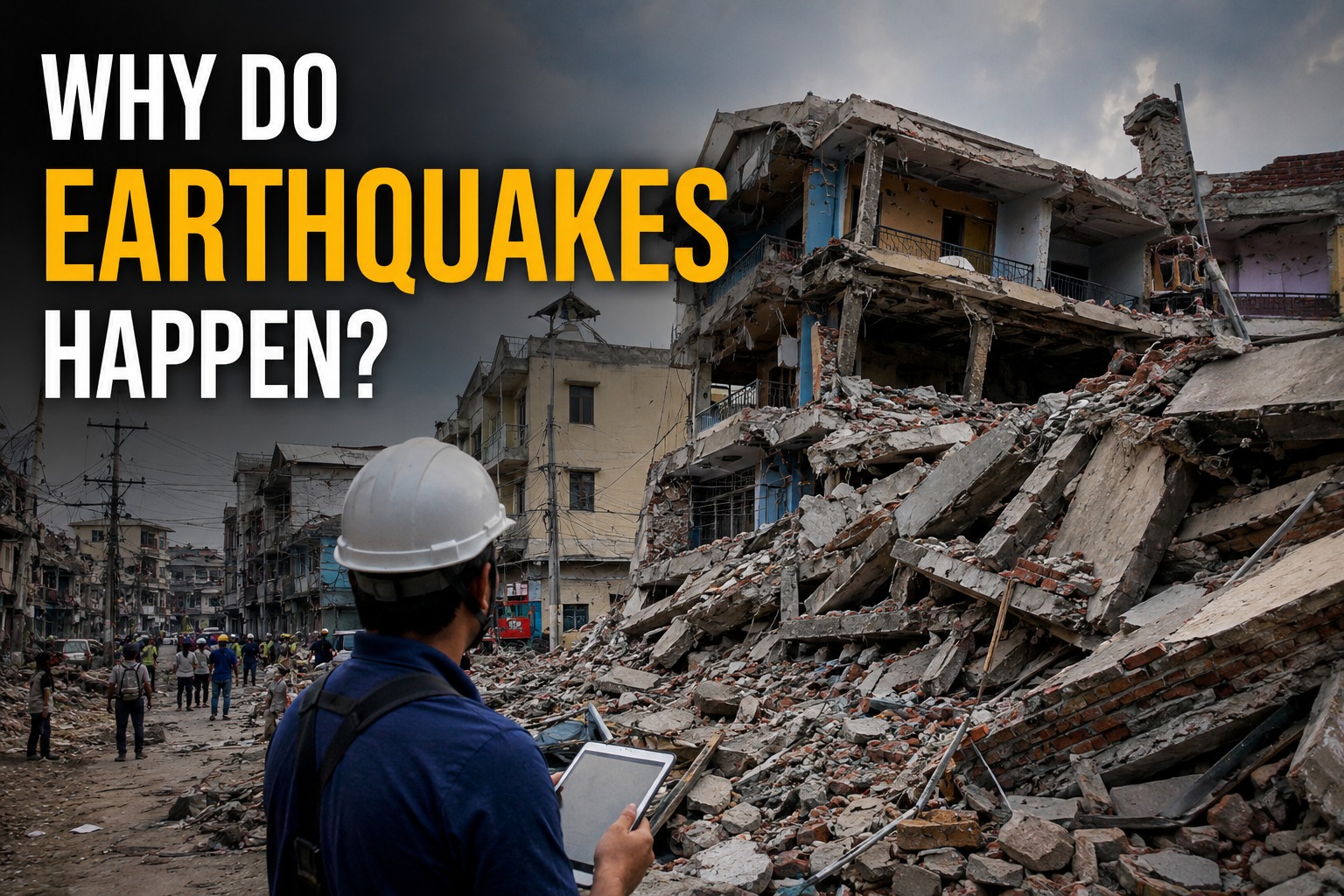
Why Do Earthquakes Happen? Geologists Explain the Real Science Behind Earth’s Powerful Tremors
Introduction
Whenever a powerful earthquake strikes, it leaves behind not only damaged buildings and tragic loss of life but also countless questions. Recent earthquakes around the world have once again reminded us of how vulnerable humans are to the forces of nature. Many people wonder why the ground suddenly begins to shake, whether earthquakes can be predicted, and if they are becoming more frequent.
The truth is that earthquakes are a natural part of how our planet works. Although modern science has significantly improved our understanding of earthquakes, they remain one of the most complex and unpredictable natural disasters. By understanding what causes them, we can better prepare for future events and reduce their impact on human life.
In this article, we explore the science behind earthquakes, how tectonic plates shape our planet, why some regions experience stronger earthquakes than others, and what experts say about earthquake prediction and safety.
What Is an Earthquake?
An earthquake is the sudden shaking of the Earth's surface caused by the rapid release of energy beneath the ground. This energy travels through the Earth in the form of seismic waves, creating vibrations that people feel as shaking.
Earthquakes can last anywhere from a few seconds to several minutes. While many are so small that they go unnoticed, larger earthquakes can destroy buildings, roads, bridges, and critical infrastructure within moments.
The location where the energy is first released underground is called the focus or hypocenter, while the point directly above it on the Earth's surface is known as the epicenter.
Understanding Earth's Structure
To understand earthquakes, it helps to know a little about the Earth's structure.
Our planet consists of several layers:
- The crust
- The mantle
- The outer core
- The inner core
The Earth's crust, along with the uppermost part of the mantle, forms a rigid shell called the lithosphere. Instead of being one solid piece, this layer is broken into massive sections called tectonic plates.
These plates fit together like a giant puzzle covering the entire planet.
What Are Tectonic Plates?
Geologists explain that Earth's outer shell is divided into several major and many smaller tectonic plates. These enormous slabs of rock constantly move, although very slowly.
Most tectonic plates move only a few centimeters each year—roughly the same speed that human fingernails grow.
Even though this movement is extremely slow, the plates are incredibly massive. As they move, they interact with one another in different ways, creating stress deep beneath the Earth's surface.
Eventually, that stress becomes too great, and the rocks suddenly break or slip. The enormous amount of stored energy is released instantly, producing an earthquake.
Why Do Tectonic Plates Move?
The movement of tectonic plates is driven by heat generated deep inside the Earth.
The Earth's interior remains extremely hot due to leftover heat from its formation and radioactive decay occurring within the mantle.
This heat creates convection currents inside the mantle. Hot material rises while cooler material sinks, creating a slow but continuous circulation that pushes and pulls tectonic plates across the planet.
Although these movements are slow, they have shaped continents, oceans, mountains, and valleys over hundreds of millions of years.
The Three Main Types of Plate Boundaries
Earthquakes usually occur where tectonic plates meet. There are three primary types of plate boundaries.
1. Convergent Boundaries
At convergent boundaries, two plates move toward each other.
Sometimes one plate slides beneath another in a process called subduction. This builds enormous pressure underground, often leading to some of the world's strongest earthquakes.
These zones are also responsible for many volcanic eruptions.
2. Divergent Boundaries
At divergent boundaries, plates move away from each other.
As they separate, magma rises from below and forms new crust. Earthquakes here are generally smaller but occur regularly.
Most of these earthquakes happen beneath the oceans along mid-ocean ridges.
3. Transform Boundaries
Transform boundaries occur when two plates slide horizontally past one another.
The edges often become locked due to friction while the plates continue trying to move.
Eventually, the pressure exceeds the strength of the rocks, causing a sudden slip that releases massive energy as an earthquake.
Some of the world's most famous earthquake zones exist along transform faults.
Why Are Some Earthquakes So Powerful?
The strength of an earthquake depends on several important factors.
First, the amount of stress stored between tectonic plates determines how much energy is released.
Second, the length of the fault that breaks affects the earthquake's magnitude.
Third, shallow earthquakes usually cause more severe damage because the seismic waves have less distance to travel before reaching the surface.
Finally, local ground conditions also matter. Soft soils often amplify shaking compared to solid bedrock, increasing damage in populated areas.
How Earthquakes Are Measured
Scientists measure earthquakes using two important scales.
Magnitude
Magnitude measures the amount of energy released during an earthquake.
Today, geologists primarily use the Moment Magnitude Scale (Mw) because it provides accurate measurements for both small and extremely large earthquakes.
Each whole-number increase represents roughly 32 times more released energy.
For example, a magnitude 7.0 earthquake releases about 32 times more energy than a magnitude 6.0 event.
Intensity
Intensity measures how strongly people experience the earthquake at different locations.
The same earthquake may produce severe shaking near the epicenter while causing only light vibrations hundreds of kilometers away.
Why Can't Scientists Predict Earthquakes?
One of the most common questions is whether earthquakes can be predicted.
Despite decades of research and major technological advances, scientists cannot accurately predict the exact date, time, and location of a future earthquake.
Researchers continuously monitor:
- Ground movement
- Seismic activity
- GPS measurements
- Satellite observations
- Changes in underground stress
These tools help estimate long-term earthquake risk but cannot forecast individual earthquakes with certainty.
Instead of prediction, experts focus on preparedness and early warning systems.
What Is an Earthquake Early Warning System?
Although earthquakes cannot be predicted in advance, some countries have developed early warning systems.
These systems detect the first fast-moving seismic waves immediately after an earthquake begins.
Because slower, more destructive waves arrive later, people farther away may receive a warning several seconds before strong shaking starts.
Those few seconds can allow people to:
- Take cover
- Stop trains
- Shut down industrial machinery
- Pause surgeries
- Reduce accidents
Countries like Japan, Mexico, and parts of the United States have invested heavily in these technologies.
Are Earthquakes Becoming More Common?
Many people believe earthquakes are increasing worldwide because they hear about them more often.
In reality, scientists say the overall number of earthquakes has remained relatively stable over long periods.
What has changed is our ability to detect and report them.
Thousands of sensitive seismic stations now operate across the globe, recording even very small earthquakes that would have gone unnoticed decades ago.
Additionally, modern communication and social media spread earthquake news almost instantly.
Can Humans Cause Earthquakes?
While most earthquakes are completely natural, certain human activities can trigger smaller earthquakes.
These include:
- Large reservoir construction behind dams
- Deep wastewater injection
- Geothermal energy projects
- Mining operations
- Oil and gas extraction
These are called induced earthquakes.
They are generally much smaller than major tectonic earthquakes but remain an active area of scientific research.
How Can People Stay Safe During an Earthquake?
Although earthquakes cannot be prevented, preparation saves lives.
Experts recommend securing heavy furniture, preparing emergency kits, identifying safe places inside buildings, and practicing earthquake drills.
During shaking, the widely recommended advice is:
Drop, Cover, and Hold On.
Stay away from windows, protect your head and neck, and avoid elevators until the shaking stops.
Afterward, remain alert for aftershocks, inspect buildings carefully, and follow instructions from local emergency authorities.
The Importance of Earthquake-Resistant Construction
One of the biggest lessons from major earthquakes is that buildings—not earthquakes themselves—cause most fatalities.
Modern engineering has developed earthquake-resistant construction techniques that help structures absorb and dissipate seismic energy.
Countries with strict building codes often experience significantly fewer casualties even during powerful earthquakes.
Investing in stronger infrastructure remains one of the most effective ways to reduce earthquake-related deaths.
Conclusion
Earthquakes are a natural consequence of our dynamic planet. Deep beneath our feet, tectonic plates are constantly moving, slowly building stress that is eventually released through sudden ruptures in the Earth's crust. While these movements cannot be stopped or precisely predicted, science has dramatically improved our understanding of how earthquakes occur and how their impact can be minimized.
Rather than fearing earthquakes, societies benefit most from education, preparedness, resilient infrastructure, and advanced monitoring systems. As research continues to evolve, geologists hope to improve early warning capabilities and deepen our understanding of Earth's powerful geological processes. Until then, awareness and preparation remain our strongest defenses against one of nature's most formidable forces.