
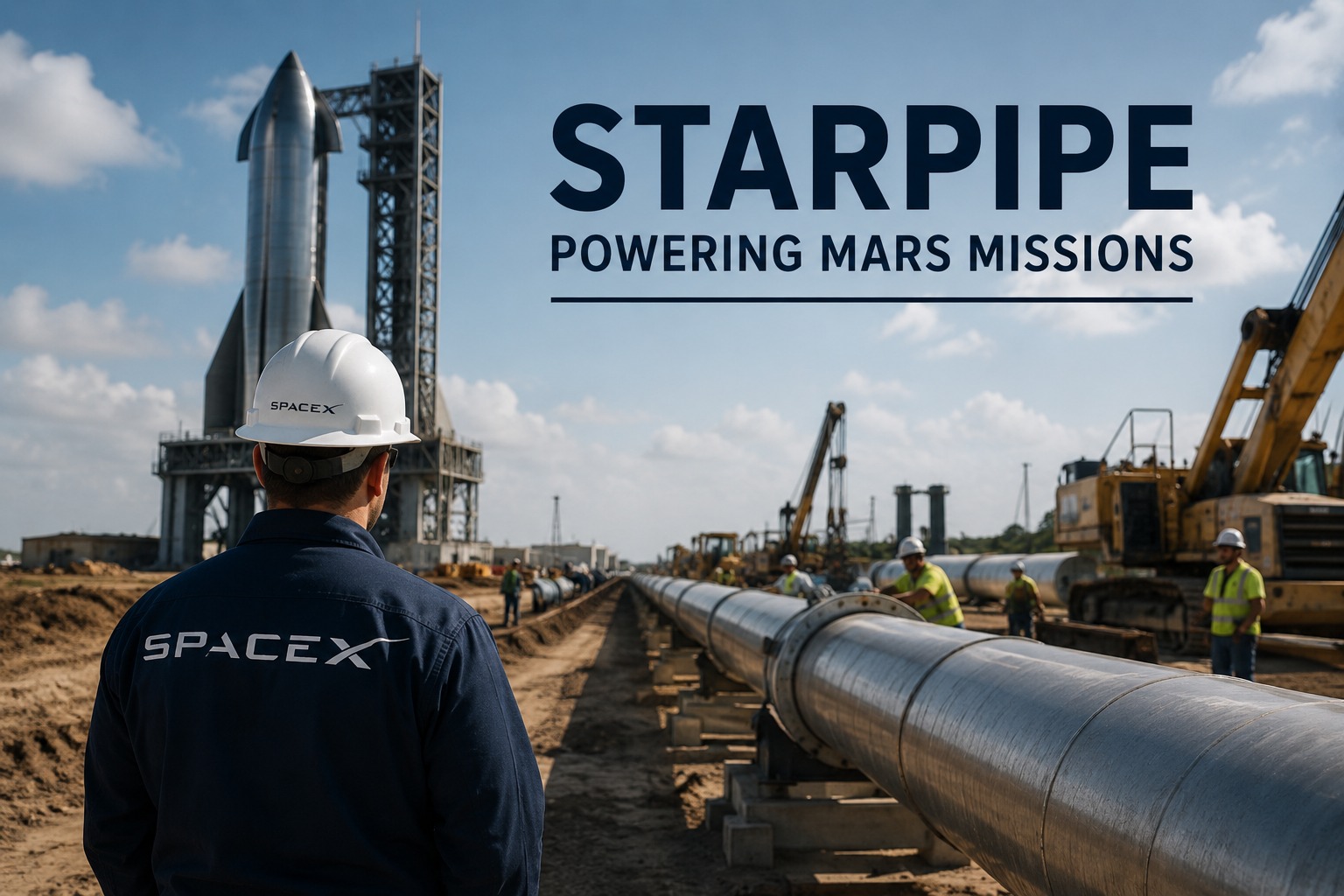
SpaceX’s Starpipe Project: How a New Fuel Pipeline Could Support Future Mars Missions
SpaceX is taking another significant step toward its long-term goal of sending humans to Mars. The company has proposed building a nearly 13-kilometer natural gas pipeline in Texas to improve the fuel supply system for its Starship rocket program. Known as Starpipe, this infrastructure project may not be as visually exciting as a rocket launch, but it could become one of the most important components behind SpaceX’s future missions.
Documents submitted to the Texas Railroad Commission indicate that the pipeline will connect directly to SpaceX’s Starbase launch facility, with construction expected to begin soon. If completed as planned, Starpipe could streamline fuel delivery, increase launch efficiency, and support the rapid testing schedule required for Starship development.
This project highlights an important reality of modern space exploration: groundbreaking missions rely not only on advanced spacecraft but also on robust infrastructure on the ground.
Why SpaceX Needs a Dedicated Fuel Pipeline
Building a reusable spacecraft capable of reaching Mars requires an enormous amount of fuel. Every Starship launch consumes vast quantities of cryogenic propellants, and frequent testing means these supplies must be delivered safely, reliably, and efficiently.
Traditionally, fuel is transported by tanker trucks or temporary storage systems. While these methods work for occasional launches, they become increasingly inefficient as launch frequency grows.
A dedicated natural gas pipeline offers several advantages:
- Continuous fuel supply
- Lower transportation costs
- Reduced road traffic around Starbase
- Improved operational safety
- Faster launch preparation
For a company aiming to launch Starship regularly, investing in permanent infrastructure makes practical and economic sense.
Understanding the Starpipe Project
According to publicly available planning documents, Starpipe is expected to stretch approximately 13 kilometers and connect SpaceX’s Starbase facility with an existing natural gas network in Texas.
Natural gas transported through the pipeline will not be used directly inside the rocket. Instead, it serves as a critical raw material for producing liquid methane, one of the two propellants used by Starship.
The pipeline will become part of a much larger fueling system that includes:
- Natural gas transportation
- Methane production facilities
- Cryogenic storage tanks
- Fuel processing equipment
- Launch pad fueling infrastructure
Together, these systems ensure that Starship has access to the large amounts of propellant required for repeated launches.
Why Starship Uses Methane Instead of Traditional Rocket Fuel
Unlike older rockets that relied on kerosene-based fuels, Starship is powered by SpaceX’s Raptor engines, which burn liquid methane (CH₄) and liquid oxygen (LOX).
This fuel combination offers several important benefits.
Higher Engine Efficiency
Methane burns more cleanly than kerosene, producing less carbon buildup inside the engines. Cleaner engines are easier to inspect, maintain, and reuse after each flight.
Better for Rapid Reusability
SpaceX's vision depends on rockets flying repeatedly, much like commercial airplanes. Cleaner-burning methane supports faster refurbishment between launches.
Suitable for Mars Missions
Perhaps the biggest advantage is that methane can potentially be manufactured on Mars using local resources.
Future astronauts could produce methane by combining carbon dioxide from the Martian atmosphere with hydrogen extracted from water ice. This process, known as the Sabatier reaction, could allow Starships to refuel on Mars before returning to Earth.
That possibility makes methane one of the most strategic fuel choices for interplanetary travel.
How Starpipe Fits Into SpaceX’s Mars Vision
Elon Musk has repeatedly stated that the ultimate objective of SpaceX is establishing a self-sustaining human settlement on Mars.
Achieving that goal requires much more than designing powerful rockets.
SpaceX must also create an industrial-scale launch system capable of supporting:
- Frequent cargo missions
- Human transportation
- Satellite deployment
- Orbital refueling operations
- Deep-space exploration
Each Starship launch demands hundreds of tons of propellant.
If dozens—or eventually hundreds—of launches are required every year, fuel logistics become one of the biggest operational challenges.
Starpipe helps solve this challenge by creating a permanent energy supply route that supports continuous rocket operations.
Supporting Rapid Starship Testing
Starship remains under active development, with SpaceX conducting frequent integrated flight tests and engine firings at Starbase.
Every test provides valuable engineering data, but each also requires large quantities of fuel.
Without reliable infrastructure, launch schedules can become limited by fuel transportation capacity rather than engineering readiness.
A dedicated pipeline allows engineers to focus on improving the spacecraft rather than managing fuel deliveries.
This becomes increasingly important as SpaceX accelerates testing toward operational missions.
Economic Benefits of the Pipeline
Although Starpipe is primarily designed for SpaceX operations, projects of this scale often generate broader economic benefits.
Construction may create temporary employment opportunities in engineering, manufacturing, transportation, and pipeline installation.
Long-term infrastructure investments can also encourage additional industrial development around the growing Starbase region.
Texas has already become one of the world's leading centers for commercial spaceflight, and continued investment strengthens its position within the expanding private space industry.
Environmental Considerations
Infrastructure projects involving natural gas inevitably raise environmental questions.
Pipeline construction requires environmental reviews to assess potential impacts on local ecosystems, wildlife habitats, wetlands, and nearby communities.
Regulators typically evaluate:
- Construction methods
- Leak prevention systems
- Emergency response planning
- Environmental protection measures
- Long-term monitoring requirements
Supporters argue that permanent pipelines reduce emissions associated with thousands of fuel transport truck trips.
Critics, however, emphasize the importance of minimizing ecological disruption during construction and ensuring long-term operational safety.
Balancing industrial development with environmental responsibility remains an important part of the approval process.
Regulatory Approval Process
Before construction begins, projects like Starpipe must undergo regulatory review.
The Texas Railroad Commission oversees many aspects of pipeline permitting, ensuring compliance with state regulations governing safety and infrastructure development.
Additional federal or local environmental requirements may also apply depending on the pipeline’s route and surrounding protected areas.
Regulatory approval helps ensure that engineering standards, public safety, and environmental protections are properly addressed before construction starts.
How Starpipe Could Improve Launch Efficiency
One of the most valuable aspects of Starpipe is operational efficiency.
Instead of coordinating dozens of tanker deliveries before every launch campaign, fuel production facilities can receive a continuous natural gas supply through the pipeline.
This simplifies logistics in several ways:
- More predictable fuel availability
- Faster preparation between launches
- Reduced transportation bottlenecks
- Lower operational costs
- Improved launch scheduling flexibility
As Starship transitions from experimental testing toward commercial operations, these efficiencies become increasingly valuable.
Preparing for High-Frequency Spaceflight
SpaceX's long-term strategy involves making spaceflight routine rather than rare.
Future Starship operations may include:
- Satellite launches
- NASA missions
- Lunar cargo deliveries
- Human Moon landings
- Mars cargo flights
- Commercial space transportation
Supporting this vision requires infrastructure capable of handling frequent launches.
Starpipe represents one piece of that larger system, alongside launch towers, propellant production facilities, engine manufacturing, and spacecraft assembly operations.
Infrastructure investments often receive less public attention than rocket launches, but they are essential for sustaining large-scale space programs.
Challenges Ahead
While the project appears promising, several challenges remain.
Construction timelines can change due to permitting requirements, environmental reviews, engineering adjustments, or weather conditions.
Additionally, SpaceX continues refining Starship itself, and future vehicle upgrades may influence fuel demands or operational planning.
Nevertheless, developing permanent fueling infrastructure demonstrates confidence in the long-term future of Starship.
Rather than preparing for only occasional test flights, SpaceX appears to be building the foundation for an operational launch system capable of supporting ambitious exploration goals.
What This Means for the Future of Mars Exploration
Sending humans to Mars is one of the most complex engineering challenges ever attempted.
Success depends not only on powerful rockets but also on creating reliable systems that support repeated launches, efficient fuel production, and sustainable operations.
The proposed Starpipe pipeline reflects this broader strategy.
Instead of focusing solely on spacecraft, SpaceX is investing in the behind-the-scenes infrastructure needed to make regular interplanetary missions possible.
As Starship development continues, projects like Starpipe could become just as important as the rockets themselves.
Conclusion
The proposed Starpipe natural gas pipeline represents far more than a simple construction project. It is a strategic investment in the infrastructure required to support SpaceX’s ambitious Starship program and its long-term vision of reaching Mars.
By providing a reliable fuel supply, improving operational efficiency, reducing logistical challenges, and supporting rapid launch schedules, the pipeline could play a key role in transforming Starship from an experimental spacecraft into a fully operational transportation system.
While regulatory approvals and environmental considerations remain part of the process, Starpipe demonstrates that successful space exploration depends on strong foundations here on Earth. As SpaceX continues pushing the boundaries of reusable rocket technology, supporting infrastructure like Starpipe may become one of the defining elements that enables humanity’s next giant leap toward becoming a multi-planetary civilization.