
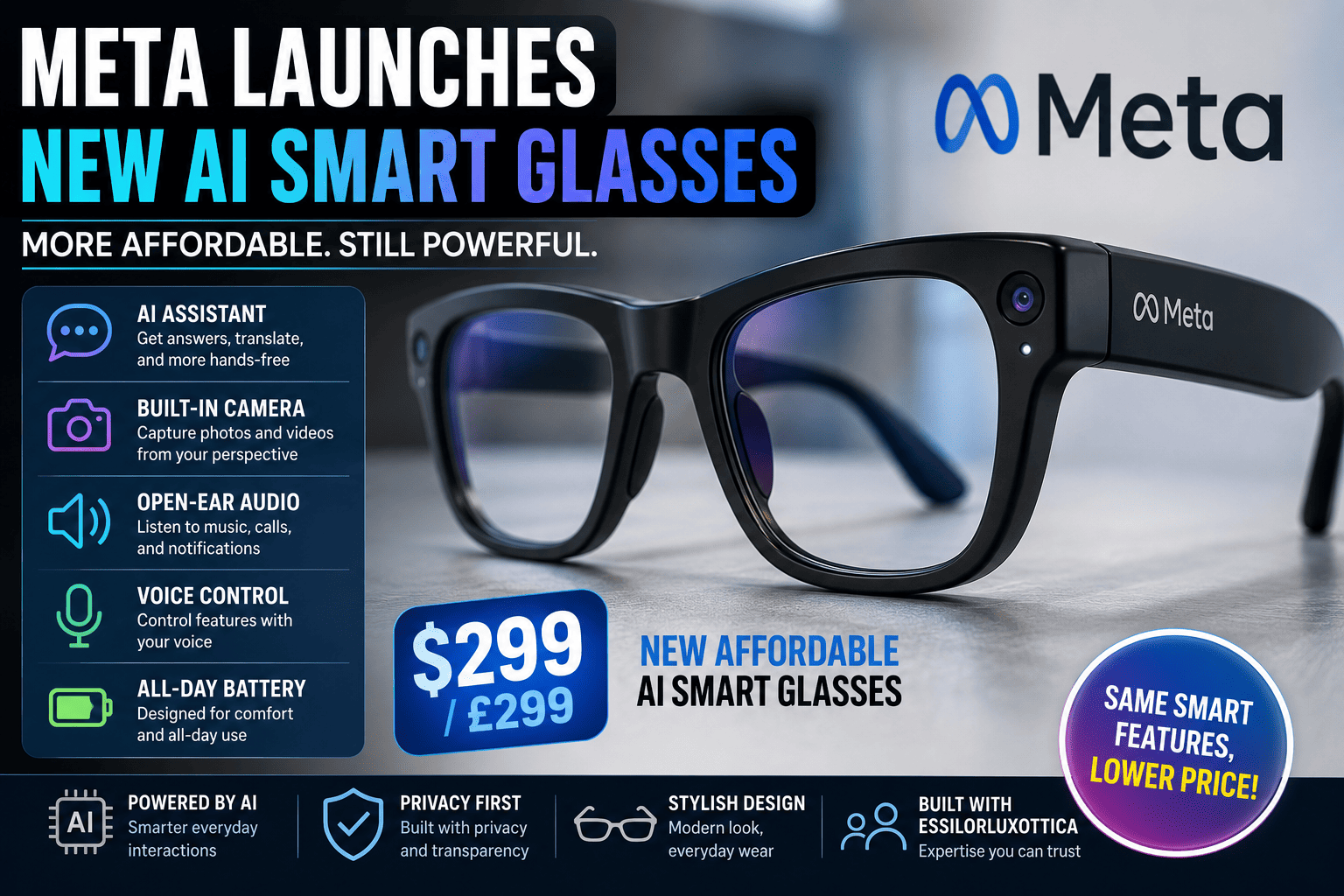
👓 Meta Launches a More Affordable AI Smart Glasses: Same Smart Features, Lower Price
The tech giant is making AI-powered wearable technology more accessible with a new budget-friendly smart glasses model.
By Admin
Artificial intelligence is rapidly finding its way into everyday devices, from smartphones and laptops to home assistants. Now, Meta is pushing that vision even further by introducing a new and more affordable version of its AI-powered smart glasses.
The company has officially unveiled a lower-cost model of its controversial yet increasingly popular smart eyewear, aiming to bring advanced wearable technology to a wider audience. Despite the reduced price, the new smart glasses retain most of the features that made Meta's previous models stand out in the growing wearable tech market.
As competition intensifies in the AI hardware industry, Meta's latest move signals that smart glasses may soon become a mainstream technology rather than a niche gadget.
🚀 A New Chapter for Meta's Smart Glasses
Meta has partnered once again with eyewear giant EssilorLuxottica, the company behind some of the world's most recognizable eyewear brands.
Previous generations of Meta's smart glasses were marketed under famous labels such as Ray-Ban and Oakley. These devices combined stylish traditional eyewear designs with modern technology, allowing users to take photos, record videos, listen to audio, and interact with AI features without reaching for a smartphone.
This time, however, Meta is taking a different approach.
Rather than relying on an established eyewear brand, the company is promoting the new device under its own Meta branding, signaling growing confidence in its wearable technology ecosystem.
💰 Lower Price, Similar Technology
One of the biggest highlights of the new smart glasses is the price.
Meta has set the price at $299 (£299), making it approximately $80 cheaper than some of the Ray-Ban smart glasses currently available.
In a market where advanced technology products often become more expensive with each generation, Meta's decision to reduce the entry price is notable.
More importantly, the lower cost does not appear to come with major sacrifices.
According to Meta, the glasses still offer many of the intelligent features users have come to expect from its wearable devices.
This strategy could help attract consumers who were interested in smart glasses but hesitant to spend more than $350 on a wearable gadget.
🤖 What Makes AI Smart Glasses Different?
Unlike traditional glasses, AI-powered smart glasses combine wearable hardware with intelligent software.
Modern smart glasses can perform several tasks, including:
- Taking photos and videos hands-free
- Playing music and podcasts
- Making phone calls
- Providing voice-controlled assistance
- Translating conversations
- Answering questions using AI
- Reading notifications aloud
- Capturing moments without using a smartphone
The goal is to make technology feel more natural and less dependent on constantly looking at a screen.
Meta believes that wearable AI devices represent the next major computing platform after smartphones.
📸 The Evolution of Meta's Smart Eyewear
Meta's journey into smart glasses began in 2021 with the launch of Ray-Ban Stories.
At the time, the concept attracted significant attention because it successfully integrated cameras and speakers into ordinary-looking sunglasses.
Unlike earlier smart glasses that often looked bulky or futuristic, Ray-Ban Stories maintained a stylish appearance while introducing useful digital features.
In 2023, Meta introduced a major upgrade.
The newer generation featured:
✅ Improved cameras
✅ Better audio quality
✅ Enhanced microphones
✅ More powerful AI integration
✅ Faster performance
These upgrades transformed the glasses from an experimental gadget into a genuinely useful wearable device.
The latest affordable model builds on those advancements while lowering the cost barrier.
⚠️ Why Meta's Smart Glasses Remain Controversial
Despite their growing popularity, Meta's smart glasses have sparked ongoing privacy concerns.
The presence of built-in cameras means people nearby may not always realize when photos or videos are being captured.
Privacy advocates have raised concerns about:
- Unauthorized recording
- Public surveillance
- Data collection
- Facial recognition possibilities
- User consent
Meta has attempted to address these concerns through visible recording indicators and transparency measures, but debates surrounding wearable cameras continue.
As smart glasses become more widespread, balancing convenience and privacy will remain a critical challenge.
🌍 The Bigger AI Wearables Race
Meta is not alone in pursuing the future of wearable computing.
Several major technology companies are investing heavily in AI-powered devices, including smart glasses, mixed-reality headsets, and voice-enabled wearables.
Industry experts believe the next decade could see a shift away from smartphones as the primary way people interact with technology.
Instead, users may increasingly rely on devices that integrate seamlessly into everyday life.
Smart glasses are considered one of the strongest candidates for that future because they combine:
- Visual information
- Audio communication
- AI assistance
- Hands-free interaction
all within a familiar form factor.
🔮 Could Smart Glasses Replace Smartphones?
The idea may sound ambitious today, but many technology leaders believe smart glasses could eventually handle many tasks currently performed by smartphones.
Imagine receiving directions, translating languages, answering messages, capturing photos, and interacting with AI assistants without ever taking a device out of your pocket.
While today's technology is not yet advanced enough to fully replace smartphones, each new generation of smart glasses brings the industry closer to that possibility.
Meta's lower-cost model may help accelerate consumer adoption and provide valuable feedback that shapes future designs.
🎯 Final Thoughts
Meta's new AI smart glasses represent an important step toward making wearable technology more affordable and accessible. By reducing the price while retaining many of the advanced features found in previous models, the company is positioning itself strongly in the rapidly growing AI hardware market.
Although questions about privacy and long-term adoption remain, the direction is becoming increasingly clear: wearable AI devices are no longer a futuristic concept—they are becoming part of everyday life.
Whether smart glasses eventually replace smartphones or simply complement them, Meta's latest launch shows that the race to define the future of personal technology is only getting started.