
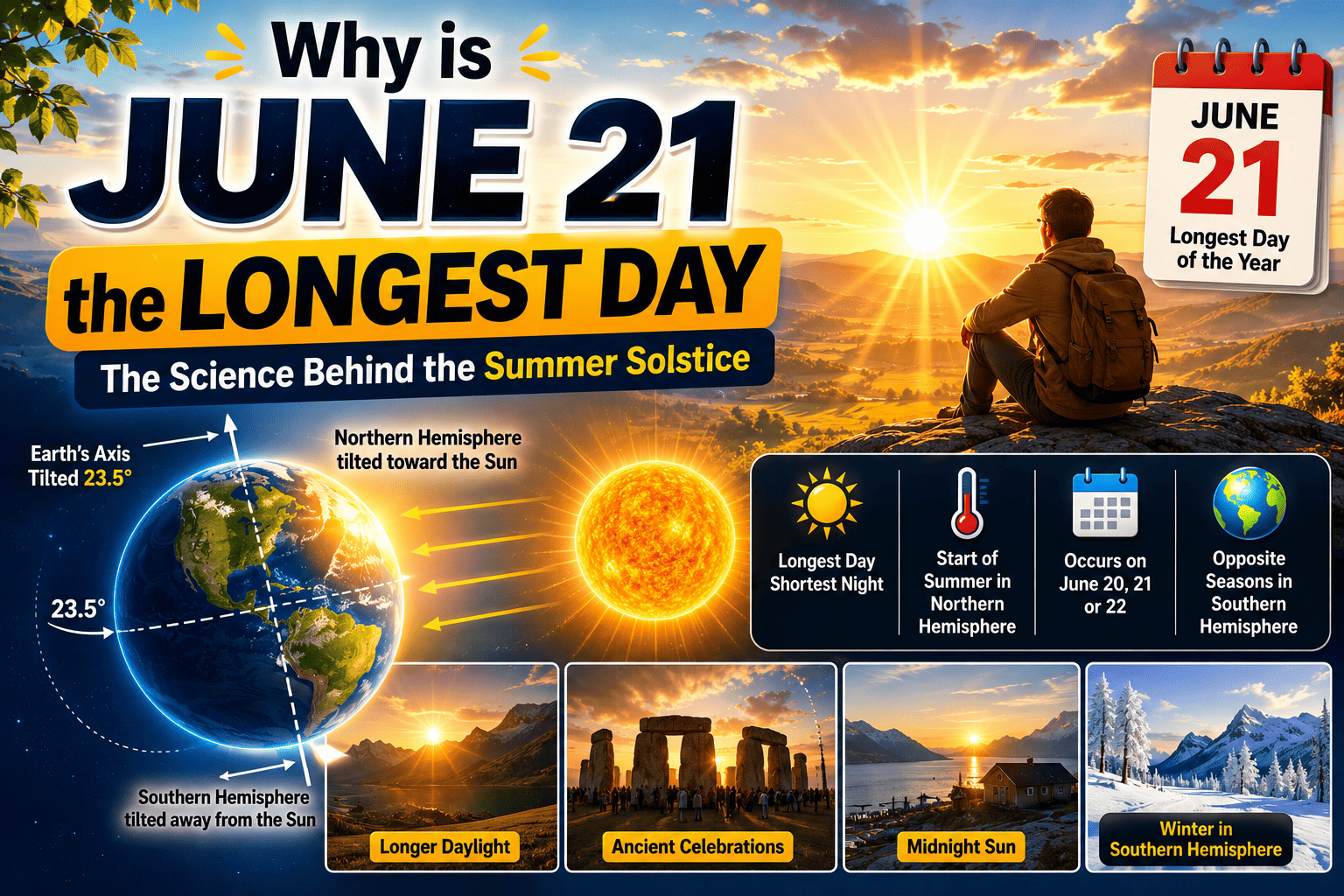
☀️ Why Is June 21 the Longest Day of the Year? The Science Behind the Summer Solstice
Every year, millions of people notice that daylight seems to last forever around June 21. But why does this happen, and what makes this date so special? The answer lies in one of Earth's most fascinating astronomical events: the Summer Solstice.
By Admin
🌎 A Day Unlike Any Other
Have you ever wondered why some days feel much longer than others?
Every year around June 21, people living across the Northern Hemisphere experience the longest day and shortest night of the year. This phenomenon is known as the Summer Solstice, an astronomical event that marks the official beginning of summer in many parts of the world.
For countries such as the United States, Canada, the United Kingdom, most of Europe, China, and Pakistan, June 21 brings the greatest amount of daylight seen all year.
While it may seem like an ordinary day, the Summer Solstice is actually the result of Earth's unique relationship with the Sun—a relationship that shapes our seasons, weather patterns, and even the length of our days.
☀️ What Exactly Is the Summer Solstice?
The word solstice comes from Latin and roughly translates to "Sun standing still."
The Summer Solstice occurs when the Sun reaches its highest apparent position in the sky relative to the Northern Hemisphere.
On this day, the Northern Hemisphere is tilted most directly toward the Sun, allowing sunlight to strike the region for the longest duration of the year.
As a result:
✅ Daylight lasts longer than any other day.
✅ The Sun appears higher in the sky at noon.
✅ Nighttime becomes shorter than usual.
This event typically occurs on June 20, 21, or 22, depending on the year and time zone.
🔭 Why Does June 21 Become the Longest Day?
The answer lies in Earth's tilt.
Many people assume that seasons occur because Earth moves closer to or farther from the Sun. In reality, the primary reason is Earth's axial tilt.
Earth rotates on an axis that is tilted approximately 23.5 degrees relative to its orbit around the Sun.
This tilt causes different parts of the planet to receive varying amounts of sunlight throughout the year.
During June:
- The Northern Hemisphere tilts toward the Sun.
- Sunlight reaches northern regions more directly.
- The Sun stays above the horizon for a longer period.
- Daylight hours increase significantly.
Without Earth's tilt, we would not experience seasons, and every day would have nearly the same amount of daylight.
🌍 Why the Northern and Southern Hemispheres Experience Opposite Seasons
One of the most fascinating aspects of the Summer Solstice is that it affects different parts of the world in completely opposite ways.
While the Northern Hemisphere enjoys its longest day and the start of summer, the Southern Hemisphere experiences:
❄️ The shortest day of the year
❄️ The longest night
❄️ The official beginning of winter
Countries such as:
- Australia
- New Zealand
- Argentina
- Chile
- South Africa
are entering winter just as northern nations are welcoming summer.
This contrast occurs because when one hemisphere tilts toward the Sun, the other tilts away from it.
🌞 The Midnight Sun: When the Sun Never Sets
The Summer Solstice creates one of the most extraordinary natural phenomena on Earth: the Midnight Sun.
In regions located near or above the Arctic Circle, the Sun can remain visible for 24 hours a day.
People living in parts of:
- Alaska
- Northern Canada
- Greenland
- Norway
- Sweden
- Finland
may experience continuous daylight for days or even weeks.
Imagine looking outside at midnight and seeing bright sunshine instead of darkness.
For many travelers, witnessing the Midnight Sun is a once-in-a-lifetime experience.
🏛️ How Ancient Civilizations Celebrated the Summer Solstice
Long before modern astronomy explained the event, ancient civilizations recognized the significance of the Summer Solstice.
Many cultures built monuments and organized festivals around the longest day of the year.
One of the most famous examples is Stonehenge in England.
Researchers believe the ancient stone structure was designed to align with the sunrise during the Summer Solstice.
Even today, thousands of people gather there annually to watch the Sun rise between the stones.
Similar celebrations existed among:
- Ancient Egyptians
- Mayans
- Romans
- Native American cultures
These societies often viewed the solstice as a symbol of life, fertility, abundance, and renewal.
🌡️ Why Isn't June 21 the Hottest Day of the Year?
This is one of the most common questions people ask.
If June 21 receives the most sunlight, why aren't temperatures at their highest?
The reason is something scientists call seasonal lag.
Earth's oceans, land, and atmosphere absorb heat gradually.
Even though the planet receives maximum sunlight around the Summer Solstice, it takes several weeks for that energy to fully warm the environment.
As a result, the hottest days of the year usually occur in:
🔥 July
🔥 August
rather than on June 21 itself.
📊 How Much Longer Is the Day?
The exact amount of daylight depends on location.
For example:
- Near the Equator, daylight remains close to 12 hours year-round.
- In Pakistan, daylight can exceed 14 hours.
- In London, daylight approaches 16.5 hours.
- In northern Scandinavia, the Sun may not set at all.
The farther north you travel, the more dramatic the effect becomes.
This is why regions near the Arctic Circle experience such extreme seasonal differences.
🚀 Why Understanding the Summer Solstice Matters
The Summer Solstice is more than an interesting astronomical event.
It reminds us that Earth is part of a complex cosmic system governed by precise physical laws.
Understanding phenomena like the Summer Solstice helps scientists:
- Study climate patterns
- Predict seasonal changes
- Improve agricultural planning
- Understand Earth's orbital dynamics
- Explore how planets behave throughout the universe
It also highlights how connected our daily lives are to the movements of celestial bodies.
Every sunrise, sunset, season, and weather pattern ultimately traces back to Earth's journey around the Sun.
🌅 Conclusion
June 21 is the longest day of the year because Earth's 23.5-degree tilt causes the Northern Hemisphere to face the Sun more directly than at any other time. This creates the Summer Solstice, bringing the greatest amount of daylight and marking the official start of astronomical summer.
From the breathtaking Midnight Sun of the Arctic to ancient monuments like Stonehenge, the Summer Solstice continues to inspire curiosity, celebration, and scientific discovery.
The next time you notice an unusually long summer evening, remember that you're witnessing a remarkable consequence of our planet's place in the cosmos—a phenomenon that has fascinated humanity for thousands of years.