
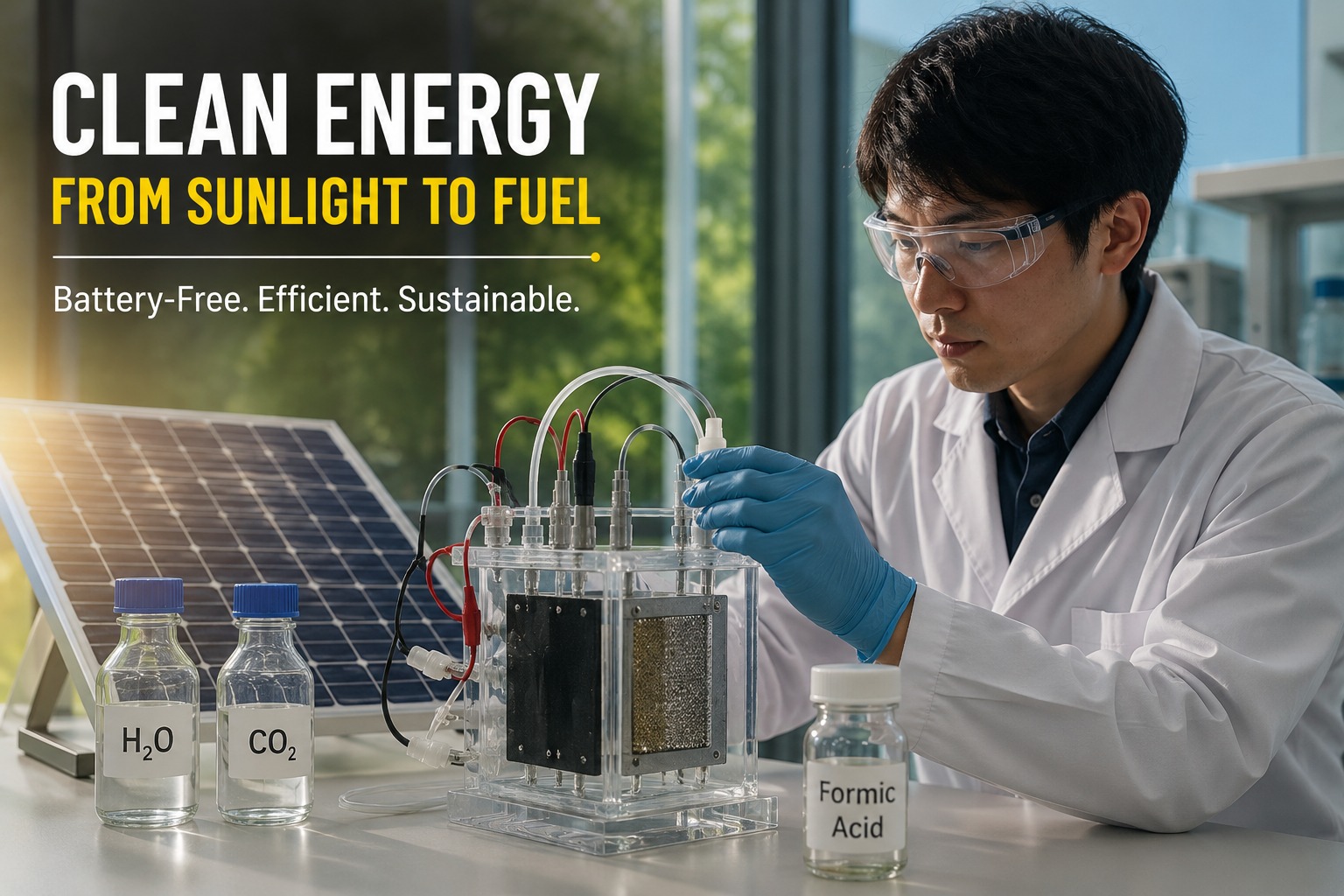
Battery-Free Artificial Photosynthesis System Could Transform the Future of Solar Fuel Production
A Breakthrough That Brings Solar Fuel Closer to Reality
As the world races to reduce carbon emissions and transition toward cleaner energy sources, scientists are exploring technologies that can go beyond traditional solar panels and wind turbines. One of the most promising concepts is artificial photosynthesis—a technology inspired by nature's ability to convert sunlight, water, and carbon dioxide into energy-rich compounds.
Now, researchers at Osaka Metropolitan University have taken a major step forward by developing a battery-free artificial photosynthesis system capable of producing usable solar fuel directly from sunlight, water, and carbon dioxide. Unlike many existing systems that require batteries, sensors, and sophisticated electronic controls, this new approach operates through a self-regulating mechanism that significantly reduces complexity and cost.
The achievement could help accelerate the adoption of solar fuels and provide a new pathway toward a low-carbon energy future.
Understanding Artificial Photosynthesis
To appreciate the significance of this breakthrough, it is important to understand what artificial photosynthesis actually means.
Plants have been performing photosynthesis for billions of years. They absorb sunlight and use it to convert water and carbon dioxide into energy-rich molecules that support life. Scientists have long sought to replicate this natural process in a technological system capable of generating clean fuels.
Artificial photosynthesis aims to mimic nature by capturing solar energy and storing it in chemical form. Instead of producing sugars like plants do, these systems create fuels such as hydrogen, methanol, or formic acid that can later be used for energy generation.
The concept is especially attractive because it addresses one of renewable energy's biggest challenges: energy storage.
Solar panels generate electricity only when sunlight is available. Artificial photosynthesis, on the other hand, converts solar energy into chemical fuel that can be stored, transported, and used whenever needed.
The Challenge Facing Existing Systems
Although artificial photosynthesis has shown tremendous potential, practical implementation has faced several obstacles.
Most current systems depend on external electronic controllers and batteries to regulate energy flow. Solar energy production fluctuates throughout the day because sunlight intensity constantly changes due to clouds, weather conditions, and the position of the sun.
These fluctuations can reduce fuel production efficiency. To overcome this problem, engineers typically add battery systems and electronic control units that help stabilize performance.
However, such additions create several disadvantages:
- Increased manufacturing costs
- Greater system complexity
- Additional maintenance requirements
- Reduced overall efficiency
- Dependence on battery technology
For large-scale deployment, these factors can become significant barriers.
Scientists therefore began searching for a simpler solution that could automatically adapt to changing sunlight conditions without relying on expensive electronics.
Osaka Metropolitan University's Innovative Solution
The research team at Osaka Metropolitan University developed a novel artificial photosynthesis system that essentially regulates itself.
Instead of using batteries and electronic control circuits, the researchers redesigned the electrolyzer—the component responsible for converting electrical energy into chemical fuel.
Their innovation allows the electrolyzer to respond naturally to environmental changes.
When sunlight intensity increases, the system warms up. This temperature change automatically alters the electrical properties of the electrolyzer, reducing its resistance and allowing electricity to flow more efficiently.
As sunlight decreases, the system adjusts accordingly.
This self-regulating behavior means the device can continuously optimize fuel production without requiring external electronic intervention.
In simple terms, the system "thinks" chemically rather than electronically.
This approach dramatically simplifies the entire process while maintaining stable performance under real-world conditions.
How the System Produces Solar Fuel
The operation of the system follows a surprisingly elegant sequence.
First, solar cells capture sunlight and generate electricity.
This electricity is then directed to the specially designed electrolyzer.
The electrolyzer uses carbon dioxide and water as raw materials and converts them into formic acid, a liquid fuel that can store energy in chemical form.
The key difference lies in the electrolyzer's ability to automatically adapt to changing sunlight conditions.
Because the system continuously adjusts itself, fuel production remains stable even when sunlight intensity fluctuates throughout the day.
This feature eliminates the need for battery-based stabilization systems while preserving efficiency.
The result is a simpler, more economical, and potentially more reliable method of producing solar fuel.
Why Formic Acid Matters
Many people are unfamiliar with formic acid, yet it is becoming increasingly important in renewable energy research.
Formic acid is a liquid chemical that can safely store hydrogen and energy. Unlike gaseous hydrogen, which requires specialized storage infrastructure, formic acid is easier to transport and handle.
Researchers view it as a promising hydrogen carrier because it can release hydrogen when needed for energy applications.
Potential uses include:
- Fuel cells
- Energy storage systems
- Industrial applications
- Renewable energy transport
- Future clean transportation technologies
Because it exists in liquid form at room temperature, formic acid offers practical advantages that could make renewable energy systems easier to deploy on a large scale.
Real-World Testing Under Natural Sunlight
Laboratory success is important, but real-world performance ultimately determines whether a technology has practical value.
The Osaka research team tested their artificial photosynthesis system outdoors under actual sunlight conditions.
The results were highly encouraging.
Even when sunlight intensity varied throughout the day, the system continued producing formic acid consistently.
This stability demonstrates that the self-regulating mechanism works effectively outside controlled laboratory environments.
Such performance is critical for future commercialization because renewable energy technologies must operate reliably under constantly changing weather conditions.
The ability to maintain fuel production without batteries or external controllers could significantly improve economic viability.
Demonstration at Expo 2025 Osaka
The technology was also showcased during Expo 2025 Osaka, where researchers demonstrated its practical capabilities.
According to the research team, the system successfully generated enough formic acid to power a miniature diorama displayed at the exhibition.
While the demonstration was relatively small in scale, it provided a tangible example of how artificial photosynthesis can convert sunlight and carbon dioxide into usable energy.
For visitors, it transformed an abstract scientific concept into something visible and understandable.
More importantly, it offered a glimpse into a future where homes and communities could potentially generate and store their own solar fuels using similar technology.
Environmental Benefits
The environmental implications of this development are substantial.
Modern society faces two interconnected challenges: reducing carbon emissions and meeting growing energy demands.
Artificial photosynthesis addresses both issues simultaneously.
The system consumes carbon dioxide, one of the primary greenhouse gases responsible for climate change.
At the same time, it generates renewable fuel using sunlight and water.
This creates a circular energy model where atmospheric carbon can be recycled into useful energy products instead of continuously accumulating in the atmosphere.
If deployed at scale, such systems could contribute to:
Reduced greenhouse gas emissions
Enhanced carbon recycling
Cleaner energy production
Greater energy independence
Lower reliance on fossil fuels
These benefits align closely with global climate goals and sustainability initiatives.
Could This Technology Power Homes in the Future?
One of the most exciting possibilities is residential energy generation.
Imagine a future home equipped with solar panels and an artificial photosynthesis unit.
During the day, sunlight would be converted into liquid fuel rather than relying solely on batteries.
The fuel could then be stored and used later for electricity generation, heating, or transportation.
Unlike conventional battery systems, chemical fuel storage could potentially offer longer storage durations and greater flexibility.
Although commercial deployment remains years away, the Osaka team's breakthrough moves this vision closer to reality.
Challenges Still Ahead
Despite the excitement surrounding this innovation, several challenges remain.
Researchers must still improve efficiency, reduce manufacturing costs, and scale the technology for larger applications.
Long-term durability testing will also be necessary to ensure reliable operation over many years.
In addition, infrastructure for solar fuels such as formic acid will need further development before widespread adoption becomes feasible.
However, these challenges are common for emerging energy technologies and are generally considered engineering problems rather than fundamental scientific barriers.
The successful demonstration of a self-regulating system suggests that many of the most difficult conceptual hurdles have already been overcome.
Conclusion
The battery-free artificial photosynthesis system developed by Osaka Metropolitan University represents a significant advancement in renewable energy technology.
By eliminating the need for batteries and complex electronic controls, the researchers have created a simpler, potentially cheaper, and more efficient way to convert sunlight, water, and carbon dioxide into usable fuel.
The technology demonstrates how nature-inspired innovation can help solve some of humanity's most pressing energy and environmental challenges.
While further development is still required before large-scale commercialization becomes possible, this breakthrough offers a compelling glimpse into a future where sunlight can be transformed directly into storable fuel through elegant, self-regulating systems.
As nations seek sustainable alternatives to fossil fuels, artificial photosynthesis may become one of the most important technologies of the clean energy transition—and this latest achievement brings that future one step closer.