
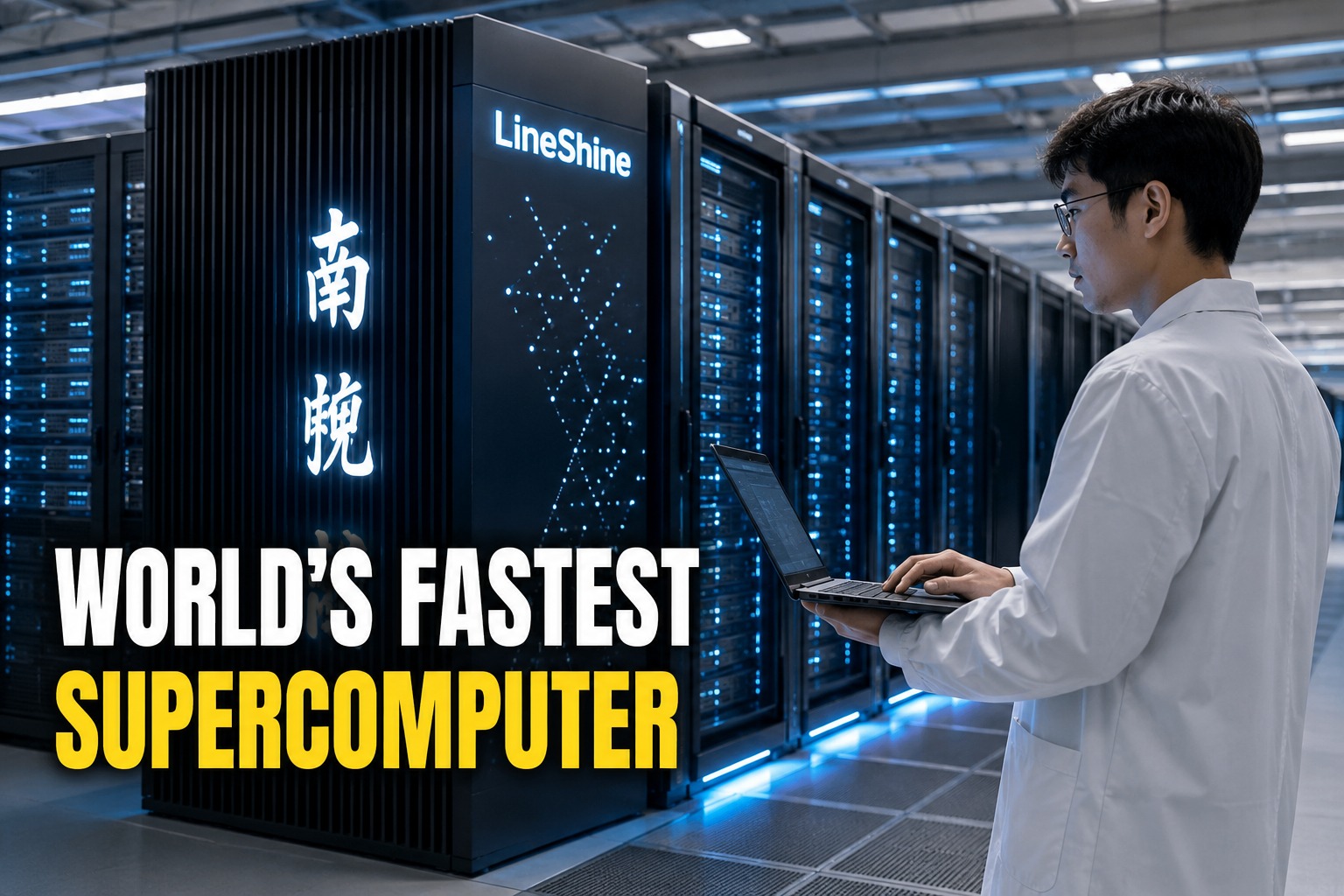
China Overtakes the United States with the World’s Most Powerful Supercomputer
How China’s LineShine Supercomputer Changed the Global Computing Race
For years, the race to build the world’s most powerful supercomputer has been viewed as a symbol of technological leadership. Nations invest billions of dollars in high-performance computing because these machines are not just about speed—they play a critical role in scientific research, artificial intelligence, climate modeling, healthcare, defense, and advanced engineering.
In a major milestone for global technology, China has reclaimed the top position in the world of supercomputing. Its newly introduced supercomputer, LineShine, has secured the number one ranking on the latest TOP500 list, surpassing the United States’ El Capitan system. This achievement marks the first time since 2017 that a Chinese supercomputer has topped the prestigious global ranking.
What makes this accomplishment even more remarkable is that LineShine was built entirely using Chinese-developed technologies, demonstrating the country's growing ability to innovate independently despite ongoing technology restrictions and export controls.
Why the TOP500 Ranking Matters
The TOP500 ranking is considered the most respected benchmark for measuring supercomputer performance worldwide. It evaluates systems based on their ability to perform complex mathematical calculations using the High-Performance Linpack (HPL) benchmark.
Although the average person may never directly interact with a supercomputer, these machines influence many aspects of modern life. They help scientists predict weather patterns, develop new medicines, study climate change, simulate nuclear reactions, and solve problems that would take ordinary computers years to process.
Being ranked number one is therefore more than a technical achievement. It reflects a nation's capability in advanced computing, semiconductor design, software engineering, and scientific research.
Meet LineShine: China’s New Computing Giant
LineShine is installed at the National Supercomputing Centre in Shenzhen and represents a new generation of Chinese high-performance computing infrastructure.
The machine achieved an impressive performance of approximately 2.2 exaflops on the HPL benchmark. To understand the scale of this achievement, an exaflop represents one quintillion calculations per second. In practical terms, LineShine can perform more than two quintillion calculations every second, making it one of the fastest computational systems ever built.
Unlike many modern supercomputers that rely heavily on GPUs for acceleration, LineShine follows a different approach. It is primarily based on Chinese-designed processors and a domestic computing architecture. This unique design demonstrates China's determination to reduce dependence on foreign technologies and build a fully self-sufficient computing ecosystem.
How LineShine Surpassed America's El Capitan
Until recently, El Capitan was considered the world's most powerful supercomputer. Located in the United States, it was developed for highly advanced scientific and national security applications.
LineShine surpassed El Capitan by delivering a higher benchmark score during TOP500 testing. While both systems belong to the elite category of exascale supercomputers, China's new machine achieved a level of sustained performance that placed it ahead in the global rankings.
This transition is significant because the United States has dominated supercomputing leadership for many years. The emergence of LineShine signals that the competitive gap between the two technological powers continues to narrow.
However, experts also point out that supercomputer rankings measure specific types of performance. Being number one on the TOP500 list does not automatically mean a system is superior in every workload, particularly modern AI training tasks, where different architectures may perform differently.
The Role of Domestic Technology in China's Success
Perhaps the most important aspect of LineShine is not its speed but how it was built.
Over the last several years, China has faced increasing restrictions on access to advanced semiconductor technologies. Many analysts believed these limitations would slow China's progress in high-performance computing.
Instead, Chinese engineers focused on developing indigenous alternatives. LineShine reportedly uses Chinese-designed processors, networking technologies, and software systems, reducing reliance on foreign suppliers.
This approach highlights a broader strategic objective: technological self-reliance.
Countries around the world have learned that access to critical technologies can become a geopolitical issue. As a result, governments are increasingly investing in domestic semiconductor manufacturing, software development, and computing infrastructure.
China's achievement demonstrates that sustained investment in local innovation can produce significant results, even under external constraints.
Why Supercomputers Matter Beyond Speed
Many people hear about supercomputers only when a new ranking is released. Yet these systems influence scientific progress in ways that are often invisible.
In healthcare, supercomputers help researchers analyze massive genetic datasets and accelerate drug discovery. During disease outbreaks, they can simulate how viruses spread and assist in developing treatments.
In climate science, researchers use supercomputers to model atmospheric conditions and predict long-term environmental changes. More accurate simulations lead to better forecasting and improved disaster preparedness.
Engineers rely on these systems to design safer aircraft, more efficient vehicles, and stronger materials. Financial institutions use advanced computing to model risk and analyze market behavior.
In short, the faster a supercomputer becomes, the more complex problems humanity can attempt to solve.
The Connection Between Supercomputing and Artificial Intelligence
One of the most interesting questions surrounding LineShine is its relationship with artificial intelligence.
Today's AI revolution is driven by enormous computational requirements. Training advanced AI models requires vast amounts of processing power, memory, and data movement.
Although LineShine excels in traditional supercomputing benchmarks, some experts note that it was not specifically optimized for AI workloads. Modern AI systems often rely heavily on specialized accelerators and GPUs that are designed for machine learning operations.
This distinction is important because the future of computing may increasingly be defined by AI performance rather than traditional scientific benchmarks alone.
Nevertheless, technologies developed for supercomputers often influence AI infrastructure. Improvements in processors, networking, memory systems, and energy efficiency can benefit both fields.
What This Means for the Global Technology Race
The success of LineShine sends a strong message to the international technology community.
First, it confirms that China remains a major force in advanced computing despite external challenges. Second, it demonstrates that innovation can emerge from alternative technological pathways rather than relying solely on established global suppliers.
For the United States, the achievement serves as a reminder that competition in high-performance computing remains intense. American laboratories and technology companies continue to lead in many areas, including AI hardware and software, but the global landscape is becoming increasingly competitive.
For other nations, the development highlights the growing importance of investing in research, education, semiconductor manufacturing, and digital infrastructure.
The future of technological leadership will likely depend not on a single breakthrough but on sustained innovation across multiple domains.
Challenges Ahead
Despite its impressive debut, LineShine also faces challenges.
Power consumption remains a major concern for all exascale systems. Running a machine capable of performing quintillions of calculations every second requires enormous amounts of electricity.
As supercomputers become larger and more powerful, energy efficiency will become just as important as raw performance.
Another challenge involves software optimization. Building powerful hardware is only part of the equation. Researchers must also develop software capable of fully utilizing the available computational resources.
The countries that succeed in balancing performance, efficiency, and usability will likely shape the next generation of computing.
Conclusion
China’s LineShine supercomputer represents a historic moment in the evolution of global technology. By overtaking America's El Capitan and securing the top position on the TOP500 ranking, China has demonstrated remarkable progress in high-performance computing.
More importantly, the achievement showcases the growing maturity of China's domestic technology ecosystem. At a time when technological independence has become a strategic priority, LineShine stands as evidence that local innovation can compete on the world stage.
While the competition between nations will continue, the real winners may ultimately be science, research, and society. Every leap in supercomputing capability expands humanity’s ability to solve complex problems, unlock new discoveries, and push the boundaries of what is possible in the digital age.