Tesla Wanted 5,000 Robotaxis in Las Vegas — Nevada Approved Just 10
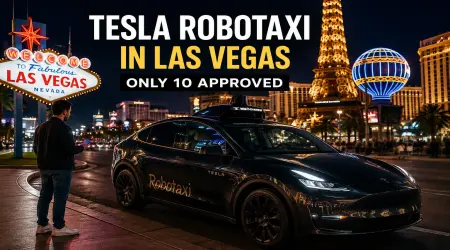
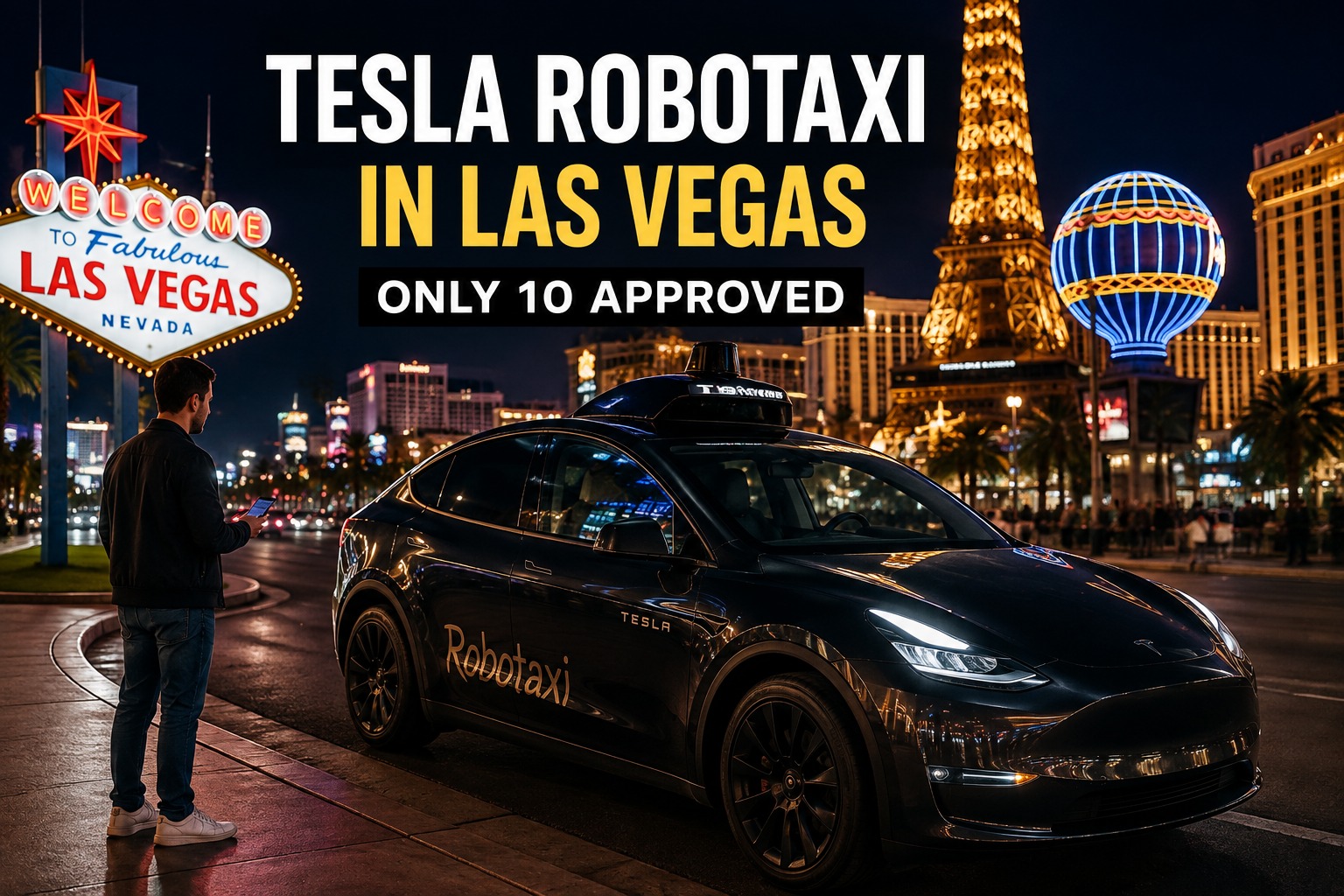
Tesla’s ambitious plan to bring thousands of driverless taxis to Las Vegas has hit a major regulatory roadblock. The company sought authorization to deploy as many as 5,000 robotaxis across Clark County, including major airport areas, during the first 12 months of operation. Instead, the Nevada Transportation Authority has granted approval for a maximum of just 10 autonomous vehicles under the initial permit.
The decision does not mean Tesla has been shut out of Las Vegas. Quite the opposite: it gives the company a path into Nevada’s commercial robotaxi market. But the dramatic difference between the requested 5,000 vehicles and the approved 10 shows that Nevada regulators are taking a cautious approach to Tesla’s autonomous-driving ambitions.
For Tesla, the approval is an important first step. For the wider robotaxi industry, it is another example of how difficult it can be to move from autonomous-driving demonstrations and limited testing to large-scale commercial deployment.
Tesla’s 5,000-Robotaxi Plan
Tesla Robotaxi, LLC filed its application with the Nevada Transportation Authority under Docket 26-05015. The company requested an Autonomous Vehicle Network Company permit that would allow it to operate up to 5,000 vehicles during the first year after approval.
The proposed service area was considerably broader than the initial operating area now permitted. Tesla’s application covered Clark County, which includes Las Vegas, and specifically referenced Harry Reid International Airport and Henderson Executive Airport.
That scale would have represented a major expansion of Tesla’s robotaxi ambitions. Instead of starting with a handful of experimental vehicles, Tesla appeared to be preparing for a substantial commercial network capable of serving a large number of passengers.
Las Vegas is an especially attractive market for autonomous taxis. The city has enormous tourism traffic, a concentrated network of hotels and casinos, major convention activity and a constant demand for short-distance transportation. The Las Vegas Strip also provides a relatively defined corridor where a robotaxi company can build operational experience.
For Tesla, a successful large-scale launch in Las Vegas could therefore have been more than another city on its map. It could have become an important demonstration of whether its autonomous-driving technology can operate reliably in one of America's busiest tourist destinations.
Why Did Nevada Approve Only 10 Vehicles?
The gap between Tesla’s request and the regulator’s decision is the most important part of the story.
Tesla asked for authorization covering thousands of vehicles, but the initial approval limits the fleet to 10. Recent reporting on the permit describes the decision as a controlled starting point rather than an immediate green light for a 5,000-vehicle network.
This type of approach makes sense from a regulatory perspective. Autonomous vehicles operate without a conventional driver continuously making decisions behind the wheel. Regulators therefore have to consider not only whether the technology works in controlled demonstrations, but also how it performs with real passengers, unpredictable road users, traffic congestion, unusual situations and emergency events.
A 10-vehicle deployment gives regulators a much smaller population to monitor while Tesla establishes its commercial operation.
It also gives Tesla an opportunity to generate real-world operating data in Nevada. If the vehicles demonstrate strong safety performance, reliable passenger service and effective responses to unexpected situations, Tesla could potentially seek permission to expand its fleet and operating area later.
In that sense, the 10-vehicle limit should not necessarily be viewed as the end of Tesla’s Las Vegas plan. It is better understood as a highly restricted first stage.
The Las Vegas Operating Area Is Also Restricted
Fleet size is not the only limitation.
The initial operation is restricted to an approved operating domain, with reporting indicating that the service is limited to the Las Vegas Strip corridor rather than immediately covering the wider Clark County area Tesla originally requested. The vehicles are also subject to a maximum operating speed of about 45 mph, or roughly 72 km/h.
This matters because autonomous-driving systems are generally easier to validate within a clearly defined geographic area than across an entire metropolitan region.
A robotaxi operating along a familiar, mapped corridor can encounter a more predictable collection of roads, intersections, traffic patterns and pickup locations. That does not make autonomous driving easy, but it can reduce the number of variables that engineers and regulators must account for during the initial deployment.
For passengers, the practical effect is that Tesla’s first Las Vegas robotaxi service will be much smaller than the company’s original vision.
Someone imagining thousands of Tesla robotaxis moving between the Strip, airports, residential neighborhoods and other parts of Clark County will have to wait. The approved operation is far more limited.
From Testing to Commercial Robotaxis
There is an important distinction between testing an autonomous vehicle and operating a commercial robotaxi service.
Tesla had already been preparing for autonomous operations in Nevada. Its broader robotaxi expansion plans identified Las Vegas as a future market, while the Nevada Transportation Authority application represented a separate regulatory step needed for commercial autonomous transportation. Tesla’s own investor materials also listed Las Vegas among the markets where preparations, testing and permitting were underway.
Obtaining commercial authorization is significant because the regulator is not simply evaluating whether a vehicle can drive autonomously. It is allowing a company to provide transportation to members of the public under a defined operating framework.
That creates additional responsibilities.
A commercial robotaxi company must think about passenger safety, vehicle monitoring, roadside assistance, incident response, maintenance, insurance, communication with emergency personnel and what happens when the autonomous system encounters a situation it cannot handle normally.
The question is therefore not simply, “Can the car drive itself?”
The larger question is, “Can an entire transportation service built around driverless vehicles operate safely and reliably?”
That is a much harder challenge.
Tesla’s Approach Faces a Real-World Test
The Las Vegas deployment will also put Tesla’s autonomous-driving strategy under closer scrutiny.
Tesla has promoted its Full Self-Driving technology and robotaxi ambitions as part of a much larger shift toward autonomous transportation. The company has also said that its long-term strategy includes expanding robotaxi services into additional major U.S. metropolitan areas. Its April 2026 investor materials listed several markets at different stages of robotaxi preparation, including Las Vegas.
But scaling autonomous transportation requires more than developing sophisticated software.
A company can demonstrate impressive autonomous driving on individual trips and still face major challenges when attempting to operate hundreds or thousands of vehicles simultaneously.
Consider what happens when a vehicle encounters a road closure, emergency vehicle, construction zone, unusual pedestrian behavior or a confusing intersection. One vehicle experiencing a problem may be manageable. Hundreds or thousands of vehicles encountering different problems at the same time create an entirely different operational challenge.
That is why regulators are likely to pay close attention to the performance of Tesla’s first 10 vehicles.
The initial fleet can effectively serve as a real-world test of the complete system: vehicles, software, remote support, customer service, maintenance and emergency procedures.
Why Las Vegas Is Such an Important Robotaxi Market
Las Vegas is already one of the most visible U.S. markets for autonomous transportation.
The city has attracted multiple robotaxi companies because its tourism-driven transportation demand creates a natural environment for testing driverless ride services. The Las Vegas Strip, in particular, has a high concentration of hotels, restaurants, entertainment venues and convention destinations.
That concentration can be valuable for an autonomous fleet.
A robotaxi does not necessarily need to travel dozens of miles to complete a trip. It can potentially make repeated short trips throughout the day, increasing vehicle utilization and creating large amounts of operational data.
The competitive environment is also becoming more important.
Tesla is not entering a completely empty market. Other autonomous-driving companies, including Waymo and Amazon-backed Zoox, have been developing robotaxi operations in Las Vegas. Zoox, for example, has already operated purpose-built autonomous vehicles in the city, giving consumers some familiarity with the concept of driverless transportation.
That means Tesla will have to compete not only on technology but also on availability, reliability, passenger experience and regulatory approval.
What the 10-Vehicle Limit Means for Tesla
At first glance, reducing a proposed fleet from 5,000 vehicles to 10 looks like a devastating setback.
Numerically, it is enormous. Ten vehicles represent only 0.2% of a 5,000-vehicle fleet.
But the strategic meaning is more complicated.
Tesla now has a commercial foothold in Nevada rather than simply a future application. The company can begin operating within the approved boundaries, collect data and demonstrate its technology to regulators and customers.
The next challenge will be proving that the service deserves to expand.
If the first vehicles operate safely and consistently, Tesla could have a stronger case for requesting additional vehicles and a larger operating domain. If significant operational problems emerge, however, the 10-vehicle ceiling could remain in place or expansion could take longer.
This makes the initial launch particularly important.
The first 10 cars may generate more regulatory significance than their small number suggests.
A Bigger Question for the Robotaxi Industry
Tesla’s Nevada permit also highlights a broader issue facing the entire autonomous-vehicle industry.
Technology companies may be capable of developing vehicles that can navigate complicated roads without a human driver, but commercial deployment depends on regulators being comfortable with the technology.
That creates a natural tension.
Companies want to scale quickly because large fleets are essential to the economics of robotaxis. Regulators, meanwhile, have a responsibility to make sure that scaling does not happen faster than safety evidence supports.
The Nevada decision demonstrates how those two priorities can collide.
Tesla’s original 5,000-vehicle proposal reflects the company's desire for rapid expansion. The 10-vehicle approval reflects a much more cautious regulatory philosophy.
Neither side can completely ignore the other. Tesla needs regulatory permission to operate, while regulators need real-world evidence from companies such as Tesla to understand how autonomous transportation performs at commercial scale.
What Happens Next?
The next stage will likely be closely watched by the autonomous-driving industry.
Tesla will need to operate within the approved limits and demonstrate that its robotaxis can provide dependable service in the permitted Las Vegas operating environment. The company’s performance could influence future discussions over fleet expansion, geographic coverage and operating conditions.
The most important measurements will not simply be how many rides Tesla completes.
Regulators and customers will care about how safely the vehicles operate, how frequently human or remote intervention is required, how the system handles unusual situations, how passengers respond to the service and how quickly Tesla can resolve operational problems.
If the company performs well, the 10-vehicle fleet could eventually become the foundation for a much larger network.
If it struggles, Nevada’s cautious approach could prove justified.
Frequently Asked Questions
Did Tesla ask for 5,000 robotaxis in Las Vegas?
Yes. Tesla Robotaxi, LLC applied for an Autonomous Vehicle Network Company permit covering Clark County and requested authorization for up to 5,000 vehicles during the first 12 months. The application also included Harry Reid International Airport and Henderson Executive Airport.
How many robotaxis did Nevada approve?
The initial permit allows Tesla to operate a maximum of 10 autonomous vehicles, according to reporting on the permit issued by the Nevada Transportation Authority.
Where can Tesla’s initial robotaxis operate?
The initial deployment is restricted to an approved operating area, with reporting indicating that the first service is limited to the Las Vegas Strip corridor rather than the wider area Tesla originally sought.
What is the speed limit for the initial operation?
The vehicles are reported to be restricted to about 45 mph, equivalent to approximately 72 km/h.
Does the 10-vehicle limit mean Tesla cannot expand?
Not necessarily. The initial authorization can be viewed as a controlled starting point. Tesla would need to demonstrate safe and reliable operation and seek further regulatory approval before significantly expanding its fleet or operating area.
Conclusion
Tesla entered Nevada with a very ambitious proposal: as many as 5,000 robotaxis serving one of America's most recognizable tourism destinations. Nevada regulators chose a dramatically different starting point, approving only 10 vehicles under a restricted operating framework.
That difference tells us something important about the current state of autonomous transportation.
The robotaxi industry is moving forward, but regulators are not necessarily willing to let companies jump directly from limited deployments to massive fleets. Real-world safety data, operational reliability and passenger experience still matter.
For Tesla, the Las Vegas story is therefore not simply about losing 4,990 vehicles from its original plan. The more important question is what the company does with the 10 vehicles it has been allowed to operate.
If those first robotaxis can prove that Tesla’s technology works safely and consistently in Las Vegas, they could become the foundation for a much larger expansion. If they cannot, the 5,000-vehicle vision will remain far beyond reach.
For now, Tesla has not received the Las Vegas robotaxi fleet it wanted. It has received something potentially more important: a tightly controlled opportunity to prove that it deserves one.