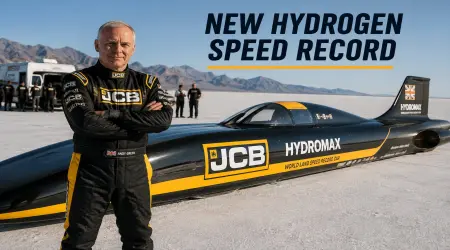
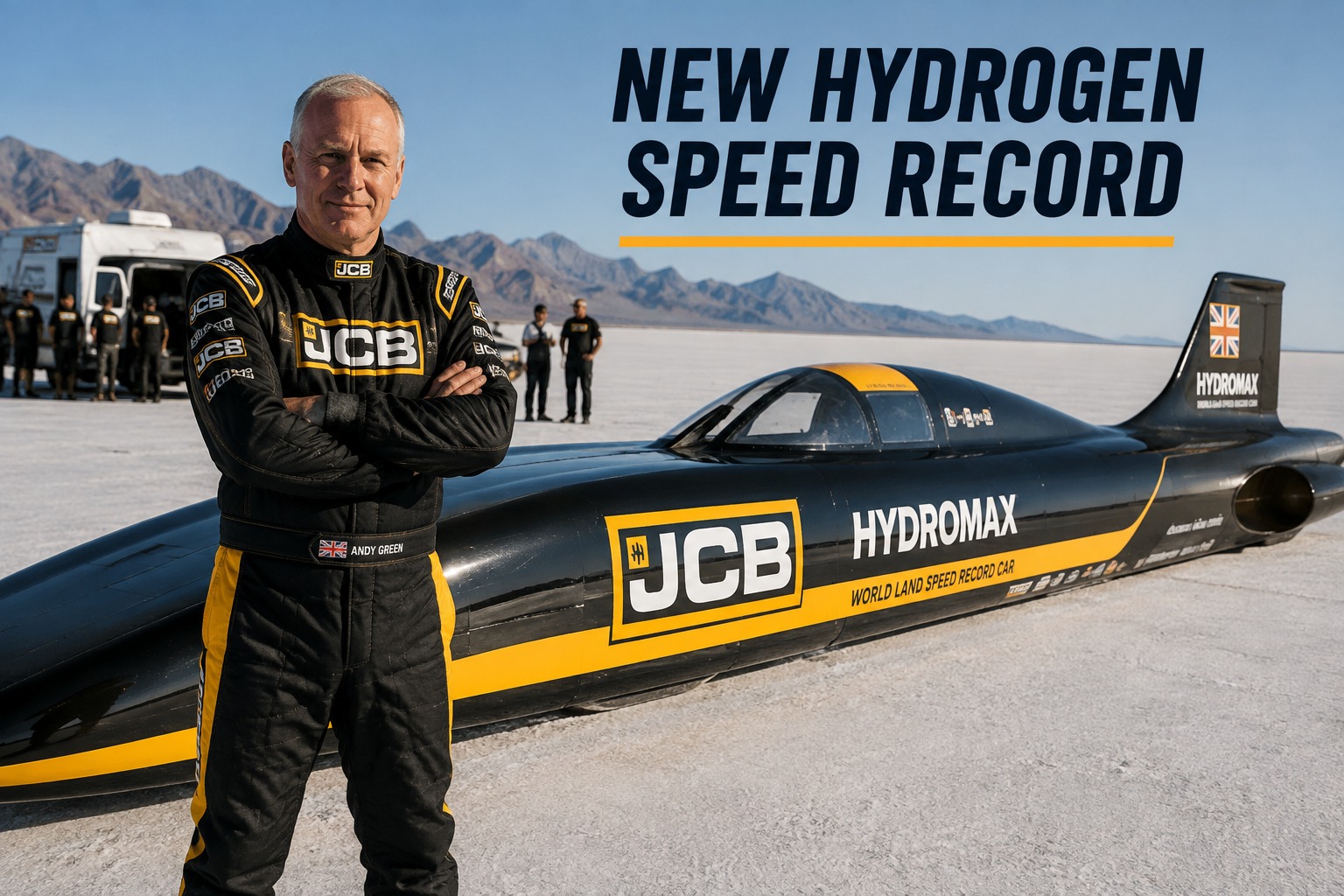
British Driver Andy Green Sets New World Speed Record With Hydrogen-Powered Car
When people think of hydrogen-powered vehicles, they often imagine quiet passenger cars or buses designed to reduce emissions. Few would associate hydrogen with a machine travelling at more than 650 kilometres per hour. Yet that is exactly what British racing driver and former Royal Air Force pilot Andy Green has helped achieve.
On August 11, 2026, Green drove JCB’s hydrogen-powered Hydromax at Utah’s Bonneville Salt Flats to an average speed of 406.320 mph (653.909 km/h) over two runs. The achievement, subject to the formal record process, set a new benchmark for a vehicle powered by hydrogen internal-combustion engines. It also demonstrated that hydrogen can be used not only for conventional transportation but for extreme high-performance applications.
The record is particularly significant because the Hydromax does not use a hydrogen fuel cell. Instead, it burns hydrogen inside modified internal-combustion engines, using an approach that resembles the basic operating principle of a conventional petrol or diesel engine.
Who Is Andy Green?
Andy Green is not new to the world of land-speed records. The 64-year-old former RAF pilot is already famous for driving the Thrust SSC to a two-way average of 763.035 mph in 1997, becoming the first and only person to officially break the sound barrier in a car on land.
Green also drove the JCB Dieselmax at Bonneville in 2006, when it established the FIA world diesel land-speed record of 350.092 mph. That record remains unbeaten.
Twenty years later, Green returned to the same salt flats, this time behind the wheel of a completely different kind of machine. Instead of diesel, the new Hydromax uses hydrogen.
That connection makes the latest achievement more than simply another speed record. It represents a continuation of JCB's effort to demonstrate alternative engine technology in one of the most demanding environments imaginable.
What Is the JCB Hydromax?
The JCB Hydromax is a highly specialized land-speed car measuring approximately 32 feet in length. Its long, narrow body is designed around the fundamental requirements of high-speed stability and aerodynamic efficiency.
At its heart are two hydrogen internal-combustion engines developed from JCB's production hydrogen technology. Together, the engines produce approximately 1,600 horsepower. Engineering companies including Prodrive and Ricardo supported the project, with Ricardo helping JCB increase the output of the hydrogen engines to around 800 horsepower each.
What makes the project especially interesting is that the engines are not simply experimental racing units created from scratch. They are based on JCB's production-oriented hydrogen engine technology.
JCB has spent years developing hydrogen combustion engines for applications such as construction machinery. The Hydromax provides an extreme test environment for that technology.
The company says more than 150,000 hours of engineering work went into the project. The vehicle also incorporates production-derived components, demonstrating how technology developed for industrial machines can potentially be adapted for demanding high-performance applications.
How Does a Hydrogen Combustion Engine Work?
Hydrogen can power a vehicle in several different ways, but the Hydromax uses what is known as a hydrogen internal-combustion engine, or H2-ICE.
The basic concept is surprisingly familiar.
In a conventional petrol engine, fuel is mixed with air and burned inside the cylinder. The resulting combustion produces pressure that pushes the piston, turning the engine's crankshaft and ultimately the wheels.
A hydrogen combustion engine follows a similar principle, but hydrogen is used as the fuel.
This is different from a hydrogen fuel-cell vehicle. A fuel-cell vehicle does not burn hydrogen in an engine. Instead, hydrogen reacts electrochemically with oxygen to generate electricity, which then powers an electric motor.
The Hydromax therefore demonstrates a different route for using hydrogen: retain the familiar mechanical architecture of an internal-combustion engine while replacing conventional fuel with hydrogen.
This distinction is important because it could make hydrogen technology attractive for industries that already understand and manufacture internal-combustion powertrains.
Why Is the Record So Important?
The Hydromax reached an average of 406.320 mph, or 653.909 km/h, across two runs. That is an extraordinary speed for any vehicle, but it is especially notable because of the technology being demonstrated.
Before the Hydromax, the FIA hydrogen internal-combustion land-speed record was held by BMW's H2R, which reached 185.5 mph in 2004. The new Hydromax figure is therefore dramatically higher. Reuters also reported that the achievement surpassed the previous hydrogen fuel-cell vehicle record of about 303 mph.
The two-run average is important because land-speed records are not normally established simply by recording one spectacular maximum-speed moment.
A controlled record attempt requires the vehicle to demonstrate its performance over designated runs, helping reduce the possibility that a temporary wind or other environmental factor produces an unrealistic result.
Bonneville's salt flats provide a unique setting for these attempts. The huge, flat surface allows specially engineered vehicles to accelerate over long distances while engineers collect detailed performance data.
Why Use Hydrogen Instead of Petrol or Diesel?
The most obvious attraction is the possibility of reducing carbon emissions at the vehicle itself.
When hydrogen is burned in an internal-combustion engine, there is no carbon in the fuel itself. That means the engine does not produce the carbon dioxide associated directly with burning petrol or diesel fuel.
However, calling hydrogen completely "clean" requires some qualification.
The environmental benefit depends heavily on how the hydrogen is produced. Hydrogen made using renewable electricity can have a much lower overall carbon footprint than hydrogen produced from fossil fuels.
There are also other engineering challenges. Hydrogen has different combustion characteristics from conventional fuels, and storing sufficient quantities requires specialized high-pressure systems. Thermal management, fuel delivery, safety and infrastructure all remain important issues.
That is why the Hydromax record should not be interpreted as proof that hydrogen will replace every petrol, diesel or electric vehicle. Instead, it is evidence that hydrogen combustion can operate at an extraordinary level of performance.
The Engineering Challenge Behind 650 km/h
Driving a vehicle at more than 650 km/h is vastly more complicated than simply installing a powerful engine.
At these speeds, aerodynamic forces become enormous. Small changes in vehicle stability can have major consequences, while the tyres, suspension, brakes, cooling systems and drivetrain must all operate under extreme conditions.
The Hydromax therefore required extensive testing before reaching Bonneville.
During earlier testing at RAF Wittering in England, the car was progressively accelerated while engineers evaluated its powertrain, four-wheel-drive transmission, clutch, braking system, cooling and electronic controls. JCB reported an early test speed of 177 mph, with later testing progressing further.
The hydrogen engines themselves also create major thermal-management demands. Reports on the project indicate that the pistons require an extremely high flow of cooling oil, while the turbochargers operate at very high rotational speeds and temperatures.
These details reveal why a land-speed record car is useful as an engineering laboratory. It pushes components far beyond ordinary operating conditions and exposes weaknesses that may not become obvious in normal road use.
Could Hydrogen Combustion Engines Become Common?
The biggest question following the record is not whether hydrogen can make a car go fast. It clearly can.
The more important question is where hydrogen combustion makes practical sense.
Battery-electric vehicles are highly effective for many passenger-car applications, but very large machines can face challenges involving battery weight, charging time and the amount of energy required for long operating periods.
This is where hydrogen could become particularly interesting.
Heavy construction equipment, agricultural machinery, long-distance transport and other demanding applications require substantial energy and often operate in locations where long charging stops may be inconvenient.
JCB has specifically been developing hydrogen combustion technology for construction equipment. The Hydromax project allows the company to showcase the same broad technological concept under extreme conditions.
The record therefore serves two purposes: it creates a spectacular demonstration for the public while giving engineers valuable experience with hydrogen fuel systems, combustion, cooling, power delivery and high-performance operation.
Hydrogen vs Electric Power
It would be misleading to describe the Hydromax as proof that hydrogen is superior to electric vehicles.
Electric motors have major advantages, including high efficiency, instant torque and relatively simple mechanical construction. Battery-electric technology is also advancing rapidly.
Hydrogen has different strengths and weaknesses.
A hydrogen combustion engine can potentially provide rapid refuelling and high power while retaining many characteristics of traditional engines. Hydrogen may therefore have a role in applications where battery weight, charging infrastructure or operating duration create difficulties.
But hydrogen infrastructure remains a major challenge. Producing low-carbon hydrogen at scale, transporting it and building reliable refuelling networks will require significant investment.
The future may therefore involve several technologies rather than a single winner.
What the Hydromax Record Really Proves
The most important lesson from Andy Green's latest achievement is not simply that a hydrogen car can travel at 654 km/h.
It demonstrates that hydrogen combustion technology has reached a level where it can be engineered for extraordinary power and reliability under extreme conditions.
The Hydromax also provides an unusual bridge between industrial engineering and motorsport. JCB is taking technology developed for heavy machinery and placing it inside a purpose-built land-speed vehicle.
That approach is reminiscent of the company's Dieselmax project two decades ago. The 2006 diesel record demonstrated what JCB's engine technology could achieve at the extreme end of performance. The Hydromax now performs a similar experiment with hydrogen.
The real value may ultimately be found not on the salt flats, but in future construction sites, farms, transport fleets and industrial machines.
FAQs
How fast did the JCB Hydromax travel?
The Hydromax achieved an average speed of 406.320 mph (653.909 km/h) over two runs at Utah's Bonneville Salt Flats.
Is the Hydromax a hydrogen fuel-cell car?
No. It uses hydrogen internal-combustion engines, meaning hydrogen is burned inside modified engines rather than being converted into electricity through a fuel cell.
How much power does the Hydromax produce?
Its two hydrogen engines produce a combined output of approximately 1,600 horsepower.
Who drove the hydrogen speed-record car?
The Hydromax was driven by Andy Green, the former RAF pilot who also holds the outright land-speed record from his 1997 Thrust SSC run.
Does hydrogen combustion produce carbon dioxide?
Hydrogen itself contains no carbon, so burning hydrogen does not produce carbon dioxide from the fuel itself. However, the overall environmental impact depends on how the hydrogen is produced, and hydrogen combustion can produce nitrogen oxides under certain conditions.
Conclusion
Andy Green's new hydrogen speed record is a remarkable demonstration of what modern engineering can accomplish. At more than 650 km/h, the JCB Hydromax has pushed hydrogen internal-combustion technology far beyond conventional road-car performance.
Yet the deeper significance of the project lies in what happens after the record attempt. The technology developed and tested for the Hydromax could contribute to the wider discussion about how heavy-duty vehicles and industrial machines can reduce their dependence on fossil fuels.
Hydrogen is unlikely to be the answer to every transportation problem, and it still faces major challenges involving production, storage, infrastructure and cost. But the Hydromax has demonstrated something important: hydrogen combustion is not merely a theoretical alternative.
At Bonneville, it proved that hydrogen can deliver extraordinary power—and, in the hands of a driver who has already broken the sound barrier on land, extraordinary speed.