
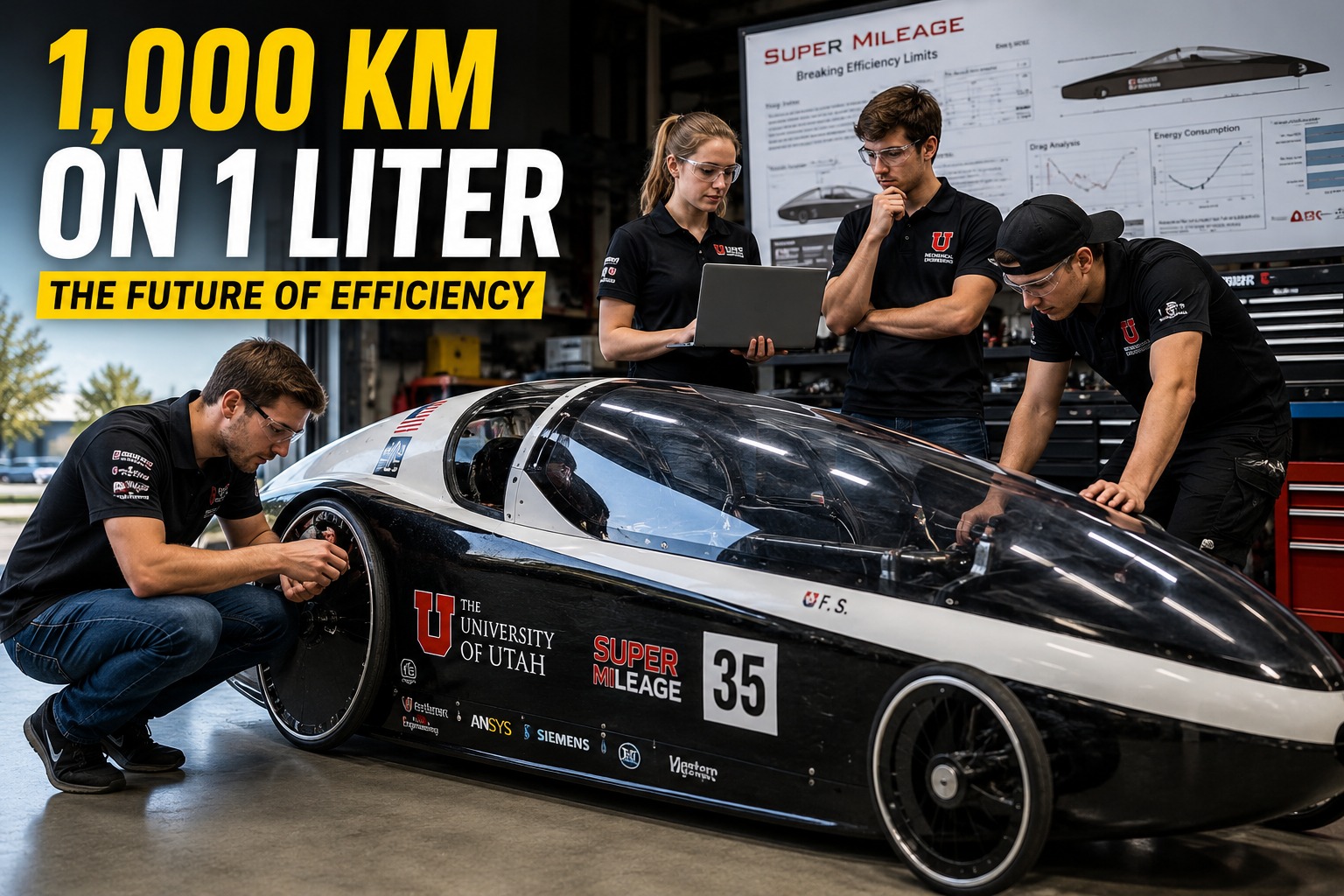
A Car That Can Travel Nearly 1,000 Kilometers on Just One Liter of Fuel: The Student-Built Innovation Redefining Efficiency
Introduction
As the automotive industry races toward an electric future, most conversations revolve around battery technology, charging infrastructure, and sustainable transportation. Yet, while major manufacturers compete to build better electric vehicles, a group of students in the United States has captured global attention with a completely different approach to fuel efficiency.
Students from Utah have developed an extraordinary vehicle known as Supermileage, a lightweight experimental car capable of traveling nearly 1,000 kilometers on just one liter of ethanol fuel. While this achievement may sound impossible at first, it demonstrates how engineering, aerodynamics, and innovative thinking can dramatically reduce energy consumption.
The project is not about creating the next commercial family car. Instead, it serves as a powerful example of what becomes possible when engineers focus entirely on maximizing efficiency. The lessons learned from such projects could influence the future design of vehicles, helping reduce fuel consumption, emissions, and transportation costs worldwide.
What Is the Supermileage Vehicle?
The Supermileage vehicle is a specialized prototype designed specifically to achieve exceptional fuel economy. Unlike conventional automobiles, it is built with a single objective: travel the greatest possible distance using the least amount of fuel.
These vehicles are commonly entered into engineering competitions where teams compete to break fuel-efficiency records. Every component is optimized to reduce energy loss, from the vehicle's shape to its weight and engine design.
The Utah students' creation stands out because it reportedly achieves fuel efficiency levels that are hundreds of times greater than those of ordinary passenger vehicles. Such performance highlights the remarkable impact of engineering optimization when efficiency becomes the primary design goal.
Why Most Cars Cannot Achieve Such Efficiency
To understand why this achievement is remarkable, it helps to consider where energy is lost in a typical vehicle.
Most road cars are designed to balance multiple requirements. They must carry several passengers, provide safety features, offer comfort, handle various road conditions, and maintain acceptable performance. These necessities add weight and complexity, which increase fuel consumption.
A standard vehicle consumes energy in several ways:
- Overcoming air resistance at higher speeds
- Moving heavy vehicle components
- Powering accessories such as air conditioning and electronics
- Dealing with friction from tires and mechanical systems
- Accelerating and braking repeatedly in traffic
The Supermileage vehicle eliminates many of these energy demands. It carries only a single driver, uses extremely lightweight materials, and operates under controlled conditions designed to maximize efficiency.
The Secret Behind the Incredible Fuel Economy
Ultra-Lightweight Construction
One of the biggest contributors to fuel efficiency is weight reduction.
Traditional cars often weigh between 1,200 and 2,000 kilograms. In contrast, Supermileage vehicles are engineered to be as light as possible. Engineers use advanced materials and minimalist construction techniques to eliminate unnecessary mass.
The lighter a vehicle is, the less energy it needs to accelerate and maintain movement. Even small reductions in weight can significantly improve efficiency.
For student engineering teams, achieving the optimal balance between strength and weight becomes one of the most important design challenges.
Advanced Aerodynamics
Air resistance becomes a major obstacle as vehicle speed increases.
When a car moves through the air, it must continuously push air molecules aside. This process consumes a significant amount of energy.
The Supermileage vehicle uses an extremely aerodynamic shape that minimizes drag. Its body is long, narrow, and smooth, allowing air to flow around it with minimal turbulence.
This design principle is similar to what engineers use in aircraft, high-speed trains, and Formula One racing. However, in the Supermileage project, aerodynamic efficiency takes priority over aesthetics and practicality.
The result is a vehicle that requires far less energy to maintain motion.
Optimized Engine Performance
Efficiency is not only about reducing resistance; it is also about extracting the maximum possible energy from fuel.
The students carefully tune the engine to operate within its most efficient range. Every drop of ethanol is used as effectively as possible.
Engineers analyze factors such as:
- Fuel-air mixture ratios
- Combustion timing
- Engine load
- Friction reduction
- Power delivery strategies
By minimizing wasted energy during combustion, the vehicle achieves extraordinary mileage figures.
Specialized Tires and Reduced Friction
Another often-overlooked source of energy loss is rolling resistance.
As tires move along a road surface, they deform slightly, creating friction that consumes energy. The Supermileage vehicle uses specialized low-resistance tires designed to reduce these losses.
Engineers also pay close attention to bearings, drivetrain components, and moving parts to minimize mechanical friction throughout the vehicle.
Every small improvement contributes to the overall efficiency record.
Why Ethanol Fuel Was Used
The vehicle runs on ethanol, a renewable fuel commonly produced from crops such as corn, sugarcane, and other plant materials.
Ethanol has several advantages:
- It can be produced from renewable resources.
- It burns relatively cleanly.
- It can be blended with traditional fuels.
- It helps reduce dependence on petroleum.
Using ethanol also allows students to explore alternative fuel technologies while demonstrating how renewable fuels can be utilized more effectively.
Although ethanol contains less energy per liter than gasoline, the exceptional efficiency of the vehicle more than compensates for this difference.
Engineering Competitions Driving Innovation
Projects like Supermileage often emerge from educational engineering competitions.
These competitions challenge students to solve real-world problems using creativity, science, and technical expertise. Participants gain practical experience in:
- Mechanical engineering
- Aerodynamics
- Manufacturing
- Project management
- Data analysis
- Sustainability
The competitive environment encourages teams to continually push efficiency boundaries.
Many innovations first tested in student competitions later influence commercial technologies. Concepts such as lightweight materials, improved aerodynamics, and energy management systems often find their way into mainstream vehicles.
Could This Technology Be Used in Everyday Cars?
This is one of the most common questions people ask when hearing about Supermileage vehicles.
The answer is both yes and no.
The exact vehicle design is not practical for everyday transportation. Most people need cars that can safely carry passengers, travel long distances comfortably, handle weather conditions, and provide protection during accidents.
However, many of the principles used in Supermileage vehicles can absolutely be applied to consumer automobiles.
Modern manufacturers already incorporate lessons from efficiency-focused engineering, including:
Lightweight Materials
Many automakers now use aluminum, carbon-fiber components, and advanced composites to reduce vehicle weight.
Improved Aerodynamics
Electric vehicles in particular benefit from aerodynamic designs because reduced drag extends driving range.
Efficient Powertrains
Both internal combustion engines and electric motors continue to become more efficient thanks to research into energy management and friction reduction.
Smart Energy Systems
Advanced software helps optimize energy usage, improving overall efficiency without sacrificing practicality.
While a family car may never achieve 1,000 kilometers per liter, the innovations behind such projects help move the automotive industry toward greater sustainability.
What This Achievement Means for the Future
The significance of the Utah students' accomplishment extends beyond a single competition.
As global populations grow and transportation demands increase, energy efficiency becomes increasingly important. Whether vehicles run on gasoline, ethanol, hydrogen, or electricity, reducing energy consumption remains one of the most effective ways to lower costs and environmental impact.
Projects like Supermileage remind us that innovation is not always about finding new energy sources. Sometimes the biggest breakthroughs come from using existing energy more intelligently.
The vehicle demonstrates that dramatic efficiency improvements are still possible when engineers challenge conventional assumptions and focus on fundamentals such as weight, aerodynamics, and energy management.
Conclusion
The student-built Supermileage vehicle from Utah represents an impressive achievement in automotive engineering. By combining ultra-lightweight construction, advanced aerodynamics, optimized engine performance, and meticulous attention to efficiency, the team created a vehicle capable of traveling nearly 1,000 kilometers on a single liter of ethanol fuel.
Although such vehicles are not designed for everyday use, they provide valuable insights into how transportation can become more efficient and sustainable. The technologies and engineering principles demonstrated through these projects continue to influence the automotive industry, helping manufacturers build vehicles that consume less energy while delivering better performance.
In a world focused on the future of mobility, the Supermileage project proves that sometimes the most remarkable innovations come not from massive corporations, but from ambitious students determined to push the limits of what is possible.