What Is a Disposable Email Address? When to Use One (2026)
What Is a Disposable Email Address, and When Should You Actually Use One?
By SHARIQ · September 6, 2026 · 7 min read
THE SHORT VERSION
|
You wanted one PDF. Or one discount code, or access to a forum thread that answered a question you’d been chasing for an hour. What you got instead was a form demanding your email address — and a mailing list you’ll be unsubscribing from for the next two years.
This is the small, constant tax of the modern web: your email address is the price of admission almost everywhere, and once you’ve paid it, you rarely get it back. A disposable email address is one way to stop paying.
What a disposable email address actually is
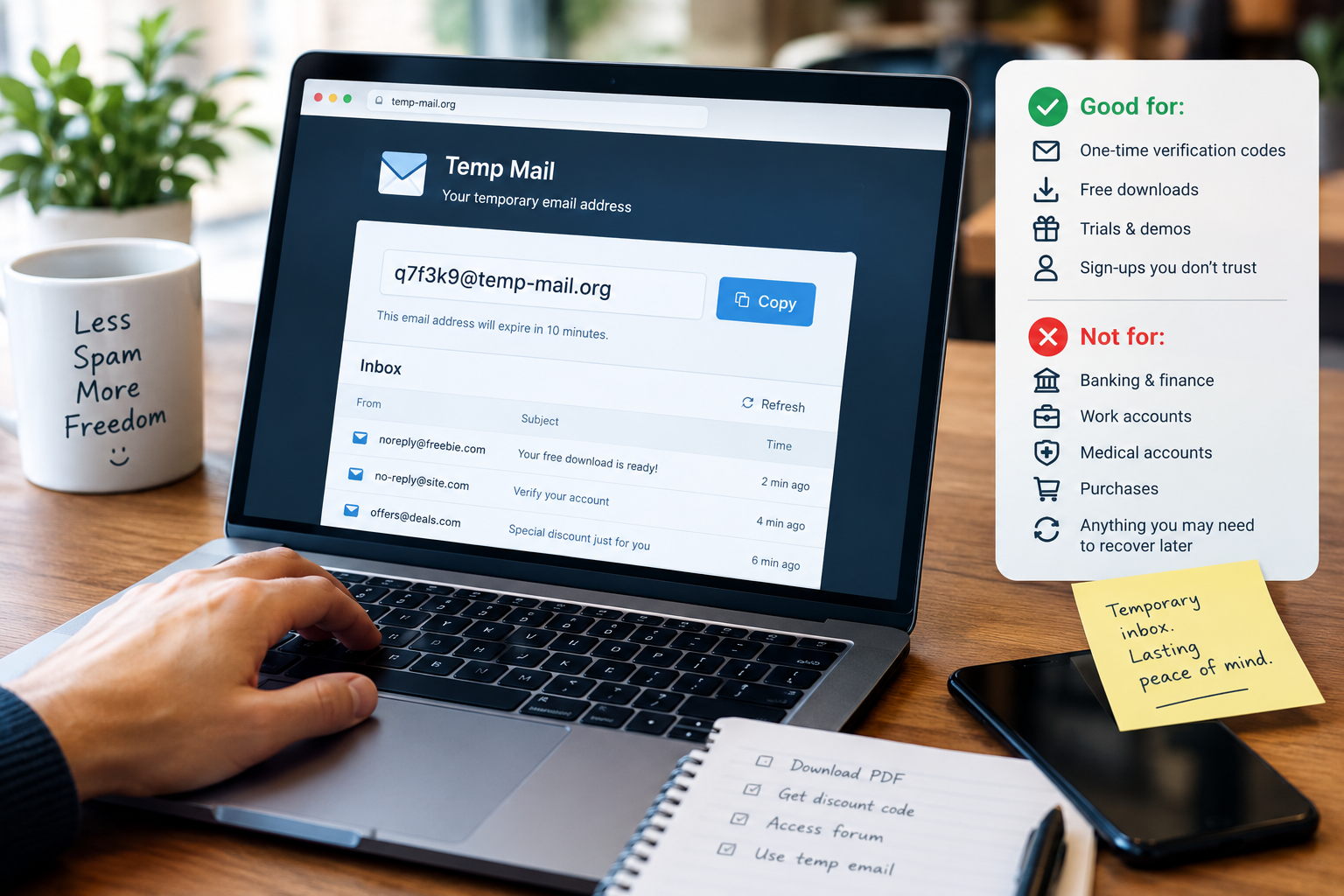
A disposable email address — also called temporary email, temp mail, or a throwaway address — is a working email address that you create in seconds, use for a specific purpose, and then walk away from. There’s no sign-up form, no password to remember, and no account tied to your name. You open a page, an address is generated for you, and mail sent to it appears on screen.
The important word is working. This isn’t a fake address you invent on the spot. A fake address bounces, which means the verification link you were waiting for never arrives. A disposable address is a real, live mailbox on a real mail server. It just happens to be one that expires and belongs to nobody in particular.
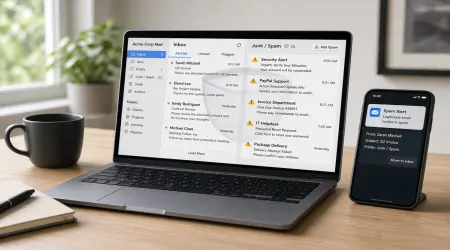
The scale of the problem it solves is not subtle. Just over half of all email sent worldwide is spam — around 51.8% in 2025, by Statista’s tracking, which works out to roughly 195 billion junk messages every single day. Every address you hand out is a potential entry point into that flood.
How temporary email works, in plain terms
The mechanism is simpler than most people expect.
A temporary email service owns one or more domain names and runs a mail server configured to accept messages sent to any address at those domains. When you visit the site, it generates a random address for you and shows you the messages arriving at it, usually refreshing every few seconds. No login is involved because there’s no account — the address itself is the only key.
Two consequences follow from that design, and they matter more than any feature list:
The inbox is only as private as the address. There is no password. Anyone who knows or guesses the address can open the same inbox and read the same mail.
The mail is temporary by design. Messages are deleted automatically, sometimes after ten minutes, sometimes after a day. When they’re gone, they’re gone — there is no recovery process and no support ticket to file.
Most services are also receive-only. You can read what arrives, but you can’t reply. That’s deliberate. A service that let anonymous users send mail would become a spam relay within hours.
Disposable email vs. aliases vs. secondary accounts
People often lump these together, but they solve different problems. Choosing the wrong one is how you end up locked out of an account you cared about.
| OPTION | HOW LONG IT LASTS | CAN YOU REPLY? | BEST FOR |
|---|---|---|---|
| Disposable / temp mail | Minutes to hours | No | One-time codes, downloads, untrusted sign-ups |
| Email alias (Hide My Email, Firefox Relay, Gmail +tags) | Until you delete it | Yes, via your real inbox | Accounts you will keep but want to be able to cut off |
| Secondary free account | Indefinite | Yes | Shopping, newsletters, hobby sign-ups |
| Your primary address | Years | Yes | Banking, work, government, anything critical |
A useful way to think about it: an alias is a door you can lock later. A disposable address is a door you’re never walking through again.
When a disposable address is the right call
Six situations where it genuinely earns its place:
1. One-time verification
A site emails you a six-digit code or a confirmation link, and after you’ve used it there is no further reason for them to contact you. This is the textbook case.
2. Gated content you’ll read once
Whitepapers, templates, sample chapters, “free” reports. The email address is the toll; the content is often worth exactly one look.
3. Free Wi-Fi and captive portals
Hotel lobbies, airports, cafés. Handing your permanent address to a network operator you’ll never see again is pure downside.
4. Trying an app you may not keep
You want to see the interface before deciding whether it deserves a place in your life. If it does, you can create a proper account with a real address later.
5. Forums, comment sections, and one-off posts
Places where you want to ask a question, get an answer, and not build an identity.
6. Sites that give you a bad feeling
A checkout page with no visible company details, a download mirror you found through three redirects, a giveaway that seems too generous. If your instinct says the address will be resold, believe it.
RULE OF THUMB If losing access to the inbox tomorrow would cost you nothing, a disposable address is safe. If it would cost you anything at all, use a real one. |
When you should not use one
This is the part most articles skip, and it’s the part that actually protects you. A disposable address is a bad choice in every one of the following cases.
Anything financial. Banks, payment services, investment platforms, crypto exchanges. You will need password resets, security alerts, and a paper trail. All three depend on an inbox that still exists in a year.
Purchases. Order confirmations, shipping updates, receipts, warranty registration, and returns all run through email. Buy something with a throwaway address and you have no proof of purchase and no way to chase a missing parcel.
Anything with two-factor authentication or account recovery. If your recovery route runs through an inbox that no longer exists — or worse, one that anybody can open — you have not made the account more secure. You’ve made it unrecoverable, and possibly hijackable.
Medical, legal, government, and employment matters. Sensitive by definition, and routing them through a passwordless public inbox is genuinely unsafe.
Anywhere it violates the rules. Using temp mail to dodge a ban, farm free trials, or create multiple accounts where one is allowed will usually breach a site’s terms of service, and can carry real consequences beyond a closed account.
REALITY CHECK Plenty of websites now check new sign-ups against public blocklists of known disposable domains and reject them outright. This isn’t a malfunction — it’s the site defending itself against trial abuse. If you hit that wall, the answer is a real address or an alias, not a workaround. |
How to use temporary email well
Four habits that separate sensible use from the kind that ends in a lost account:
Copy anything you need before you close the tab. Licence keys, download links, order references. Once the inbox expires, nobody can retrieve them for you.
Never route a password reset through it. If the account matters enough to reset, it matters enough for a real address.
Keep the address to yourself. Don’t post it publicly. The address is the only thing standing between your messages and a stranger.
Decide up front whether this is a keeper. Ten seconds of thought at the sign-up form prevents the far more annoying job of migrating an account later.
Frequently asked questions
Is using a disposable email address legal?
Yes. Creating a temporary inbox is legal essentially everywhere. What matters is what you do with it. Keeping marketing mail out of your personal inbox is ordinary privacy hygiene. Using one to evade a ban, abuse a trial system, or misrepresent who you are may breach a site’s terms of service and, in some contexts, the law.
Can someone else read my temporary inbox?
Potentially, yes. Most disposable services have no password, so anyone who knows or guesses the address can open the same inbox. Treat a temporary inbox as a public noticeboard rather than a private mailbox.
How long does a disposable email address last?
It depends on the service. Some addresses expire after ten minutes; others last hours or days, or stay reachable as long as you keep the session. Assume the messages will disappear and save anything important immediately.
Why do some websites reject disposable email addresses?
Because throwaway addresses are widely used to abuse free trials and inflate sign-up numbers, many sites screen new registrations against blocklists of known temporary domains. Services with less common custom domains are rejected less often, but no service is accepted everywhere.
Can I send email from a disposable address?
Usually not. Most temporary email services are receive-only by design — outbound sending would turn them into a spam relay. They exist to catch verification links and confirmations, not to hold conversations.
The bottom line
A disposable email address is a small tool with a narrow, genuinely useful job: absorbing the one-time messages that would otherwise follow you around for years. It isn’t anonymity, it isn’t encryption, and it isn’t a replacement for a real inbox. Used for what it’s good at — the throwaway sign-up, the code you need once, the download you’ll never revisit — it quietly removes a whole category of clutter from your life.