
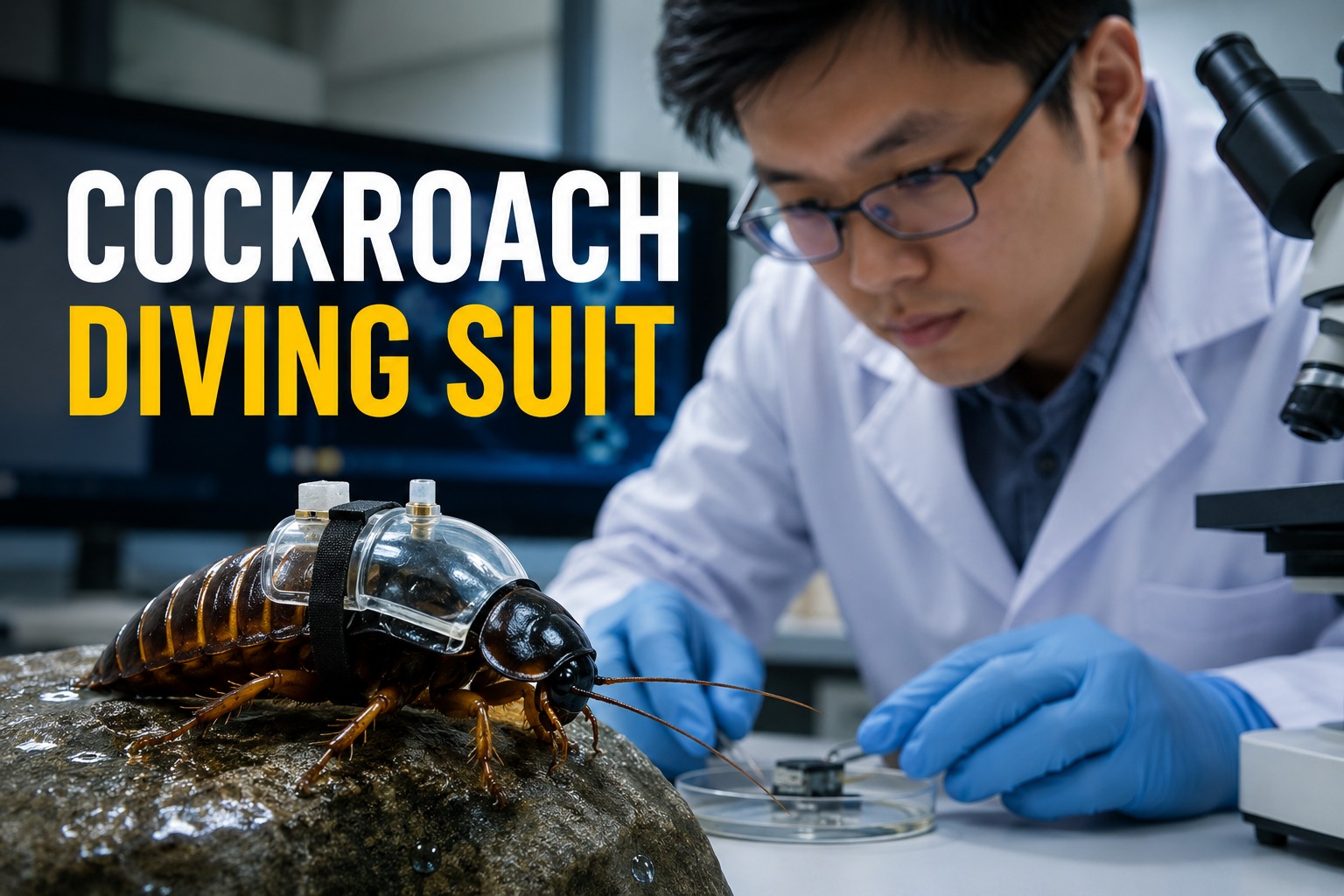
Scientists Create a Tiny Diving Suit That Lets Cockroaches Breathe Underwater for Hours
Introduction
Imagine a robot small enough to crawl through the narrow gaps of a collapsed building and search for survivors after an earthquake. While engineers have spent decades trying to build such machines, nature has already created an incredibly efficient crawler—the cockroach. Now, scientists have taken this idea a step further by developing a miniature diving suit that allows certain cockroaches to remain underwater for up to three hours while continuing to breathe and move.
This remarkable innovation comes from researchers at Singapore's Nanyang Technological University (NTU), where scientists have designed a lightweight underwater breathing system for Madagascar hissing cockroaches. The technology is not intended to create "super insects" for entertainment. Instead, it aims to solve real-world problems such as disaster response, environmental monitoring, and search-and-rescue missions in places that are too dangerous or inaccessible for humans.
The development highlights how biology and engineering can work together to create practical solutions that conventional robots still struggle to achieve.
How the Cockroach Diving Suit Works
The newly developed diving suit is an ultra-light device designed specifically for Madagascar hissing cockroaches, one of the largest and strongest cockroach species. Unlike humans, cockroaches breathe through tiny openings on the sides of their bodies called spiracles. These openings connect to a network of tubes known as the tracheal system, which delivers oxygen throughout the insect's body.
Underwater, these spiracles normally become blocked, preventing the insect from breathing for extended periods. The NTU researchers solved this challenge by designing a compact breathing apparatus that traps a pocket of air around the breathing openings. As a result, the cockroach continues receiving oxygen even while submerged.
The suit is carefully engineered to be extremely light so that it does not interfere with the insect's natural movements. Laboratory tests showed that cockroaches wearing the device could walk underwater and survive for approximately three hours before needing fresh air.
The design demonstrates how even tiny engineering improvements can dramatically expand the capabilities of living organisms.
Why Scientists Chose Madagascar Hissing Cockroaches
Not every insect is suitable for scientific applications like this. Madagascar hissing cockroaches were selected because they possess several characteristics that make them ideal biological platforms.
These cockroaches are considerably larger than common household cockroaches, providing enough space to attach miniature electronic devices and specialized equipment. They are also remarkably durable, capable of carrying additional weight without significant difficulty.
Another advantage is their ability to move efficiently across uneven surfaces, climb obstacles, squeeze through tight openings, and survive in harsh environments. These natural abilities remain difficult for even advanced miniature robots to replicate.
Scientists are not attempting to replace robots entirely. Instead, they are combining the strengths of biological organisms with modern technology to create hybrid systems capable of performing specialized tasks.
Building on Previous Cyborg Cockroach Research
The underwater breathing device builds upon years of research conducted by Professor Hirotaka Sato and his team at NTU.
Previously, the researchers successfully developed remotely controlled "cyborg cockroaches" by attaching miniature electronic backpacks to the insects. Tiny electrodes were connected to the cockroaches' sensory organs, allowing researchers to influence their direction of movement using electrical signals.
Rather than controlling every step, the system gently guides the insect toward a desired direction while allowing it to navigate obstacles naturally. This approach requires significantly less computing power than programming a small robot to perform the same task.
By adding the new diving suit, these biohybrid insects may eventually operate in both dry and partially flooded environments, greatly expanding their usefulness during emergency situations.
Potential Applications in Disaster Response
One of the most promising uses of this technology is search-and-rescue operations following natural disasters.
After earthquakes, explosions, or building collapses, survivors are often trapped beneath layers of debris. Rescue teams frequently face difficulties entering unstable structures because additional movement could trigger further collapses.
Small biohybrid insects equipped with cameras, microphones, temperature sensors, or gas detectors could crawl through tiny openings inaccessible to humans or larger robots. They could gather valuable information about trapped victims and transmit it wirelessly to rescue personnel.
The underwater breathing capability becomes especially valuable during floods or disasters involving standing water, where conventional insects or electronics may fail.
These systems could help emergency responders locate survivors faster, potentially saving lives during the critical first hours after a disaster.
Environmental Monitoring and Scientific Research
Beyond disaster relief, underwater-capable cyborg insects could support environmental monitoring.
Scientists often need to collect data from difficult locations such as wetlands, underground tunnels, drainage systems, or flooded caves. Traditional robotic equipment can be expensive, fragile, and limited by battery life.
Modified insects carrying miniature sensors could monitor water quality, temperature, humidity, toxic gases, or pollution levels while navigating complex environments naturally.
Researchers also envision applications in agriculture, where insects might inspect irrigation systems, monitor crop conditions, or detect environmental hazards in areas difficult for larger equipment to access.
Although these ideas remain largely experimental, they demonstrate the wide range of possibilities offered by biohybrid technologies.
Why Not Use Tiny Robots Instead?
Many people wonder why scientists do not simply build miniature robots instead of modifying insects.
The answer lies in engineering limitations.
Creating a robot as small, agile, energy-efficient, and adaptable as a cockroach remains an enormous technological challenge. Tiny robots often struggle with battery capacity, locomotion, navigation, and durability.
Cockroaches have evolved over hundreds of millions of years to overcome these challenges naturally. They can climb walls, survive impacts, squeeze through narrow gaps, and move efficiently using very little energy.
By adding lightweight electronics instead of recreating the entire organism mechanically, scientists can achieve capabilities that would otherwise require much more advanced robotics.
This hybrid approach represents a practical shortcut while robotic technology continues to evolve.
Ethical Questions Surrounding Biohybrid Insects
As with many emerging technologies, biohybrid insects raise important ethical questions.
Some people express concern about using living creatures for technological purposes. Researchers acknowledge these concerns and emphasize that insect welfare is taken seriously throughout experimentation.
Many insects possess much simpler nervous systems than mammals, but scientists still follow ethical research guidelines to minimize unnecessary stress or harm.
Another concern involves privacy and security. If tiny remotely controlled insects eventually carry cameras or sensors, regulations will be necessary to prevent misuse outside legitimate scientific or emergency applications.
Open public discussion will play an important role as the technology advances toward real-world deployment.
Current Limitations
Despite impressive progress, the technology is still in its early stages.
Several technical challenges remain before biohybrid cockroaches become common tools for rescue teams.
Researchers continue working to improve battery life, communication range, navigation accuracy, sensor integration, and overall reliability in unpredictable environments.
The diving suit currently allows underwater operation for about three hours under controlled conditions. Real disaster environments may present additional obstacles such as debris, contaminated water, strong currents, or extreme temperatures.
Extensive testing and further engineering improvements will be required before the technology becomes operational outside research laboratories.
The Future of Biohybrid Rescue Technology
The development of underwater breathing systems for cockroaches represents a fascinating intersection of biology, robotics, and engineering.
Future versions may include high-definition cameras, thermal imaging sensors, artificial intelligence for autonomous navigation, and more advanced communication systems. Researchers could also design improved breathing devices that extend underwater operation even further.
As miniature electronics continue shrinking, biohybrid insects may become increasingly capable while remaining lightweight enough to preserve their natural mobility.
Although they may never replace human rescue workers or advanced robots, they could become valuable partners during dangerous missions where every minute counts.
Conclusion
The miniature diving suit created by researchers at Singapore's Nanyang Technological University is far more than an unusual scientific experiment. It demonstrates how combining living organisms with advanced engineering can solve problems that traditional robotics still struggles to address.
By enabling Madagascar hissing cockroaches to breathe and move underwater for up to three hours, scientists have opened new possibilities for disaster response, environmental monitoring, and future search-and-rescue technologies. While significant research remains before these biohybrid insects are widely deployed, the project highlights the growing potential of nature-inspired engineering.
As science continues blending biology with technology, innovations like these remind us that sometimes the most effective solutions come not from replacing nature, but from learning how to work alongside it.