
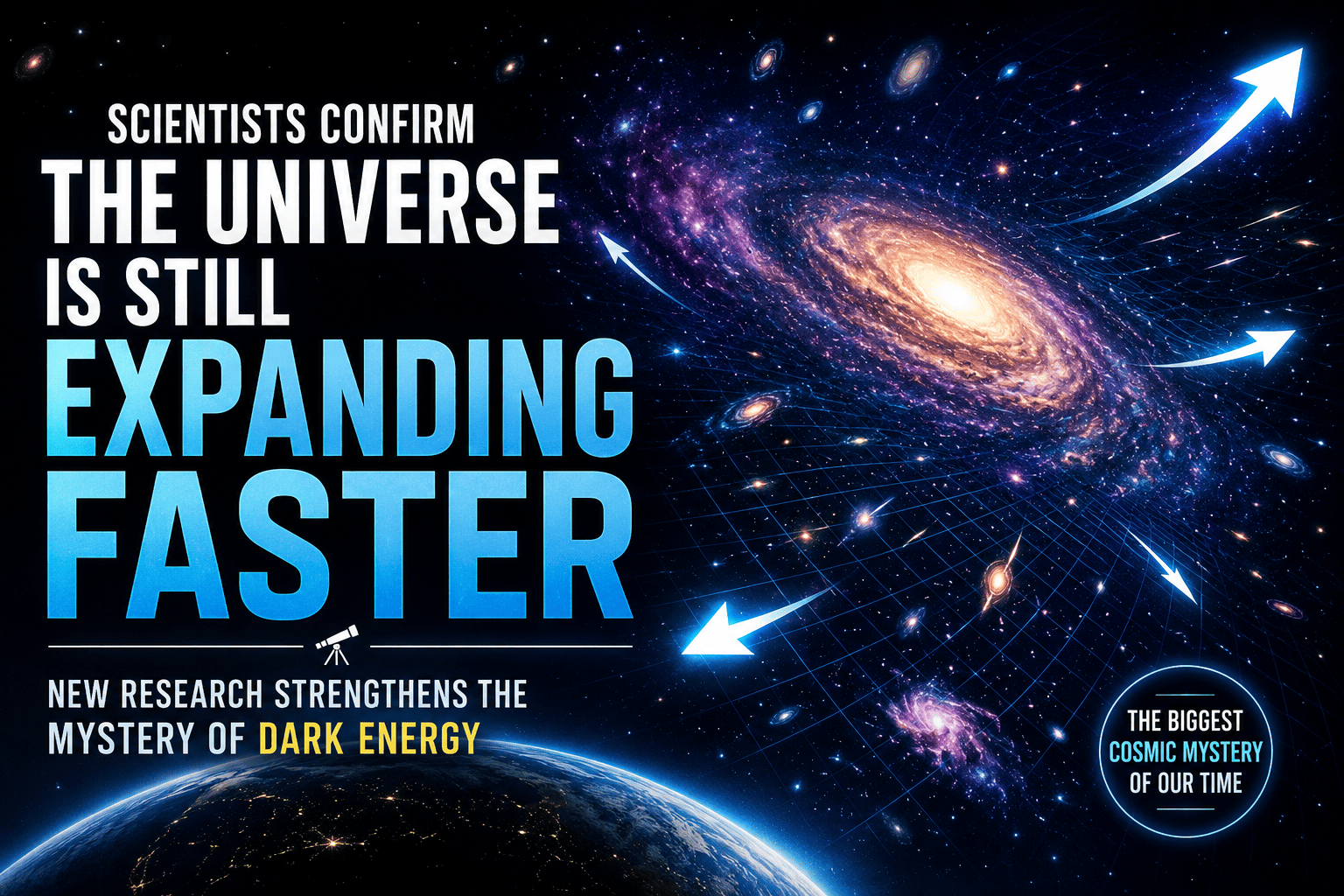
Scientists Confirm the Universe Is Still Expanding Faster: New Research Strengthens the Mystery of Dark Energy
A New Look at the Universe Reveals an Old Mystery That Refuses to Disappear
For decades, astronomers have been trying to answer one of the biggest questions in science: how is the universe evolving over time? While gravity should naturally slow down cosmic expansion, observations made in the late 1990s shocked the scientific community by showing that the universe is actually expanding at an accelerating rate. This surprising discovery led to the concept of dark energy, an invisible force believed to make up most of the cosmos.
Now, a new study has provided fresh evidence supporting this idea. After reanalyzing data from a particular type of stellar explosion, scientists have once again confirmed that the universe is still expanding faster and faster. The findings reinforce one of the most important discoveries in modern cosmology and highlight how much remains unknown about the forces shaping our universe.
Understanding the Expansion of the Universe
The idea that the universe is expanding is not new. In the 1920s, astronomer Edwin Hubble discovered that distant galaxies are moving away from us. The farther away a galaxy is, the faster it appears to recede. This observation led to the understanding that space itself is expanding.
For many years, researchers assumed that gravity from all the matter in the universe would gradually slow this expansion. Since gravity attracts objects toward each other, it seemed reasonable to expect that cosmic expansion would eventually decrease over time.
However, observations made in the late twentieth century challenged this assumption in a dramatic way.
How Exploding Stars Changed Cosmology
One of the most important tools used to study the universe is a special kind of exploding star known as a Type Ia supernova. These explosions occur when a white dwarf star reaches a critical mass and undergoes a powerful detonation.
What makes Type Ia supernovae particularly valuable is their consistent brightness. Since astronomers know how bright these explosions should be, they can compare their true brightness with how bright they appear from Earth. This allows scientists to calculate enormous cosmic distances with remarkable accuracy.
In the late 1990s, two independent research teams used these stellar explosions to measure the expansion history of the universe. To their surprise, distant supernovae appeared dimmer than expected, indicating that the universe's expansion was accelerating rather than slowing down.
The discovery earned the 2011 Nobel Prize in Physics and transformed our understanding of cosmology.
New Research Reexamines Decades of Data
Although the accelerating universe model has become widely accepted, scientists continuously test their conclusions using improved methods and larger datasets. In the latest study, researchers revisited observations of Type Ia supernovae to determine whether earlier findings still held true.
By applying updated calibration techniques and more sophisticated statistical analysis, the team carefully examined how these stellar explosions behave across vast distances and different periods of cosmic history.
The results showed that the evidence for accelerated expansion remains strong. Rather than weakening previous conclusions, the new analysis further strengthens the case that some unknown force is driving galaxies apart at increasing speeds.
This finding provides additional support for the existence of dark energy, although the exact nature of this mysterious phenomenon remains one of the greatest unsolved puzzles in science.
What Exactly Is Dark Energy?
Dark energy is one of the most mysterious concepts in physics. Scientists estimate that it accounts for roughly 68 to 70 percent of the entire universe. Yet, despite its enormous influence, nobody has directly detected it.
Researchers have proposed several explanations:
Einstein's Cosmological Constant
One possibility is that dark energy represents a property of empty space itself. Albert Einstein introduced a mathematical term called the cosmological constant in his equations of general relativity. Although he later abandoned the idea, modern observations suggest that this concept might actually describe reality.
If the cosmological constant is correct, empty space contains a small but constant amount of energy that causes the expansion of the universe to accelerate.
Dynamic Dark Energy
Another theory suggests that dark energy changes over time. In this scenario, a hypothetical field known as quintessence could be responsible for the accelerating expansion.
Unlike the cosmological constant, quintessence would allow dark energy to evolve throughout cosmic history, potentially affecting the ultimate fate of the universe.
Modifications to Gravity
Some scientists believe the answer may not involve dark energy at all. Instead, they propose that our understanding of gravity might be incomplete. If gravity behaves differently on cosmic scales, the observed acceleration could be explained without invoking an unknown energy source.
These ideas are still under investigation, and no single explanation has yet been confirmed.
Why This Discovery Matters
At first glance, the accelerating expansion of the universe may seem like an abstract scientific issue with little relevance to everyday life. However, understanding the universe's evolution helps answer fundamental questions about existence itself.
Knowing how the cosmos behaves allows scientists to reconstruct the universe's history, study galaxy formation, and predict what the distant future might look like.
More importantly, solving the mystery of dark energy could lead to revolutionary breakthroughs in physics. Throughout history, major discoveries about the universe have often produced unexpected technological and scientific advances.
The Hubble Tension Adds Another Layer of Mystery
Modern cosmology faces another challenge known as the Hubble tension. Different methods of measuring the universe's expansion rate produce slightly different answers.
Measurements based on the cosmic microwave background suggest one value, while observations involving supernovae and nearby galaxies indicate a somewhat higher rate.
This discrepancy has sparked intense debate among researchers. Some scientists believe the difference may result from hidden systematic errors, while others suspect that entirely new physics could be involved.
The latest findings regarding accelerated expansion do not eliminate the Hubble tension, but they contribute valuable information that may help resolve this puzzle in the future.
What Could Happen to the Universe in the Distant Future?
The continued acceleration of cosmic expansion raises fascinating questions about the ultimate destiny of the universe.
If dark energy remains constant, galaxies will continue drifting farther apart. Over billions and trillions of years, the universe could become increasingly cold and empty in a scenario often called the "Big Freeze."
Stars will eventually exhaust their fuel, and galaxies beyond our local region may disappear from view entirely as space expands faster than light can bridge the growing distances.
Some speculative theories suggest more dramatic possibilities, including the "Big Rip," where accelerated expansion becomes so powerful that galaxies, stars, planets, and even atoms are torn apart. However, current evidence does not strongly support such an extreme outcome.
Advances in Technology Are Helping Scientists Search for Answers
Modern observatories and space missions are providing unprecedented amounts of data about the cosmos.
Projects such as the James Webb Space Telescope, the European Space Agency's Euclid mission, and the Vera C. Rubin Observatory are expected to improve our understanding of dark energy and the large-scale structure of the universe.
These instruments will allow researchers to study billions of galaxies and trace cosmic evolution with extraordinary precision. As datasets become larger and analysis techniques more sophisticated, scientists hope to uncover clues that reveal the true nature of dark energy.
A Mystery That Continues to Inspire Science
The latest research confirming the accelerated expansion of the universe demonstrates the remarkable power of scientific investigation. More than twenty-five years after the original discovery, evidence continues to support the idea that a mysterious force is influencing the cosmos on the largest scales imaginable.
Yet, despite enormous progress, humanity still does not know what dark energy actually is. This uncertainty is not a weakness of science but one of its greatest strengths. Each new observation raises deeper questions and pushes researchers toward a more complete understanding of reality.
As future telescopes and missions explore the cosmos with increasing precision, the mystery of dark energy may eventually be solved. Until then, the accelerating universe remains one of the most fascinating and profound discoveries in modern science—a reminder that the cosmos still holds secrets waiting to be uncovered.