
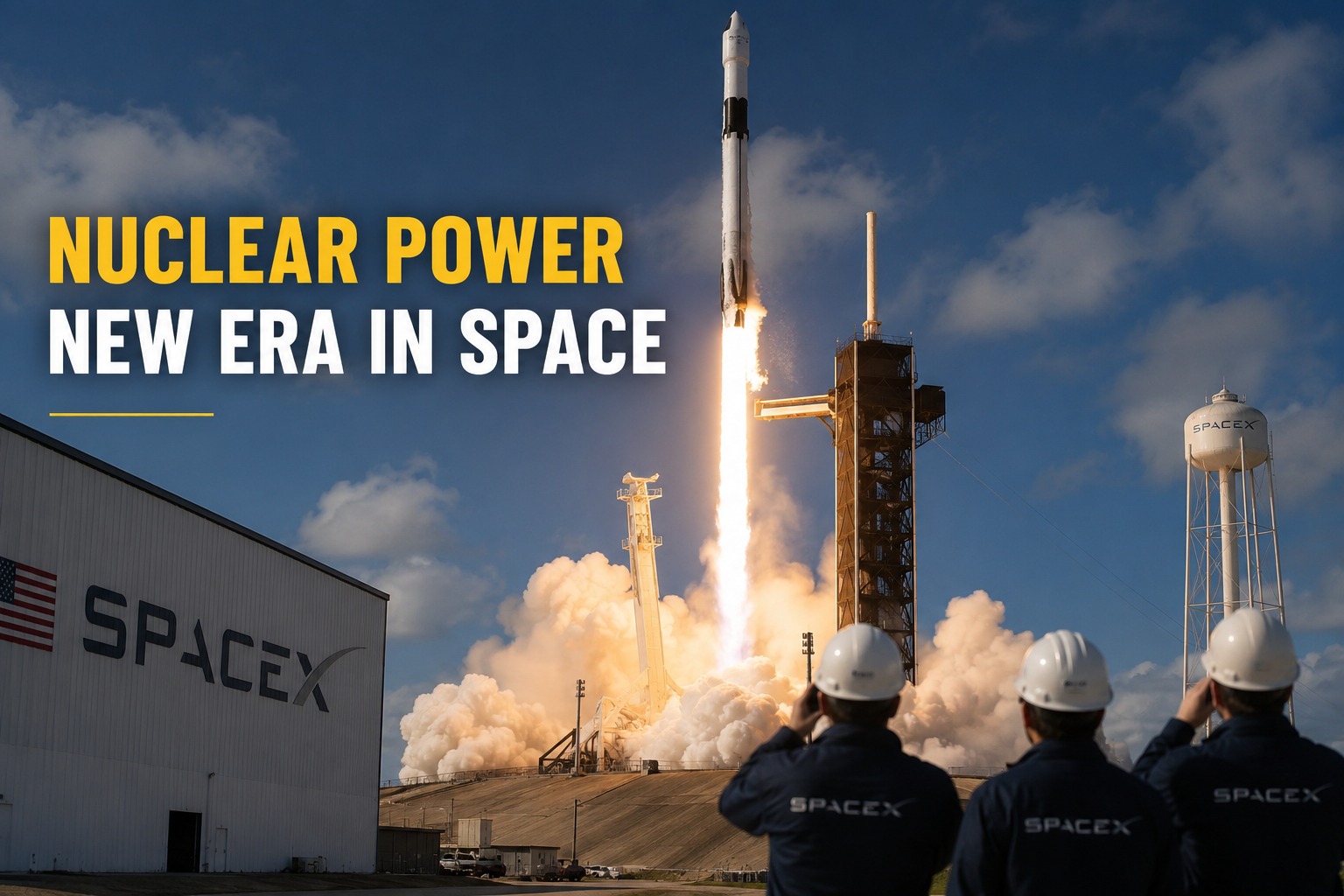
Nuclear-Powered Payload Satellite Successfully Launched: A Historic Milestone for Commercial Space Exploration
Space exploration has entered another groundbreaking chapter with the successful launch of the world's first commercial satellite carrying a nuclear-powered payload. The mission, conducted by SpaceX aboard its reliable Falcon 9 rocket, represents a significant technological achievement that could influence the future of deep-space exploration, satellite operations, and commercial space missions.
Unlike conventional satellites that rely entirely on solar panels and batteries, this mission introduces a nuclear-powered system designed to demonstrate how compact nuclear technology can provide reliable energy in environments where sunlight is weak or unavailable. While the satellite itself is not nuclear-powered in the traditional sense, it carries a payload intended to test nuclear energy technologies in space, making it a landmark experiment for the growing commercial space industry.
As governments and private companies race toward the Moon, Mars, and beyond, dependable power sources are becoming one of the biggest engineering challenges. This launch offers an important glimpse into how nuclear technology could help solve that problem.
SpaceX Launches the Historic Mission
The satellite was launched aboard a Falcon 9 rocket from Vandenberg Space Force Base in California as part of the Transporter-17 rideshare mission. SpaceX's rideshare program allows multiple customers to launch satellites together on a single rocket, dramatically reducing launch costs and making space more accessible for research institutions, startups, and commercial companies.
The Falcon 9 has built a reputation as one of the world's most reliable reusable launch vehicles. By successfully delivering the satellite into orbit, SpaceX once again demonstrated the efficiency and maturity of reusable rocket technology.
Although dozens of satellites were launched during the Transporter-17 mission, this particular payload attracted worldwide attention because it carried experimental nuclear technology designed for future space applications.
What Does "Nuclear-Powered Payload" Actually Mean?
Many headlines may lead readers to believe that the satellite itself is powered entirely by nuclear energy. In reality, the mission is more specific.
The satellite carries a nuclear-powered payload, meaning an experimental device or technology related to nuclear energy is onboard. The mission's purpose is to test how compact nuclear power systems perform in the harsh environment of space.
These systems are expected to provide stable electrical power for future spacecraft, scientific instruments, lunar bases, and deep-space probes where solar panels become less practical.
This distinction is important because the mission is focused on technology validation rather than immediately replacing traditional satellite power systems.
Why Space Needs Nuclear Energy
Solar panels have powered satellites for decades and continue to perform exceptionally well in Earth's orbit. However, as missions travel farther from the Sun, solar energy becomes much less effective.
For example, spacecraft traveling toward Jupiter receive only a fraction of the sunlight available near Earth. Beyond that, missions exploring permanently shadowed regions of the Moon or operating during long lunar nights cannot rely solely on solar panels.
Nuclear power offers several advantages:
- Continuous power generation regardless of sunlight.
- Higher energy density than batteries.
- Long operational lifetimes.
- Reliable performance in extreme temperatures.
- Greater support for scientific instruments and communication systems.
These benefits make nuclear technology one of the most promising energy sources for future exploration missions.
How Nuclear Space Power Works
When people hear the word "nuclear," they often imagine large reactors similar to those used for electricity generation on Earth. Space nuclear systems, however, are much smaller and designed specifically for spacecraft.
There are two primary technologies used in space.
Radioisotope Power Systems
These systems generate electricity using the natural heat produced by radioactive materials. They contain no moving parts and have powered famous NASA missions including Voyager, Cassini, and Perseverance.
They produce relatively small amounts of electricity but can operate reliably for decades.
Compact Space Reactors
Unlike radioisotope systems, compact reactors use controlled nuclear fission to generate much larger amounts of electricity.
These reactors could eventually power:
- Permanent lunar habitats
- Mars research stations
- Deep-space cargo vehicles
- High-powered communications
- Electric propulsion systems
Many governments and private companies are actively researching these next-generation technologies.
Why This Mission Matters
Although this launch is only a technology demonstration, its implications are enormous.
Commercial companies have traditionally focused on communications satellites, Earth observation, and internet services. Now, they are beginning to participate in advanced scientific research that was once limited to government agencies.
This mission represents several important milestones.
First, it demonstrates that commercial launch providers can safely transport highly specialized experimental technologies into orbit.
Second, it accelerates research that could support future Moon and Mars missions.
Third, it encourages collaboration between private companies, research organizations, and government space agencies.
As commercial spaceflight becomes more affordable, innovations like nuclear power systems may develop much faster than before.
The Growing Importance of Reliable Space Power
Every spacecraft depends on electrical power.
Electricity keeps communication systems running, powers scientific instruments, regulates onboard temperatures, and allows satellites to maintain their orientation.
Future exploration missions will demand far greater amounts of energy than today's satellites.
Consider a future lunar research station. It would require electricity for:
- Life-support systems
- Scientific laboratories
- Water extraction
- Oxygen production
- Heating during lunar nights
- Communications with Earth
Solar panels alone may struggle to provide continuous power under these conditions.
Compact nuclear systems could become the backbone of future off-world infrastructure.
Safety Considerations
Whenever nuclear technology is involved, safety naturally becomes a major concern.
Space missions carrying radioactive materials undergo extensive testing before launch.
Engineers design protective containers capable of surviving:
- Rocket launch vibrations
- Potential launch accidents
- Atmospheric re-entry
- Extreme temperatures
- High-speed impacts
Modern nuclear space systems use multiple layers of safety engineering to minimize environmental risks.
Additionally, only small amounts of radioactive material are typically used for research missions, and every launch must satisfy strict regulatory requirements before receiving approval.
Commercial Space Industry Reaches a New Stage
The commercial space sector has evolved dramatically over the past decade.
Initially, private companies focused primarily on reducing launch costs.
Today, commercial firms are developing:
- Lunar landers
- Space stations
- Satellite servicing vehicles
- In-orbit manufacturing
- Deep-space transportation
- Advanced power systems
This mission reflects that transformation.
Instead of simply transporting satellites into orbit, private companies are now helping develop technologies that may support humanity's expansion throughout the Solar System.
Potential Applications Beyond Earth Orbit
If nuclear-powered payload technologies prove successful, they could enable missions that were previously impossible.
Future applications include:
Lunar Exploration
The Moon experiences nights lasting approximately 14 Earth days.
Without sunlight, solar-powered systems become difficult to operate continuously.
Nuclear energy could provide uninterrupted electricity throughout the lunar day-night cycle.
Mars Missions
Dust storms on Mars can block sunlight for weeks.
Reliable nuclear power would keep habitats, scientific equipment, and life-support systems operating regardless of weather conditions.
Deep-Space Exploration
Missions traveling to Jupiter, Saturn, Uranus, Neptune, and beyond receive very little solar energy.
Nuclear systems become essential for powering scientific instruments over decades-long missions.
Space Infrastructure
Future orbital factories, communication hubs, and refueling stations may also benefit from compact nuclear energy sources.
Challenges That Still Remain
Despite its enormous potential, nuclear space technology still faces several challenges.
Developing compact reactors that are lightweight, highly reliable, and affordable remains technically demanding.
Engineers must also address:
- Long-term radiation shielding
- Heat management
- Regulatory approvals
- Public acceptance
- Launch safety requirements
These challenges require years of research, testing, and international cooperation.
However, successful demonstration missions like this one are essential first steps toward overcoming these obstacles.
Looking Ahead
The successful launch of a commercial satellite carrying a nuclear-powered payload represents more than a technological milestone—it signals a shift in how humanity approaches space exploration.
As governments pursue ambitious lunar programs and private companies plan commercial activities beyond Earth orbit, dependable energy systems will become increasingly important.
While solar technology will remain indispensable for many missions, nuclear power offers capabilities that solar energy simply cannot provide in certain environments.
If ongoing experiments validate these technologies, future astronauts may one day rely on compact nuclear power systems while living on the Moon, exploring Mars, or operating scientific stations in deep space.
Conclusion
SpaceX's successful launch of the world's first commercial satellite carrying a nuclear-powered payload marks an exciting moment in the evolution of space technology. Although the mission is primarily an experimental demonstration, it highlights the growing role of commercial companies in developing advanced technologies once reserved for national space agencies.
Reliable energy remains one of the greatest challenges in long-duration space exploration. By testing nuclear-powered systems in orbit today, scientists and engineers are laying the groundwork for tomorrow's lunar bases, Mars expeditions, and deep-space missions.
As space exploration continues to expand beyond Earth's orbit, innovations like this could become essential building blocks for humanity's future among the stars.