
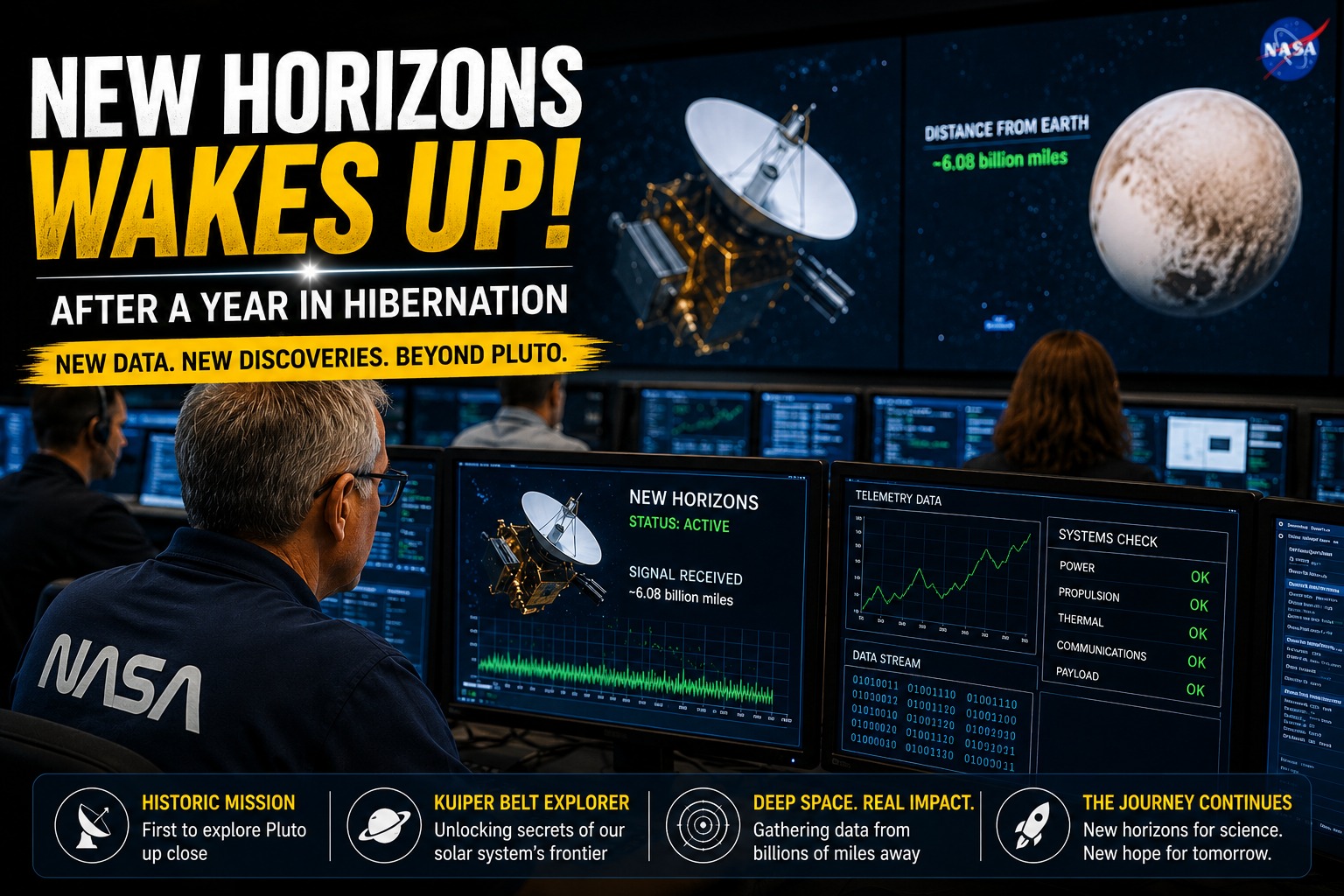
NASA's New Horizons Spacecraft Wakes Up After a Year in Hibernation, Bringing Fresh Hope for Deep Space Discoveries
Space exploration often captures attention during rocket launches or dramatic planetary flyby’s, but some of the most important milestones happen quietly, billions of miles away from Earth. That is exactly what has happened with NASA's New Horizons spacecraft, which has successfully awakened after spending nearly a year in hibernation mode. While the spacecraft remained inactive to conserve power and protect its systems, its return to full operation marks another exciting chapter in one of humanity's most successful deep-space missions.
Originally built at a cost of approximately $780.6 million, New Horizons became the first spacecraft in history to perform a close flyby of Pluto, transforming scientists' understanding of the distant dwarf planet. Now, even though it is traveling nearly 6 billion miles (about 9.7 billion kilometers) from Earth in the outer reaches of the Solar System, the spacecraft continues its scientific journey, collecting valuable information about one of the least explored regions of space.
Why Were New Horizons Put Into Hibernation?
Operating a spacecraft billions of miles from Earth presents enormous engineering challenges. Communication signals require several hours to travel between Earth and the spacecraft, and every onboard system must function with exceptional reliability.
To reduce wear on sensitive electronics, conserve energy, and minimize operational risks, NASA periodically places New Horizons into hibernation mode. During this state, most of the spacecraft's instruments and onboard computers remain powered down, while only essential systems continue operating. Engineers regularly receive basic "heartbeat" signals confirming that the spacecraft remains healthy.
This strategy has been used successfully throughout the mission and allows the spacecraft to survive long periods when intensive scientific observations are not required.
A Successful Wake-Up Signals Excellent Spacecraft Health
After nearly a year in hibernation, New Horizons has now returned to active operations exactly as planned. The successful wake-up demonstrates the remarkable durability of the spacecraft, especially considering the harsh environment of deep space.
Once fully activated, mission engineers begin carefully checking every onboard system, including:
- Navigation equipment
- Scientific instruments
- Communication systems
- Power generation from its radioisotope power source
- Data storage and transmission systems
The fact that every major component continues functioning normally is an impressive achievement for a spacecraft launched nearly two decades ago.
The Historic Mission That Changed Our Understanding of Pluto
Before New Horizons reached Pluto in July 2015, scientists had only blurry images of the distant dwarf planet captured by powerful telescopes. Pluto remained one of the Solar System's biggest mysteries.
Everything changed when New Horizons performed its historic flyby.
Instead of a frozen, inactive world, the spacecraft revealed a surprisingly complex planet-like body featuring enormous icy mountains, vast nitrogen glaciers, towering cliffs, mysterious haze layers in the atmosphere, and heart-shaped terrain that quickly became one of the most recognizable images in planetary science.
These discoveries challenged long-held assumptions that Pluto was simply a frozen ball of rock and ice. Scientists instead found evidence of active geological processes, suggesting Pluto has remained surprisingly dynamic despite its extreme distance from the Sun.
The mission instantly became one of NASA's greatest planetary exploration successes.
Exploring the Kuiper Belt
Although Pluto was the mission's primary destination, New Horizons did not stop there.
After its successful Pluto encounter, NASA redirected the spacecraft toward the Kuiper Belt, a vast region beyond Neptune filled with ancient icy bodies left over from the formation of the Solar System.
These objects act as cosmic time capsules, preserving materials that have remained relatively unchanged for billions of years. By studying them, scientists can better understand how planets formed around the young Sun.
One of New Horizons' most remarkable achievements after Pluto was its close flyby of Arrokoth in January 2019.
Arrokoth surprised researchers because it consists of two connected lobes that appear to have merged gently billions of years ago rather than through a violent collision. This provided direct evidence supporting theories about how small objects gradually combined to form larger planetary bodies during the Solar System's earliest history.
Why Scientists Are Excited About the New Data
With New Horizons once again fully operational, scientists eagerly await fresh scientific observations collected from the distant outer Solar System.
Unlike planets closer to Earth, the Kuiper Belt remains largely unexplored. Every new measurement from New Horizons has the potential to improve our understanding of:
Space Environment
The spacecraft continuously measures charged particles, solar wind, and cosmic radiation in regions that have never been explored by previous missions.
These observations help researchers understand how the Sun influences space even at extraordinary distances.
Dust Distribution
Tiny dust particles drifting through the outer Solar System provide important clues about collisions between distant icy bodies.
Studying these particles helps scientists reconstruct the history of planetary formation.
Kuiper Belt Objects
Even distant observations of Kuiper Belt objects can reveal valuable information about their composition, size, shape, and surface characteristics.
Because these objects formed during the Solar System's infancy, they preserve evidence of conditions that existed more than 4.5 billion years ago.
The Challenge of Operating Six Billion Miles Away
Maintaining communication with a spacecraft nearly six billion miles from Earth is an extraordinary technical accomplishment.
Radio signals travel at the speed of light, yet messages between Earth and New Horizons still require approximately seven to eight hours in one direction.
This means engineers cannot control the spacecraft in real time. Instead, they carefully prepare sequences of commands that the spacecraft executes autonomously.
Any unexpected issue must be diagnosed using limited telemetry data, making spacecraft reliability critically important.
Despite these challenges, New Horizons has consistently exceeded expectations throughout its mission.
Why Deep Space Missions Matter
Some people wonder why governments invest hundreds of millions of dollars in spacecraft exploring distant worlds.
The answer goes beyond scientific curiosity.
Deep-space missions often produce technological innovations that benefit everyday life, including advances in communications, imaging technology, autonomous systems, power management, and spacecraft engineering.
Perhaps more importantly, missions like New Horizons expand humanity's understanding of our place in the universe.
Every discovery helps answer fundamental questions about how planets formed, how our Solar System evolved, and whether similar planetary systems exist elsewhere in the galaxy.
Knowledge gained from these missions also helps scientists better understand Earth's own origins.
A Remarkable Engineering Achievement
The successful reactivation of New Horizons is also a tribute to the engineers who designed it.
Spacecraft operating in deep space cannot be repaired. Every component must survive extreme cold, intense radiation, and decades of continuous operation.
The fact that New Horizons continues functioning years after completing its primary mission demonstrates the exceptional quality of its design and construction.
Its radioisotope power system continues supplying electricity, onboard computers remain reliable, and its scientific instruments are still capable of collecting valuable observations.
Such longevity is rare and greatly increases the scientific return on NASA's investment.
What Comes Next for New Horizons?
Although no additional close flybys have been officially confirmed, New Horizons still has an important scientific role.
Mission scientists will continue using its instruments to study the outer Solar System, monitor the space environment, and search for opportunities to observe distant Kuiper Belt objects from unique perspectives unavailable to Earth-based telescopes.
Every new dataset contributes to one of the most comprehensive investigations ever conducted beyond Neptune.
As long as the spacecraft remains healthy and its power source continues generating enough electricity, New Horizons may continue producing valuable scientific data well into the coming years.
Conclusion
NASA's decision to awaken New Horizons after nearly a year in hibernation represents much more than a routine spacecraft operation. It highlights the incredible endurance of one of humanity's most successful deep-space explorers and opens the door to new discoveries from one of the Solar System's most mysterious regions.
From transforming our understanding of Pluto to exploring the ancient objects of the Kuiper Belt, New Horizons has already rewritten planetary science. Now, traveling almost 6 billion miles from Earth, the spacecraft continues its remarkable journey into the unknown.
As scientists analyze the latest data transmitted across billions of miles of space, New Horizons reminds us that exploration does not end after reaching a destination. Sometimes, the greatest discoveries begin long after the headlines fade, quietly expanding humanity's knowledge of the universe one signal at a time.