
Microsoft Lays Off Nearly 4,800 Employees as Xbox Faces Major Restructuring
Microsoft Announces Another Round of Global Job Cuts
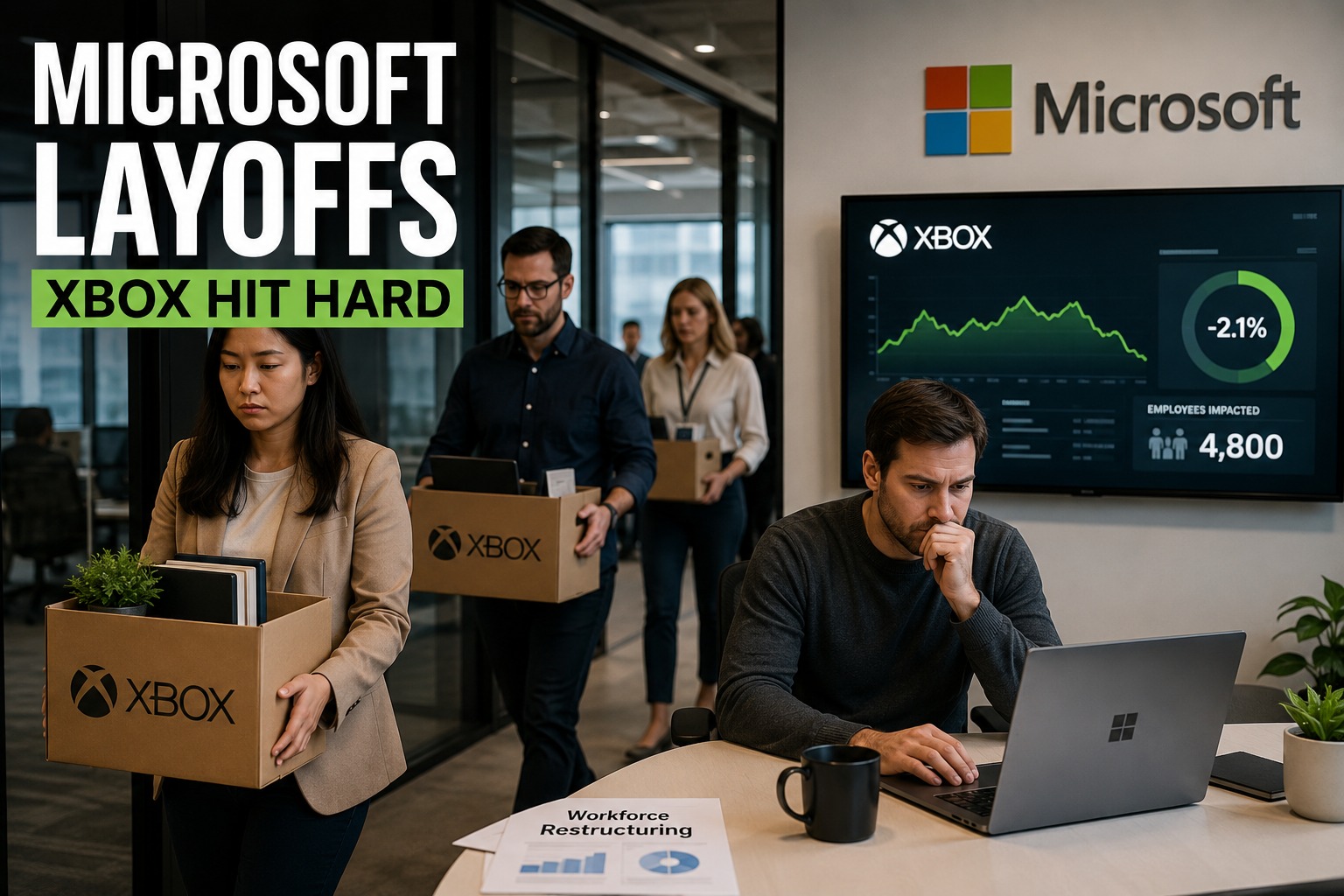
Microsoft has announced plans to lay off nearly 4,800 employees worldwide, representing around 2.1% of its global workforce. The latest round of layoffs affects several business divisions, with the Xbox gaming division emerging as one of the hardest-hit areas.
The company has confirmed that approximately 1,600 Xbox employees have already been laid off, and industry reports suggest that additional workforce reductions may follow later this year as Microsoft continues reshaping its gaming business.
The announcement comes at a time when the technology industry is experiencing significant changes driven by rising operational costs, artificial intelligence investments, shifting consumer demand, and increasing competition in the gaming market.
Why Is Microsoft Cutting Jobs?
Although Microsoft remains one of the world's most profitable technology companies, executives say the layoffs are part of a broader effort to improve operational efficiency rather than a response to immediate financial distress.
According to the company, the decision is closely tied to a major restructuring of the Xbox division. Microsoft wants to simplify its organizational structure, reduce overlapping roles, and focus resources on areas with stronger long-term growth potential.
Like many large technology companies, Microsoft regularly reviews its workforce to ensure that investments are aligned with changing market conditions. The company believes that a leaner organizational model will help it respond more quickly to industry trends and technological innovation.
Xbox Becomes the Center of the Restructuring
The Xbox division has experienced several major changes over the past few years, particularly following Microsoft's multi-billion-dollar acquisition of Activision Blizzard. Integrating such a large organization inevitably creates duplicate teams, overlapping responsibilities, and operational challenges.
As part of the restructuring process, Microsoft has already laid off around 1,600 employees from Xbox, with reports indicating that more changes may occur throughout the year.
The restructuring is expected to impact multiple departments, including game publishing, marketing, business operations, support services, and corporate functions. While game development remains a strategic priority, Microsoft appears focused on optimizing how its gaming business operates.
Leadership Explains the Decision
In a message shared with employees, Xbox Chief Executive Asha Sharma acknowledged that the gaming business continues to face significant financial pressures despite remaining operationally healthy.
According to Sharma, Microsoft's gaming division currently operates with profit margins that are estimated to be three to ten times lower than many competing platform and publishing companies.
This means that although Xbox generates substantial revenue, the overall profitability of the business remains considerably weaker than several of its biggest competitors.
Company leadership believes that improving operational efficiency is necessary to strengthen Xbox's long-term financial performance while continuing to invest in future gaming technologies.
Rising Hardware Costs Continue to Hurt the Gaming Industry
One of the major challenges highlighted by Microsoft is the ongoing increase in hardware manufacturing costs.
The global electronics supply chain has experienced years of disruption caused by inflation, component shortages, logistics costs, and higher manufacturing expenses. Although supply chains have gradually improved since the pandemic, production costs remain significantly higher than they were several years ago.
Gaming consoles rely on sophisticated processors, graphics chips, memory modules, storage devices, and specialized components. Rising prices for these parts directly increase manufacturing costs and reduce profit margins.
Unlike software, gaming hardware often generates relatively small profits, especially when companies try to keep retail prices competitive.
As a result, hardware manufacturers like Microsoft continue facing pressure to balance affordability with profitability.
Xbox Faces Intense Competition
Microsoft also acknowledged the highly competitive environment within the gaming console market.
Xbox continues to compete directly against Sony's PlayStation and Nintendo Switch, both of which have maintained strong positions in the global gaming industry.
Sony has consistently delivered high-selling exclusive game titles that attract millions of players worldwide, while Nintendo continues to dominate family-friendly gaming with its unique hybrid console approach and popular first-party franchises.
Although Microsoft has invested heavily in expanding Xbox Game Pass, cloud gaming, and game studio acquisitions, competition remains extremely intense.
Success in today's gaming market depends not only on powerful hardware but also on exclusive content, subscription services, online ecosystems, developer partnerships, and player engagement.
Microsoft's Long-Term Gaming Strategy
Despite the layoffs, Microsoft has repeatedly emphasized that gaming remains one of its core business priorities.
Rather than reducing its commitment to gaming, the company appears to be shifting its strategy toward higher-margin services and long-term digital growth.
Several major initiatives remain central to Microsoft's gaming vision:
- Continued expansion of Xbox Game Pass.
- Increased investment in cloud gaming.
- Greater integration of Activision Blizzard content.
- Development of artificial intelligence tools for game creation.
- Cross-platform gaming experiences.
- Stronger digital services and subscription revenue.
These areas typically offer better profit potential than hardware manufacturing alone and align with broader industry trends.
AI Investments Are Also Influencing Corporate Priorities
Another important factor behind Microsoft's restructuring is its aggressive investment in artificial intelligence.
Over the past two years, Microsoft has committed billions of dollars toward AI infrastructure, cloud computing, data centers, and next-generation AI products.
Building and operating large AI systems requires enormous financial resources. Companies must continuously evaluate where to allocate capital, and this often means reducing costs in slower-growing areas while increasing investment in emerging technologies.
This trend is not unique to Microsoft. Many major technology firms have simultaneously increased AI spending while reducing workforce sizes in other departments.
Impact on Employees
Large-scale layoffs inevitably create uncertainty for employees and their families.
Although Microsoft generally provides severance packages, career transition assistance, and support resources, losing a job remains a difficult experience.
Many experienced professionals from the Xbox division are expected to seek opportunities across the broader gaming and technology industries, where demand for software engineers, designers, developers, and AI specialists remains relatively strong.
Industry observers believe that while short-term disruption is unavoidable, many affected employees possess valuable skills that will continue to be in demand.
What This Means for Xbox Users
For gamers, the layoffs are unlikely to produce immediate changes in day-to-day Xbox services.
Microsoft has not announced any plans to discontinue Xbox consoles, Xbox Game Pass, or major game development projects.
However, internal restructuring may influence development timelines for certain titles, future hardware planning, or organizational priorities behind upcoming releases.
The company's focus appears to be shifting toward delivering more value through software, subscriptions, and cloud gaming rather than relying solely on console sales.
What It Means for the Technology Industry
Microsoft's latest workforce reduction reflects a broader trend across the global technology sector.
Over the past few years, many leading technology companies have announced job cuts despite maintaining healthy revenues. Businesses are increasingly prioritizing operational efficiency, automation, artificial intelligence, and sustainable profitability instead of aggressive workforce expansion.
These changes highlight how rapidly the technology landscape continues to evolve. Companies are adapting to higher costs, changing consumer behavior, and new technological opportunities while attempting to remain competitive in increasingly demanding markets.
Conclusion
Microsoft's decision to lay off nearly 4,800 employees, including approximately 1,600 workers from the Xbox division, represents one of the company's latest efforts to reshape its business for the future. While the layoffs are difficult for those directly affected, Microsoft argues that the restructuring is necessary to strengthen profitability, streamline operations, and position Xbox for long-term success.
The gaming industry is undergoing significant transformation, driven by rising hardware costs, fierce competition, digital subscriptions, cloud gaming, and artificial intelligence. Microsoft's latest actions demonstrate how even the world's largest technology companies must continually adapt to remain competitive.
Whether this restructuring ultimately strengthens Xbox will depend on Microsoft's ability to balance cost reductions with innovation, maintain player confidence, and continue delivering compelling gaming experiences in an increasingly competitive global market.