
Meta’s New AI Emotion Detection Device: A Patent That Could Change Human–Technology Interaction
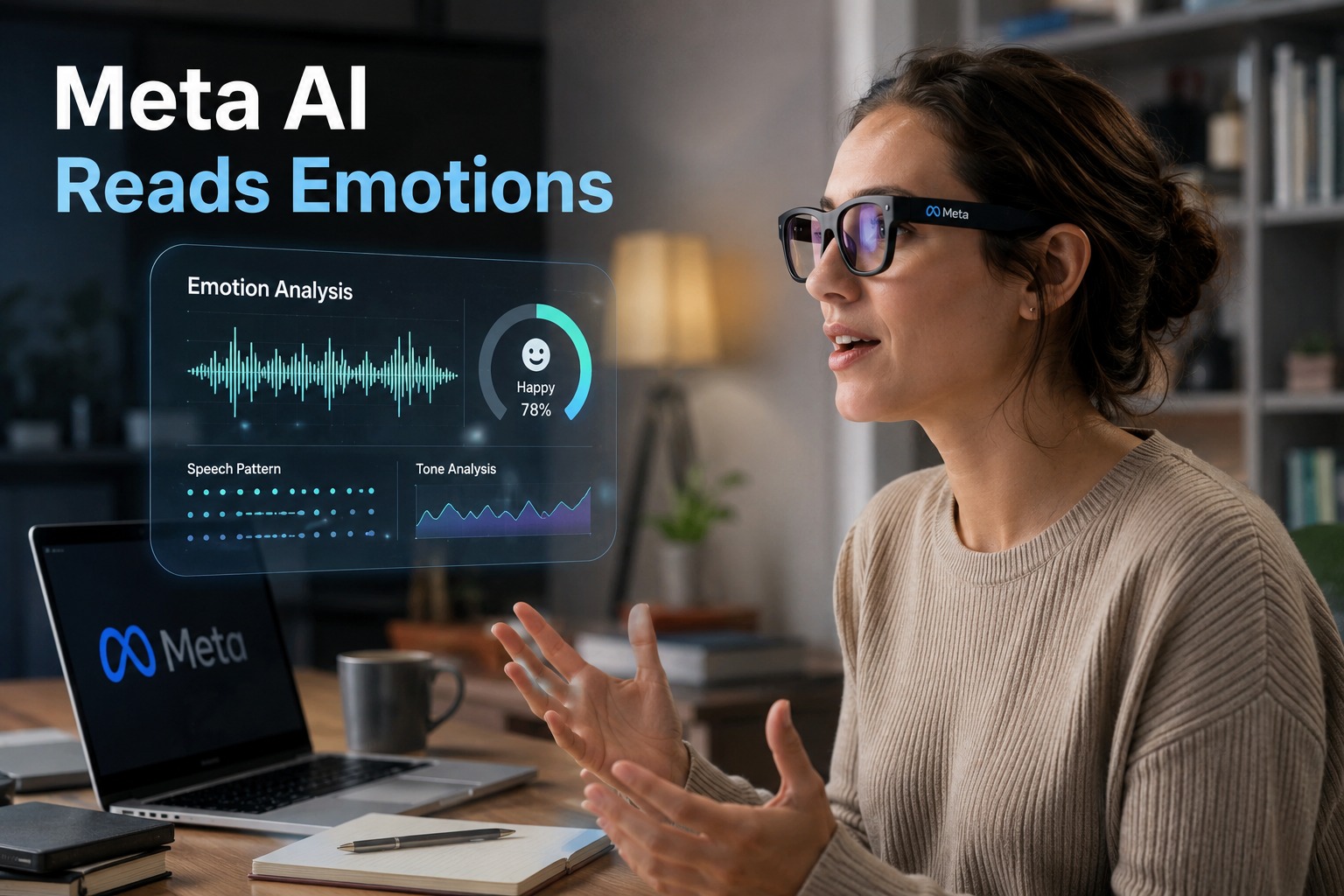
Artificial intelligence is becoming more capable of understanding not only what people say but also how they feel. In its latest move, Meta has filed a patent for an AI-powered device designed to estimate a user's emotional state by analyzing verbal and non-verbal cues. The technology could represent a significant step toward more emotionally aware AI systems, opening new possibilities for smart devices, virtual assistants, wearable technology, and augmented reality.
The patent, which was published by the United States Patent and Trademark Office (USPTO) on July 2 after being filed by Meta, describes an AI system capable of analyzing laughter, sighs, speech patterns, voice tone, pauses, and other behavioral signals to infer a person's emotions. While a patent does not necessarily mean that a commercial product will be released, it offers an interesting glimpse into the company's long-term vision for human-computer interaction.
Why Is Meta Building an Emotion Detection AI?
Technology has become increasingly personalized over the past decade. Smartphones recommend content based on user behavior, streaming platforms suggest movies according to viewing history, and AI assistants can answer increasingly complex questions.
However, today's AI systems often lack emotional awareness. They may understand words but struggle to recognize whether a person is excited, frustrated, anxious, tired, or happy. Meta's new patent appears to address this limitation by giving AI the ability to interpret emotional signals during conversations and interactions.
The idea is simple but ambitious: if technology can understand how people feel, it can respond in a more helpful, empathetic, and natural way.
For example, instead of responding with generic answers, an AI assistant might detect stress in a user's voice and choose a calmer communication style. Likewise, an augmented reality headset could adapt notifications or experiences based on the user's emotional condition.
How the AI Emotion Detection System Works
According to the patent description, the proposed device would use artificial intelligence to analyze a combination of verbal and non-verbal indicators.
Rather than relying on a single signal, the system would evaluate multiple inputs simultaneously. These may include:
- Speech rhythm and speed
- Voice pitch and tone
- Laughter
- Sighing
- Hesitation and pauses
- Speaking style
- Other vocal expressions and behavioral cues
Machine learning algorithms would compare these patterns with previously learned emotional models to estimate whether the user is experiencing emotions such as happiness, sadness, excitement, frustration, fatigue, or stress.
This multi-signal approach is important because emotions are complex. A person may smile while feeling nervous or speak loudly because of excitement rather than anger. By combining different indicators, the AI aims to improve accuracy instead of depending on one expression or sound alone.
Potential Applications Across Meta's Ecosystem
Although the patent does not confirm where the technology will eventually be used, several possible applications align with Meta's existing products and future ambitions.
Smarter AI Assistants
Meta has invested heavily in conversational AI. Emotion-aware assistants could provide responses that better match a user's emotional state.
For instance, if someone sounds confused, the assistant could slow down its explanations. If the user appears frustrated, it could offer simpler solutions or additional guidance.
Augmented Reality and Smart Glasses
Meta continues developing wearable devices such as smart glasses and mixed reality headsets. An emotion recognition system could make these devices more adaptive.
Imagine wearing smart glasses during a meeting. The system could recognize signs of mental fatigue and recommend taking a short break or reducing notification interruptions.
Similarly, virtual environments could automatically adjust lighting, sound, or interaction styles depending on the user's mood.
Improved Accessibility
Emotion-aware AI could also help people with communication challenges.
Individuals who have difficulty expressing emotions verbally might benefit from systems that recognize subtle vocal patterns and provide supportive communication tools.
Likewise, digital assistants could become more effective companions for elderly users by detecting signs of distress or confusion during conversations.
Personalized Content Recommendations
Meta already uses AI to recommend videos, posts, and advertisements.
If emotional awareness were incorporated responsibly, future recommendation systems might prioritize uplifting or relaxing content when users appear stressed or avoid presenting emotionally overwhelming material during sensitive moments.
However, such applications would require careful privacy protections and transparent user consent.
The Technology Behind Emotion Recognition
Emotion recognition AI is built using machine learning and large datasets containing examples of human speech, facial expressions, and behavioral patterns.
During training, algorithms learn to associate particular combinations of signals with different emotional states.
For example:
- A slow speaking pace combined with long pauses may suggest sadness or fatigue.
- Rapid speech and elevated pitch could indicate excitement.
- Frequent sighs alongside reduced vocal energy might signal stress.
Modern AI models do not simply search for one characteristic. Instead, they identify complex relationships between many features simultaneously.
Researchers continue improving these systems because human emotions are highly nuanced and influenced by personality, culture, language, and context.
Challenges in Reading Human Emotions
Despite impressive progress, emotion recognition remains one of the most difficult areas of artificial intelligence.
Human emotions are rarely straightforward.
Two people experiencing the same emotion may express it differently. Cultural differences also influence how emotions are communicated. A loud speaking style may be completely normal in one culture but interpreted as anger in another.
Similarly, laughter does not always indicate happiness. People sometimes laugh because they are nervous, embarrassed, or uncomfortable.
Because of these complexities, AI systems can make incorrect assumptions if they rely solely on behavioral signals.
This is why researchers increasingly combine multiple data sources and continuously refine their models to improve reliability.
Privacy Concerns and Ethical Questions
Whenever AI attempts to interpret personal emotions, privacy becomes a major concern.
Unlike ordinary personal information, emotional data can reveal highly sensitive aspects of an individual's mental state and behavior.
Privacy advocates argue that companies developing emotion recognition technology must clearly explain:
- What information is being collected
- How long it will be stored
- Who can access the data
- Whether users can opt out
- How the information will be protected
Transparency and informed consent will likely become essential requirements if such technologies reach consumers.
Many experts also emphasize that emotional analysis should never be performed secretly or without user permission.
Patent Filing Does Not Guarantee a Product
It is important to remember that technology companies file thousands of patents every year.
Many patented ideas never become commercial products.
Patents primarily protect innovative concepts and allow companies to secure intellectual property while continuing research and development.
Meta's emotion detection device may eventually appear in future AI assistants, wearable products, or mixed reality platforms. On the other hand, the company may choose to modify the technology significantly or never release it publicly.
Therefore, the patent should be viewed as an indication of Meta's research direction rather than confirmation of an upcoming consumer device.
The Growing Race for Emotion-Aware AI
Meta is not alone in exploring emotionally intelligent artificial intelligence.
Technology companies and academic researchers worldwide are studying ways to make AI systems more capable of understanding human communication beyond simple text recognition.
The broader goal is often referred to as "affective computing," a field focused on enabling computers to recognize, interpret, and respond to human emotions.
Future AI systems may combine speech analysis, facial expressions, body language, physiological signals, and contextual understanding to deliver more natural interactions.
As competition in generative AI intensifies, emotional intelligence could become another important feature that differentiates next-generation digital assistants.
What This Could Mean for Everyday Users
If developed responsibly, emotion-aware AI has the potential to improve user experiences across many digital products.
Virtual assistants may become more supportive, customer service interactions could feel less robotic, educational software might adapt to students' frustration levels, and healthcare applications could provide earlier emotional support.
However, these benefits must be balanced with strong privacy safeguards, transparent policies, and user control over personal data.
Public trust will likely determine how widely emotion recognition technologies are accepted.
Conclusion
Meta's newly published patent highlights an ambitious vision for the future of artificial intelligence—one where devices do more than process language and commands. By analyzing laughter, sighs, speech patterns, and other verbal and non-verbal signals, AI could one day better understand the emotional context behind human communication.
Although the patent does not confirm that such a device will reach the market, it reflects a broader industry trend toward creating more emotionally intelligent technology. If implemented responsibly, with clear privacy protections and ethical safeguards, emotion-aware AI could make digital interactions more natural, personalized, and genuinely helpful.
As AI continues evolving, the next major breakthrough may not be teaching machines to think like humans—but helping them better understand how humans feel.