Japan Reaches a Major Milestone with Successful Reusable Rocket Landing
Space exploration is entering a new era where launching rockets is no longer the only challenge—bringing them back safely for reuse has become just as important. Countries around the world are investing heavily in reusable launch technology because it dramatically lowers the cost of space missions and makes frequent launches more practical. Japan has now taken a significant step in this direction.
The Japan Aerospace Exploration Agency (JAXA) has successfully completed its first experimental flight and landing of a reusable rocket vehicle, marking a historic achievement for the country's space program. While the demonstration was relatively small in scale, its technological significance is enormous. It represents years of engineering research and could lay the foundation for Japan's next generation of reusable launch systems.
Japan Successfully Tests a Reusable Rocket
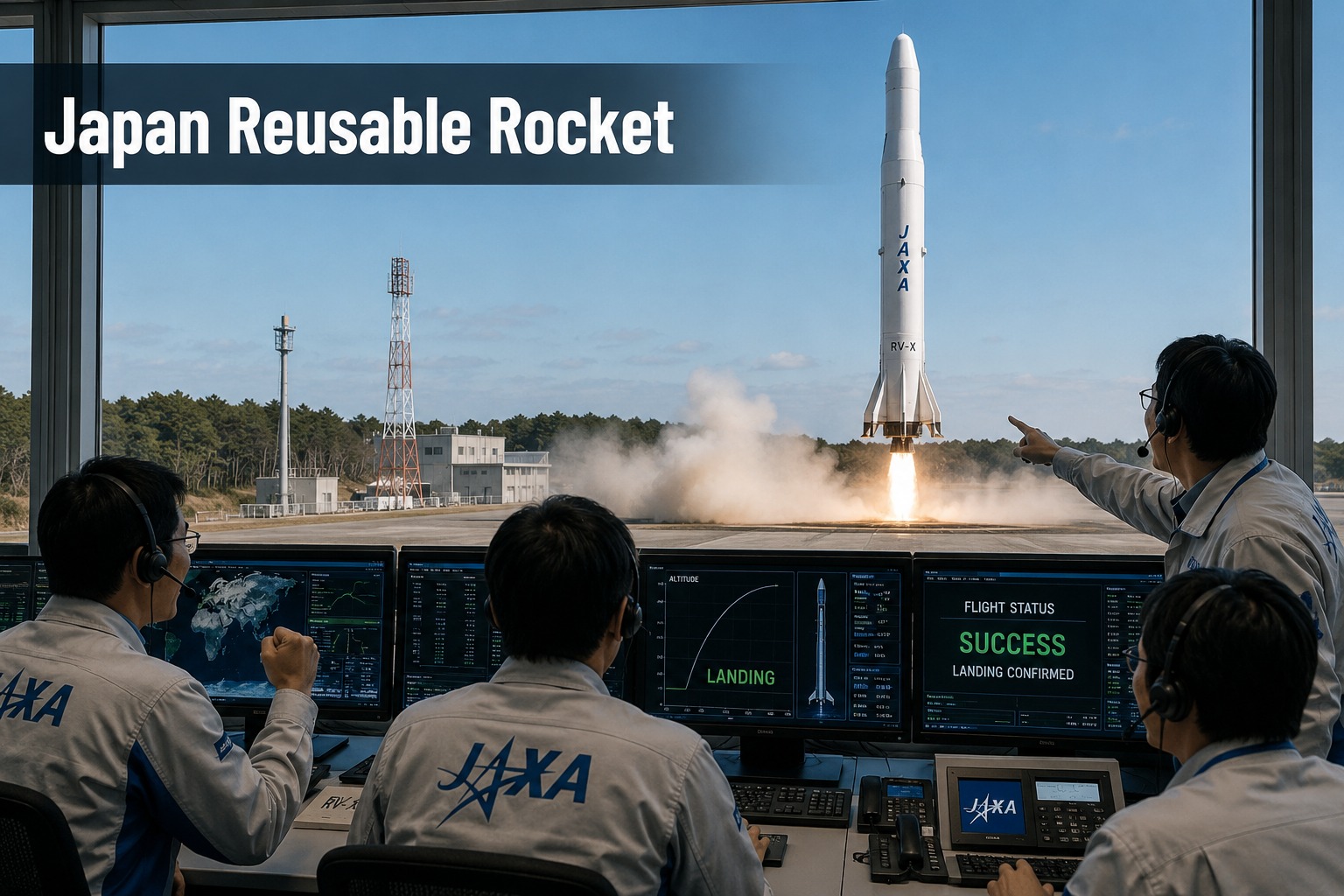
JAXA recently conducted a successful test of its Reusable Vehicle Experiment (RV-X) at the Noshiro Testing Center in northeastern Japan. During the trial, the experimental rocket lifted off vertically, reached an altitude of approximately 11 meters, hovered briefly, and then landed safely in an upright position around 16 meters away from its launch point.
Although the flight lasted only a short time, the test validated several critical technologies required for reusable rocket systems. Achieving a controlled vertical takeoff, maintaining stability during flight, and performing a precise vertical landing are among the most difficult engineering challenges in modern aerospace.
For JAXA, the successful demonstration proves that its guidance, navigation, propulsion, and landing systems are functioning as intended in real-world conditions.
Why Reusable Rockets Matter
For decades, most rockets used for space missions were designed for only one flight. After delivering satellites or spacecraft into orbit, large portions of these rockets fell into the ocean or burned up in the atmosphere. This meant that expensive hardware had to be rebuilt for every launch, making space missions extremely costly.
Reusable rockets completely change this economic model.
Instead of discarding major components after a single launch, engineers recover them, inspect them, and prepare them for future missions. This approach significantly reduces manufacturing costs while increasing launch frequency.
The concept is similar to commercial aviation. Airplanes are not built for one flight; they fly thousands of times throughout their service life. Space agencies hope reusable rockets can eventually operate in a similar way, making access to space more affordable and efficient.
The Technology Behind Vertical Landing
Landing a rocket safely is much more complicated than launching one.
As the vehicle descends, onboard computers must continuously calculate its speed, altitude, orientation, and environmental conditions. Small adjustments to engine thrust and steering controls must occur in real time to keep the rocket perfectly balanced.
The reusable vehicle tested by JAXA relies on sophisticated flight software, precision sensors, and advanced propulsion control systems to perform these tasks automatically.
Even though the recent flight reached only about 11 meters, it allowed engineers to validate critical technologies such as:
- Autonomous flight control
- Precision engine throttling
- Stable hovering capability
- Controlled descent
- Accurate vertical landing
Each successful test provides valuable engineering data that will support larger and more complex reusable launch vehicles in the future.
Why This Test Is Important for Japan
Japan has long been recognized for producing reliable satellites, scientific spacecraft, and launch vehicles. However, reusable rocket technology represents a relatively new area of competition within the global space industry.
This successful experiment demonstrates Japan's commitment to remaining competitive in future space transportation.
Developing reusable launch systems offers several long-term advantages:
Lower Launch Costs
Building a new rocket for every mission is extremely expensive. Recovering and reusing hardware can significantly reduce operational costs over time.
More Frequent Space Missions
Affordable rockets allow space agencies and commercial companies to launch satellites more often, supporting communications, weather forecasting, Earth observation, and scientific research.
Stronger Commercial Space Industry
Private companies increasingly seek affordable launch services. Reusable rockets could help Japan become a more attractive launch provider in the growing global space market.
Improved Technological Independence
Mastering reusable launch technology strengthens Japan's domestic aerospace capabilities and reduces dependence on foreign launch systems.
A Growing Global Race
Japan joins several leading space organizations pursuing reusable rocket technology.
In recent years, reusable launch systems have transformed the economics of spaceflight. Successful vertical landings have demonstrated that rocket recovery is no longer just an experimental concept but a practical operational capability.
Many countries are now investing in reusable technologies because they understand that future space exploration—including satellite deployment, lunar missions, and eventually Mars exploration—will require lower launch costs and higher launch frequencies.
Japan's latest achievement signals that it intends to play an increasingly important role in this evolving landscape.
What Makes the RV-X Different?
The Reusable Vehicle Experiment (RV-X) is not intended to reach orbit or carry payloads into space. Instead, it serves as a technology demonstrator.
Its primary purpose is to test critical systems in a controlled environment before engineers apply them to larger launch vehicles.
Technology demonstrators allow engineers to identify problems early, improve software, refine engine performance, and validate safety systems without risking expensive orbital missions.
Every successful experimental flight reduces uncertainty and builds confidence for future projects.
Challenges That Still Remain
Despite this milestone, developing a fully reusable orbital rocket remains an enormous engineering challenge.
Future systems must operate under far more demanding conditions than those experienced during this low-altitude test.
Engineers must solve issues including:
- High-speed atmospheric re-entry
- Extreme heat protection
- Long-duration engine reliability
- Fuel efficiency
- Structural durability over multiple flights
- Rapid refurbishment between launches
Each of these challenges requires years of testing, refinement, and technological innovation.
The recent RV-X flight represents an important first step rather than the final destination.
What This Means for Future Space Exploration
Reusable launch technology could transform nearly every aspect of the space industry.
Lower launch costs make it economically feasible to deploy larger satellite constellations, conduct more scientific missions, and expand international collaboration in space research.
Future lunar exploration, asteroid missions, and deep-space expeditions will all benefit from more affordable launch systems.
Japan's investment in reusable technology could also support commercial opportunities, including satellite deployment services, space-based research, and emerging industries such as in-orbit manufacturing.
As launch costs continue to decline globally, countries with advanced reusable technologies will be better positioned to compete in the rapidly expanding space economy.
Looking Ahead
Although the recent test involved only a short vertical flight, its significance extends far beyond the 11-meter altitude achieved during the demonstration.
Every successful experiment builds the technological foundation needed for larger, more capable reusable launch vehicles. Engineers will now analyze flight data, refine control systems, and conduct additional tests with increasingly ambitious objectives.
If progress continues, Japan could eventually develop reusable rockets capable of supporting both scientific exploration and commercial launch services, strengthening its position in the global aerospace industry.
Conclusion
JAXA's successful test of the Reusable Vehicle Experiment marks an important milestone in Japan's journey toward reusable space transportation. The controlled launch, stable flight, and precise vertical landing demonstrate that the agency has made meaningful progress in mastering one of the most complex technologies in modern aerospace engineering.
While considerable work remains before Japan operates fully reusable orbital rockets, this achievement highlights the country's growing ambitions in the global space sector. As reusable launch systems continue to reshape the economics of space exploration, milestones like the RV-X test bring the vision of more affordable, sustainable, and frequent access to space one step closer to reality.