
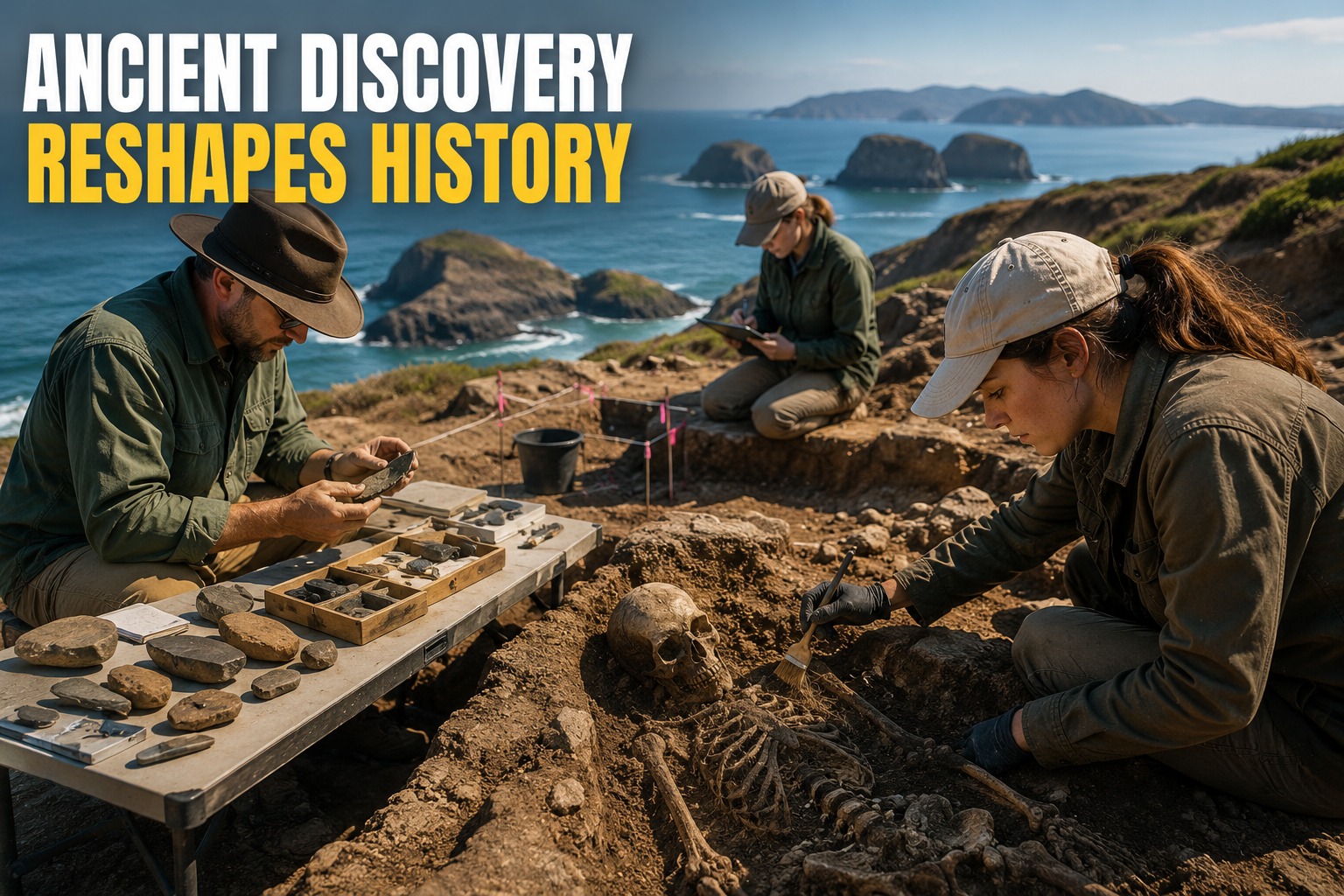
Ancient Human Remains Found in California Could Rewrite the Story of America's First Settlers
For decades, scientists have believed that the first humans arrived in the Americas by crossing a land bridge known as Beringia, which once connected present-day Siberia and Alaska during the last Ice Age. According to this widely accepted theory, these early settlers gradually spread southward across North America before eventually reaching other parts of the continent. However, an extraordinary archaeological discovery on California's Channel Islands is challenging that long-held belief and opening a fascinating new chapter in the story of human migration.
Researchers have uncovered approximately 13,000-year-old human remains, ancient settlements, and stone tools on the Channel Islands, located off the coast of Southern California. These discoveries suggest that some of the earliest inhabitants of North America may have traveled by sea instead of relying solely on land routes. If future research continues to support this idea, it could significantly reshape our understanding of how the Americas were first populated.
Why This Discovery Matters
The history of the first Americans has remained one of archaeology's greatest mysteries. While researchers generally agree that humans reached the Americas during the late Ice Age, there has been ongoing debate over exactly when they arrived and which routes they used.
The newly discovered archaeological evidence from the Channel Islands adds an important piece to this puzzle. These islands were never connected to mainland California, even when sea levels were much lower during the Ice Age. This means that anyone living there around 13,000 years ago must have crossed several kilometers of open water.
Such a journey would have required more than simple survival skills. It would indicate that these ancient people possessed advanced knowledge of boat-building, navigation, fishing, and coastal living far earlier than many traditional migration models suggest.
What Was Found on the Channel Islands?
Archaeologists working on California's Channel Islands uncovered a remarkable collection of ancient evidence, including:
- Human skeletal remains estimated to be around 13,000 years old.
- Stone tools believed to have been used for hunting and daily survival.
- Ancient habitation sites that indicate long-term human occupation.
- Animal remains and marine resources showing that these early communities relied heavily on coastal ecosystems.
Together, these discoveries paint the picture of people who had adapted remarkably well to island life. Rather than being temporary visitors, they appear to have established thriving communities capable of exploiting both land and marine resources.
Could America's First Settlers Have Arrived by Boat?
One of the most exciting implications of the discovery is the growing support for the "Coastal Migration Theory."
Unlike the traditional Ice-Free Corridor theory, which proposes that humans traveled south through an inland passage after glaciers retreated, the coastal migration model suggests that early humans moved along the Pacific coastline using simple watercraft.
This route may have offered several advantages. Coastal environments provided abundant seafood, fresh water, and relatively mild climates. Instead of waiting for massive glaciers to melt completely, migrating groups could have followed the coastline while stopping at resource-rich locations like the Channel Islands.
The archaeological evidence found on these islands strengthens this possibility because reaching them would have required intentional sea travel. Even though the islands were somewhat closer to the mainland during the Ice Age due to lower sea levels, crossing open water was still unavoidable.
The Role of Rising Sea Levels
Understanding ancient migration is challenging because much of the evidence may now lie underwater.
At the end of the last Ice Age, global sea levels rose dramatically as glaciers melted. Large portions of ancient coastlines were submerged beneath the ocean. If early humans primarily traveled along the Pacific coast, many of their campsites, villages, and migration routes may now be hidden underwater.
This makes discoveries like those on the Channel Islands especially valuable. They provide rare archaeological evidence from a period when many coastal sites have disappeared beneath the sea.
Scientists believe future underwater archaeological research could uncover even older evidence of human settlement, potentially pushing the timeline of America's first inhabitants back even further.
Comparing the Two Migration Theories
For many years, the land bridge theory dominated textbooks and archaeological discussions. According to this model, humans migrated from northeastern Asia into Alaska via Beringia before traveling south through an opening between massive ice sheets.
However, growing archaeological evidence has revealed problems with this explanation. Some ancient sites in the Americas appear to be older than the period during which the inland migration corridor became fully accessible.
The coastal migration theory offers an alternative explanation. It suggests that small groups of hunter-gatherers traveled by boat along the Pacific coastline, gradually moving south while taking advantage of marine food sources.
Rather than replacing the land bridge theory entirely, many researchers now believe both routes may have been used. Different human groups could have entered the Americas at different times using multiple migration paths.
Evidence Beyond California
The discoveries on the Channel Islands are not isolated findings.
Other archaeological sites across North and South America have also challenged traditional migration timelines. Locations such as Monte Verde in Chile and several pre-Clovis sites in North America indicate that humans may have arrived earlier than once believed.
These discoveries suggest that human migration into the Americas was likely more complex than previously imagined. Instead of a single migration event, there may have been multiple waves of migration spanning thousands of years.
The California findings contribute another important piece of evidence supporting this broader and more nuanced picture.
What This Tells Us About Early Human Technology
If people were traveling across open water 13,000 years ago, they were far more technologically capable than many assume.
Building seaworthy boats requires careful planning, suitable materials, and engineering knowledge. Successful ocean crossings also demand navigation skills, an understanding of tides and weather, and the ability to transport families, tools, and food safely.
These early coastal communities were likely highly adaptable and innovative. Their ability to survive on islands demonstrates impressive knowledge of fishing techniques, marine hunting, food preservation, and environmental awareness.
Rather than primitive wanderers, these people were skilled explorers capable of adapting to challenging environments.
Why Archaeologists Remain Cautious
Although the discovery is exciting, scientists are careful not to draw final conclusions too quickly.
Archaeological research depends on careful dating techniques, repeated excavations, and independent verification. Researchers continue analyzing the remains, stone tools, sediment layers, and environmental conditions surrounding the discoveries.
As new technologies such as DNA analysis, radiocarbon dating, and underwater mapping improve, researchers hope to build a clearer picture of how these early communities lived and where they originated.
Science advances through evidence, and each new discovery helps refine rather than completely replace previous theories.
What This Means for the History of the Americas
If ongoing research confirms that early humans reached the Channel Islands by boat around 13,000 years ago, history books may require significant updates.
The discovery highlights that human migration was likely more diverse, flexible, and technologically advanced than previously believed. Instead of following one simple route, ancient people may have explored multiple pathways, adapting to changing climates and landscapes as they spread across new continents.
It also emphasizes the importance of coastal archaeology. Since many ancient shorelines now lie beneath the ocean, future underwater discoveries may reveal even earlier chapters of human history that remain hidden today.
Each archaeological discovery reminds us that history is never completely settled. New evidence continues to challenge assumptions, encouraging scientists to ask better questions and develop more accurate explanations of our shared past.
Conclusion
The discovery of approximately 13,000-year-old human remains and archaeological sites on California's Channel Islands represents one of the most intriguing developments in the study of America's earliest inhabitants. While further research is needed, the findings strengthen the possibility that some of the continent's first settlers traveled by sea rather than exclusively by land.
If confirmed, this evidence would not only reshape our understanding of ancient migration but also highlight the remarkable ingenuity and adaptability of early humans. Their ability to navigate coastal environments, cross open water, and establish thriving communities demonstrates that humanity's spirit of exploration stretches back much further than once imagined.
As archaeologists continue investigating these ancient sites and searching submerged coastlines, the story of how humans first reached the Americas is likely to become even richer, more complex, and more fascinating than ever before.