
World’s Most Powerful Solar Telescope Reveals Astonishing New Details of the Sun
For centuries, the Sun has appeared to us as a brilliant, almost featureless disk in the sky. Modern telescopes changed that picture, revealing sunspots, prominences, magnetic fields and enormous eruptions. But even the most advanced instruments have struggled to show what happens on the smallest scales of the Sun’s visible surface.
Now, scientists have taken another major step forward.
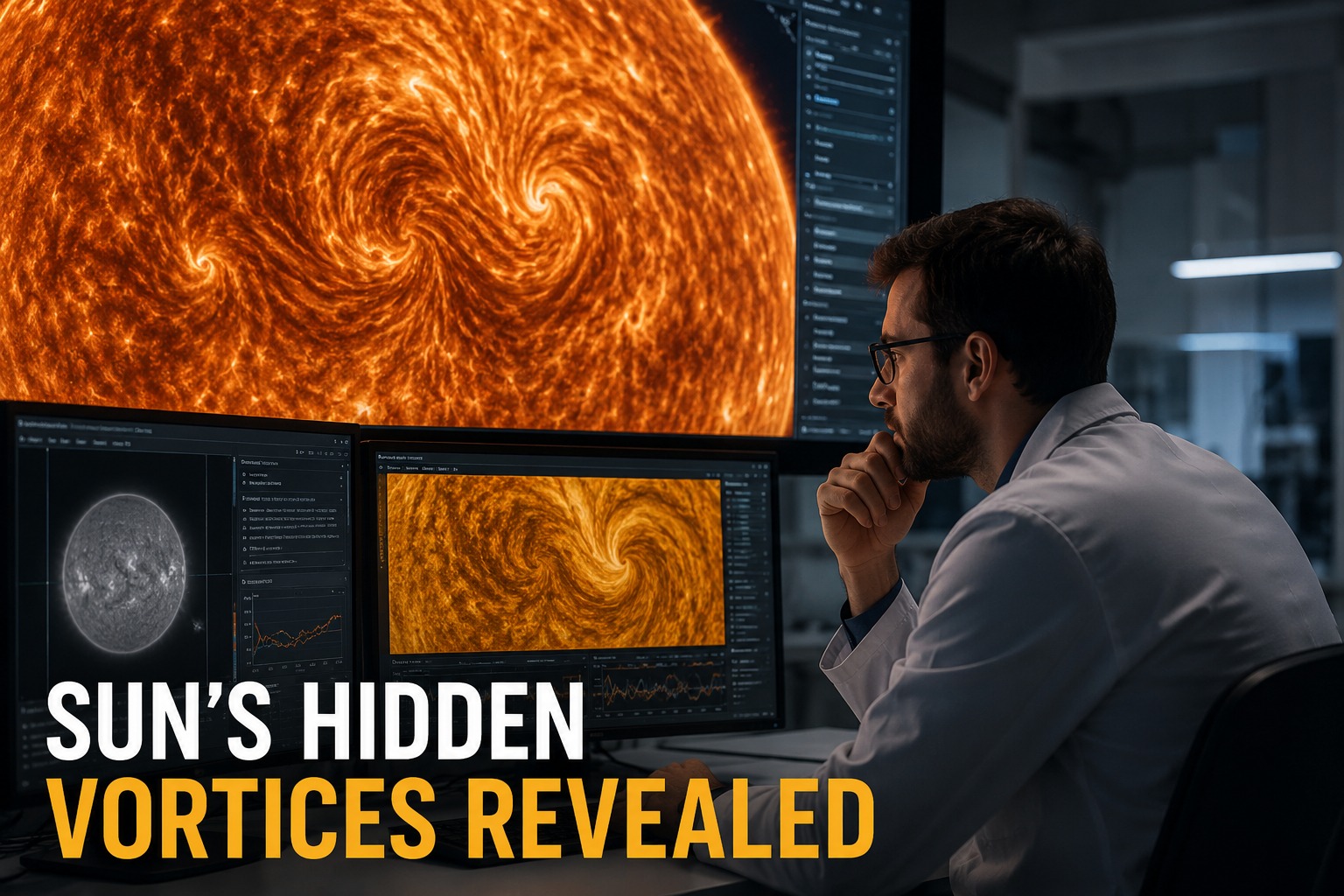
Using the Daniel K. Inouye Solar Telescope (DKIST) in Hawaii, researchers have obtained some of the most detailed observations of the Sun’s surface ever recorded. The images and time-sequence observations reveal tiny, swirling structures in the solar atmosphere that resemble miniature whirlpools. These patterns are associated with a physical process known as Kelvin–Helmholtz instability, which occurs when layers of fluid or plasma move at different speeds.
The discovery is important because these structures had been predicted by theory but had not previously been directly identified with such clarity on the Sun’s visible surface. The observations provide scientists with a new way to study how plasma flows, magnetic fields interact and energy moves through the solar atmosphere.
A New Window Into the Sun’s Violent Surface
The Sun may look smooth from Earth, but its visible surface is anything but calm.
What astronomers call the photosphere is a constantly changing layer of hot plasma. Huge convection cells rise and fall as energy generated deep inside the Sun makes its way toward the surface. Hot material rises, cools and sinks again, creating a turbulent pattern that resembles boiling liquid.
Earlier observations from the Inouye Solar Telescope had already revealed extraordinary details in this process. The telescope’s first-light images showed structures as small as roughly 30 kilometres across, exposing the cellular pattern created by convection and tiny concentrations of magnetic fields.
The latest observations push this capability even further. Researchers were able to resolve structures smaller than about 20 kilometres in the relevant observations, exposing fine patterns that had previously been hidden within the blurred appearance of the solar surface.
Instead of seeing a relatively uniform layer of glowing gas, scientists can now examine an incredibly dynamic environment filled with moving plasma, narrow magnetic boundaries and rapidly changing structures.
That difference is more than an improvement in image quality. It allows researchers to investigate physical processes that occur on scales that were previously inaccessible.
What Are the Strange Solar Vortices?
The newly observed structures look like small whirlpools or waves curling around one another.
They are associated with Kelvin–Helmholtz instability, a well-known phenomenon in fluid dynamics. The basic idea is relatively simple: when two layers of fluid move past each other at different speeds, the boundary between them can become unstable.
Small disturbances along that boundary can grow. Instead of remaining a smooth dividing line, the interface begins to develop waves and eventually rolls into characteristic spiral or vortex-like shapes.
The same underlying physics can appear in many environments. On Earth, Kelvin–Helmholtz instability can occur when different layers of air move at different speeds, producing distinctive cloud formations. Similar processes have also been observed in planetary atmospheres and around Earth's magnetosphere.
The Sun, however, presents a much more extreme environment because the fluid is not ordinary gas. It is plasma—electrically charged matter that interacts strongly with magnetic fields.
That makes the solar version of the phenomenon considerably more complicated.
The new observations provide evidence that these instabilities occur widely around small magnetic concentrations in the solar photosphere. Researchers compared the observations with sophisticated numerical simulations and found that the simulated structures closely matched important characteristics of the observed patterns.
Why Magnetic Fields Matter So Much
To understand why the discovery matters, it is necessary to understand the Sun's magnetic personality.
The Sun is not simply a giant ball of hot gas. Its plasma is constantly moving, and those motions generate and reshape magnetic fields. These fields can become concentrated, twisted, stretched and tangled.
Sunspots are among the most obvious examples. They appear darker than their surroundings because powerful magnetic fields inhibit some of the normal movement of hot plasma. Around sunspots, scientists can observe complex structures where magnetic fields interact with rapidly moving material.
The newly observed vortices appear at boundaries associated with magnetic structures. As plasma moves, it can drag and distort magnetic field lines. The resulting motions can twist and braid those fields, potentially allowing magnetic energy to accumulate.
Eventually, magnetic energy can be released through processes such as magnetic reconnection, contributing to powerful solar eruptions.
This does not mean that every small vortex produces a solar flare. Rather, the discovery gives scientists another piece of the much larger puzzle describing how energy and magnetic structure evolve on the Sun.
The Possible Connection to Solar Flares
Solar flares are among the most energetic events in the solar system.
A flare occurs when magnetic energy stored in the solar atmosphere is rapidly converted into other forms of energy, producing intense radiation and accelerating charged particles. The Sun can also launch enormous clouds of magnetized plasma known as coronal mass ejections, or CMEs.
These eruptions can become important for Earth when they interact with our planet's magnetic environment.
Scientists have long wanted to understand exactly how the Sun stores magnetic energy and how that energy eventually escapes. The new observations could help answer part of that question.
The tiny vortex structures show how motions on relatively small scales can interact with magnetic fields. The instability can transport mass, momentum and energy while also helping rearrange magnetic structures. Researchers believe this process could contribute to magnetic-field braiding and the transfer of energy into higher layers of the solar atmosphere.
However, scientists are still working to determine how these small-scale processes connect quantitatively to major solar eruptions. It would therefore be premature to describe the vortices as a single direct cause of solar flares.
Their importance is that they reveal a previously hidden part of the physical machinery operating beneath larger solar phenomena.
Could These Vortices Help Explain the Sun’s Hot Corona?
One of the biggest mysteries in solar physics is known as the coronal heating problem.
The Sun's visible surface has a temperature of roughly 5,500°C, while its outer atmosphere, the corona, can reach temperatures of more than one million degrees Celsius.
At first glance, this seems backwards. Why should the atmosphere above the Sun be dramatically hotter than the surface beneath it?
Scientists have proposed several mechanisms involving magnetic fields, waves, turbulence and small-scale energy releases. But no single explanation has completely solved the problem.
The newly observed Kelvin–Helmholtz instabilities could provide an important clue.
Because these structures occur where plasma flows interact with magnetic fields, they may help move and redistribute energy through the solar atmosphere. Their turbulent motions can potentially contribute to the transfer and dissipation of energy at small scales.
The researchers therefore see the observations as relevant not only to solar surface dynamics but also to the broader question of how energy travels upward through the solar atmosphere.
The discovery does not solve the coronal heating mystery by itself. Instead, it identifies a physical process that scientists can now investigate directly rather than relying only on theoretical models.
Why the Daniel K. Inouye Solar Telescope Is So Powerful
The breakthrough was made possible by the exceptional capabilities of the Daniel K. Inouye Solar Telescope, operated by the U.S. National Solar Observatory on Maui, Hawaii.
The telescope is a four-metre-class solar observatory and has the largest solar telescope mirror in the world. Its enormous light-gathering capability and advanced instruments allow researchers to study extremely small features on the Sun.
One of the major challenges in solar astronomy is that Earth’s atmosphere constantly distorts incoming light. Even a theoretically perfect telescope can lose detail when looking through turbulent air.
The Inouye telescope uses sophisticated technology to compensate for atmospheric distortion, allowing it to approach the theoretical resolution of its optics.
Its instruments can also record the Sun at high speed. Recent reporting indicates that the FastCam system used in the work can capture hundreds of images every second, allowing researchers to follow rapidly changing structures rather than simply taking isolated snapshots.
That combination—high spatial resolution and high temporal resolution—is particularly valuable for studying plasma instabilities.
A structure that changes quickly could easily disappear in a conventional observation. With high-speed imaging, scientists can watch the process unfold.
From Beautiful Images to Scientific Evidence
The visual appearance of the new observations is certainly spectacular. Some of the swirling structures have been compared to the brushstrokes of Vincent van Gogh's The Starry Night.
But their scientific value goes far beyond their beauty.
A photograph alone cannot prove what a particular structure represents. Researchers must determine whether the observed shapes and motions agree with the predictions of physical models.
In this case, scientists combined high-resolution observations with computer simulations. The simulations reproduced important features of the observed Kelvin–Helmholtz patterns, strengthening the interpretation that the structures are generated by velocity differences and magnetic interactions in the solar plasma.
This combination of observation and modelling is becoming increasingly important in modern solar physics.
Observations tell researchers what the Sun is actually doing. Computer models allow them to test possible explanations. When the two agree, confidence in the physical interpretation becomes much stronger.
What This Could Mean for Space Weather
The Sun's activity is not just an astronomical curiosity.
Solar flares and CMEs can send radiation and charged particles toward Earth. When these disturbances interact with Earth's magnetic field, they can produce space weather.
Strong space-weather events can interfere with satellite operations, radio communications and navigation systems. They can also induce electrical currents in power infrastructure and create spectacular auroras at high and sometimes lower latitudes.
Modern society has become increasingly dependent on technologies that operate in space or rely on satellites. GPS navigation, communications, weather monitoring and many other systems can be affected by severe solar activity.
That makes understanding the physics behind solar eruptions practically important.
The new discovery is not yet a forecasting system. Scientists cannot look at one of these vortices and accurately predict that a particular flare or CME will occur.
But improving our understanding of the physical processes that precede and accompany solar eruptions is an essential step toward better space-weather models.
A Discovery That Changes the Scale of Solar Physics
Perhaps the most important aspect of this research is the change in scale it represents.
For a long time, astronomers studied the Sun using relatively large structures such as sunspots, active regions and giant magnetic loops. Modern instruments are allowing researchers to move toward increasingly smaller structures.
The newly observed vortices demonstrate that apparently tiny motions can be part of larger magnetic processes.
This is important because the Sun operates across an enormous range of scales. Energy generated deep inside the star eventually influences the surface and atmosphere, while small magnetic structures can participate in processes that ultimately contribute to much larger eruptions.
The ability to observe these small structures directly gives scientists a new opportunity to connect the dots between microscopic—or at least very small-scale—plasma processes and large-scale solar behaviour.
What Scientists Will Study Next
The discovery raises almost as many questions as it answers.
Researchers will want to determine how frequently these instabilities occur, how long they survive, how their properties change with magnetic-field strength and whether their behaviour differs between quiet and highly active regions.
Another major question is how efficiently these vortices transport energy upward.
Future observations may combine the Inouye telescope with spacecraft observing the Sun from space. Instruments aboard missions such as Solar Orbiter can provide complementary views of the solar atmosphere, while other spacecraft can monitor the solar wind and the effects of solar eruptions farther from the Sun.
Combining these different observations could eventually allow researchers to follow the chain from small-scale plasma motion to magnetic restructuring, solar eruptions and ultimately space weather near Earth.
Frequently Asked Questions
What did the new solar images reveal?
The observations revealed extremely fine, swirling plasma structures on the Sun's visible surface. Researchers identify these structures with Kelvin–Helmholtz instabilities occurring around magnetic concentrations.
What is Kelvin–Helmholtz instability?
It is an instability that develops when neighbouring layers of fluid or plasma move at different speeds. Small disturbances can grow into waves and vortex-like structures.
Which telescope captured the images?
The observations were made using the Daniel K. Inouye Solar Telescope in Hawaii, operated by the National Solar Observatory.
Can the vortices cause solar flares?
They may contribute to the processes that store, transport and redistribute magnetic energy, but scientists are still determining exactly how these small-scale structures connect to major solar eruptions. It is more accurate to describe them as a potentially important part of the Sun's magnetic-energy system rather than as a single direct cause of flares.
Why is this discovery important for Earth?
A better understanding of how the Sun's magnetic energy develops and is released could eventually improve scientific models of solar eruptions and space weather, helping researchers better understand events that can affect satellites, communications and power infrastructure.
Conclusion
The latest images of the Sun show that even a star we have observed for centuries still contains remarkable secrets.
The Daniel K. Inouye Solar Telescope has allowed scientists to see the solar surface at an extraordinary level of detail, revealing swirling plasma instabilities that were previously hidden from direct observation. These tiny structures provide new evidence of the complex interaction between flowing plasma and magnetic fields.
More importantly, they offer scientists a way to investigate how energy and magnetic fields move through the Sun's atmosphere. That could eventually improve our understanding of some of the Sun's biggest mysteries, from the extraordinary heat of the corona to the physical processes behind solar flares and coronal mass ejections.
The discovery is a reminder that groundbreaking astronomy does not always require finding a new planet or a distant galaxy. Sometimes, the biggest scientific breakthroughs come from looking more closely at the star that has been shining above us all along.