
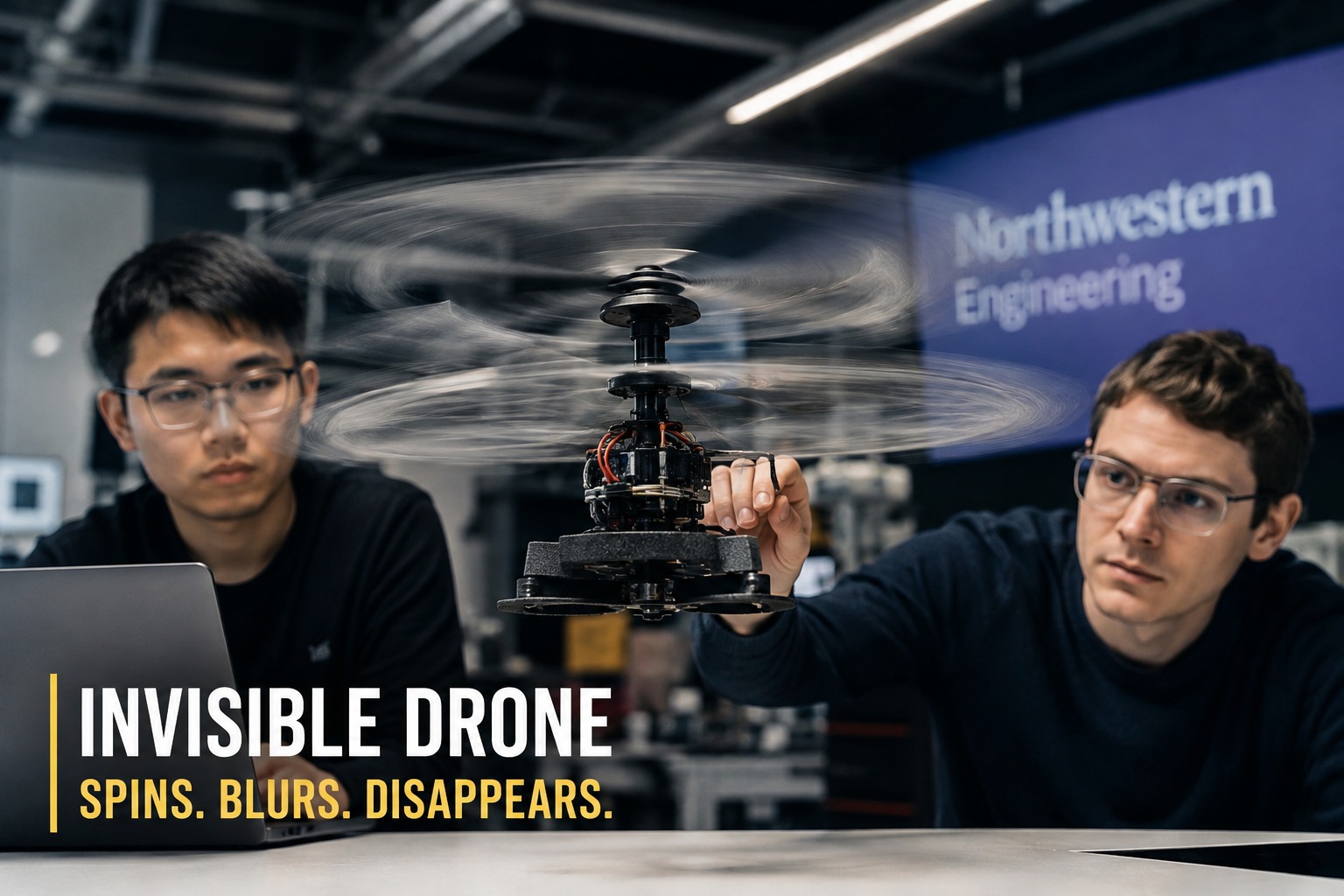
Phantom Twist: The Drone That Almost Disappears by Spinning 25 Times a Second
Imagine looking up at the sky and knowing that a drone is flying directly in front of you—yet struggling to see its shape. There is no elaborate optical cloak, no science-fiction invisibility shield and no sophisticated camouflage painted across its body. Instead, the drone simply spins so quickly that the human eye has difficulty forming a clear picture of it.
That is the unusual idea behind Phantom Twist, an experimental drone developed by engineers and researchers at Northwestern University. The prototype uses rapid rotation and a visual phenomenon known as motion blur to dramatically reduce how noticeable it is to people watching it fly. Researchers say the optimized design can be about ten times less visually perceptible than a conventional quadcopter under comparable conditions.
The technology does not make the aircraft physically disappear. Rather, it changes the way the aircraft is perceived. Instead of presenting the eye with a stable, recognizable drone-shaped object, Phantom Twist turns much of its structure into a faint, moving blur.
The concept is simple in principle but surprisingly challenging to engineer.
Why Conventional Drones Are Easy to Spot
Most consumer and professional drones have a familiar structure. A quadcopter, for example, generally has a central body with four arms extending outward, while its propellers spin around fixed positions.
Although the propellers themselves may become blurred during flight, the rest of the aircraft remains relatively stationary in relation to its own frame. This gives the human eye a recognizable silhouette.
That silhouette is important. Human vision is extremely good at detecting objects against a background, especially when the object has a distinctive shape or remains relatively stable. Even at a distance, a conventional drone can often be recognized because its body and arms maintain a consistent visual pattern.
Researchers at Northwestern approached the problem from a completely different direction.
Instead of asking how to make a drone look like its surroundings, they asked whether the drone could be designed around the way human vision processes movement. This led to a concept based on persistent motion and motion blur.
How Phantom Twist Creates the Blur
The key feature of Phantom Twist is that the entire aircraft rotates.
Unlike a conventional quadcopter with multiple independent rotors, the experimental aircraft uses a single motor and a single propeller. The propeller rotates in one direction while the body of the drone rotates in the opposite direction.
The result is an unusual aircraft in which the major components are constantly moving relative to an observer.
The prototype can spin at up to 25 rotations per second. At that speed, the eye does not always perceive individual components as sharply separated objects. Instead, their appearances are effectively spread across the visual field over a short period of time.
This is similar to what happens when you look at a rapidly rotating fan. At low speed, you can identify individual blades. As the speed increases, the blades become increasingly difficult to distinguish, eventually appearing as a translucent or blurry shape.
Phantom Twist applies this familiar phenomenon to the drone's entire structure.
The objective is not perfect invisibility. The goal is low visual perceptibility—making it difficult for an observer to recognize and track the drone as a distinct object.
Why the Drone Does Not Simply Look Like a Spinning Disc
Creating the visual effect is more complicated than simply attaching a motor and making an aircraft rotate.
A drone still needs essential components such as a battery, electronics, motor, control system and structural supports. If these components were placed carelessly, they could overlap visually during rotation and create a strong, recognizable silhouette.
The Northwestern researchers therefore designed the aircraft so that its components are distributed at different heights and angles, with space between them. When the drone rotates, these separated components contribute to a diffuse visual pattern rather than forming one solid-looking object.
This is where computational design played an important role.
The researchers developed an automated design process that evaluated numerous possible arrangements of the drone's components. According to the research, the system optimized the placement of functional parts while also respecting the aerodynamic and inertial requirements needed for stable flight.
In other words, the computer was not simply searching for the prettiest design. It was trying to balance two competing demands: the drone had to fly properly while also remaining difficult for human observers to perceive.
AI Helped Find a Better Design
One of the most interesting aspects of Phantom Twist is the role of computational optimization.
The researchers evaluated roughly 20,000 design variations while searching for configurations that could maintain flight performance while reducing visual perceptibility.
This approach illustrates a broader trend in modern robotics: computers are increasingly being used not merely to control robots, but to help design their physical structures.
Traditional engineering often begins with a human-designed concept and then improves it through testing. Computational design can explore thousands of alternatives that would be difficult to evaluate manually.
For Phantom Twist, the optimization process considered the location of components and how those components would appear as the aircraft rotated. The researchers used a human-aligned perceptual metric to evaluate visibility while simultaneously accounting for physical requirements.
The result was a prototype that demonstrated substantially lower visual perceptibility than a similarly sized conventional quadcopter.
The Drone Is Not Actually Invisible
The word “invisible” makes the technology sound more dramatic than it really is.
Phantom Twist does not vanish from physical reality. Its components remain present, and under suitable viewing conditions an observer can still notice it. Researchers describe it as nearly disappearing or becoming a ghost-like blur rather than becoming literally invisible.
This distinction matters.
The effectiveness of motion blur depends on factors such as viewing conditions, background, lighting, distance and the observer's attention. A drone may be difficult to recognize in one environment but easier to notice in another.
The technology also does not eliminate sound. A spinning aircraft can still produce an audible mechanical and aerodynamic signature, which provides another way for people to detect its presence. Reports on the prototype also note that the current design has practical limitations related to payloads and imaging.
So Phantom Twist should be viewed as a low-visibility research prototype, not a true cloaking device.
What Could a Low-Visibility Drone Be Used For?
The researchers emphasize civilian and scientific possibilities for the concept.
One promising application is wildlife monitoring. Conventional drones can disturb birds and other animals because they are visually obvious and can alter animal behavior. A less visually noticeable aircraft could potentially collect observations while causing less disruption.
Environmental researchers could also use low-visibility drones for surveying ecosystems or observing areas where the presence of a conventional aircraft might influence what is being studied.
Another possible application is infrastructure inspection. Bridges, towers, industrial facilities and other structures sometimes require aerial observation. A drone that is less visually conspicuous could potentially operate around environments where a large or easily noticed aircraft would be distracting.
The broader idea is important: sometimes the best way to observe something is not to make the observer forget that a drone exists, but to reduce the degree to which the drone itself changes the environment.
There Is a Major Engineering Challenge: Cameras
There is an interesting trade-off at the heart of Phantom Twist.
A drone designed to rotate continuously is naturally difficult to use as a conventional camera platform. Standard drones are valuable partly because their cameras can remain relatively stable while the aircraft moves through the air.
A rapidly rotating body creates a very different imaging problem.
The current research therefore represents an early demonstration of the low-visibility concept rather than a finished commercial drone. The researchers' work focuses primarily on proving that a stable flying machine can be designed around human visual perception.
Future versions would need to address how sensors, cameras and other payloads could be integrated without undermining either flight stability or the low-visibility effect.
That challenge could ultimately be just as important as the spinning mechanism itself.
Why This Research Is Different From Traditional Stealth Technology
The most fascinating part of Phantom Twist is not the speed at which it spins. It is the philosophy behind the design.
Traditional visual camouflage attempts to alter an object's appearance. A camouflage pattern might make an object blend into trees, buildings or terrain. Transparent materials can attempt to reduce the object's visible surface. Optical systems can go even further by manipulating light.
Phantom Twist takes another route.
It does not primarily attempt to change what the drone is. It changes how the drone is perceived while moving.
That makes the project an interesting example of human-centered engineering. Instead of designing a machine solely around mechanical performance, the researchers considered the limitations and characteristics of human perception as part of the engineering problem.
The approach could inspire other robotic systems in which visibility, attention and perception are treated as design variables.
Could This Technology Become Practical?
That remains an open question.
The prototype has demonstrated that the basic concept works, but turning a research prototype into a practical aircraft would require solving several engineering problems.
A useful real-world drone needs reliable control, adequate battery life, useful payload capacity and sensors. It must also remain stable in changing weather and operate safely around people and obstacles.
Adding equipment can change the aircraft's weight distribution and therefore affect the carefully balanced rotational system. A camera or other sensor could also introduce visual features that make the aircraft easier to notice.
The researchers are therefore working at the intersection of robotics, computer vision, aerodynamics and computational design rather than simply developing another type of consumer drone.
What Phantom Twist Tells Us About the Future of Robotics
The significance of Phantom Twist goes beyond one unusual aircraft.
Robots are traditionally designed to be strong, stable, efficient and controllable. Increasingly, however, researchers are asking another question: How will humans perceive the robot?
That question could become increasingly important as robots move from controlled industrial environments into parks, cities, farms, wildlife habitats and public spaces.
A robot that performs its job perfectly but constantly attracts attention may not always be the best robot for the task. In some situations, reducing visual disruption could be as valuable as improving speed or battery life.
Phantom Twist demonstrates one possible solution: use the physical dynamics of the robot itself to influence perception.
The idea is elegant because it does not require a futuristic invisibility material. It uses something much more familiar—motion—and combines it with computational optimization.
Frequently Asked Questions
Is Phantom Twist completely invisible?
No. Phantom Twist is not literally invisible. It becomes much harder for human observers to perceive clearly because rapid rotation creates motion blur. Researchers describe the result as a faint or ghost-like visual appearance.
How fast does Phantom Twist spin?
The prototype can rotate at up to approximately 25 times per second, or about 1,500 rotations per minute.
Who developed Phantom Twist?
The project was developed by researchers at Northwestern University in the United States, with Michael Rubenstein among the researchers leading the work.
Was the drone developed in Australia?
No. The researchers are from Northwestern University in Illinois. The work was presented at the Robotics: Science and Systems 2026 conference in Sydney, Australia, on July 16, 2026.
Why does the drone spin its entire body?
The spinning body helps prevent the human eye from seeing a stable, recognizable silhouette. Combined with its rapid rotation, the design causes the drone's components to blend into a visual blur.
Conclusion
Phantom Twist is a fascinating example of how a seemingly simple idea can produce a radically different approach to robotics. Instead of trying to make a drone transparent or cover it with conventional camouflage, Northwestern researchers designed the aircraft around a basic characteristic of human vision: rapidly moving objects can become difficult to distinguish.
By rotating its body at up to 25 times per second and carefully positioning its components, the experimental drone can appear as little more than a faint blur to a human observer. Computational optimization helped researchers explore thousands of possible configurations while maintaining the physical requirements needed for flight.
The technology is still experimental, and important challenges remain, particularly around cameras, payloads, noise and practical flight performance. Nevertheless, the project demonstrates an important shift in thinking.
The future of robotics may not always be about making machines more powerful or more visible. Sometimes, it may be about designing machines that interact with the world so subtly that people barely notice them at all.