
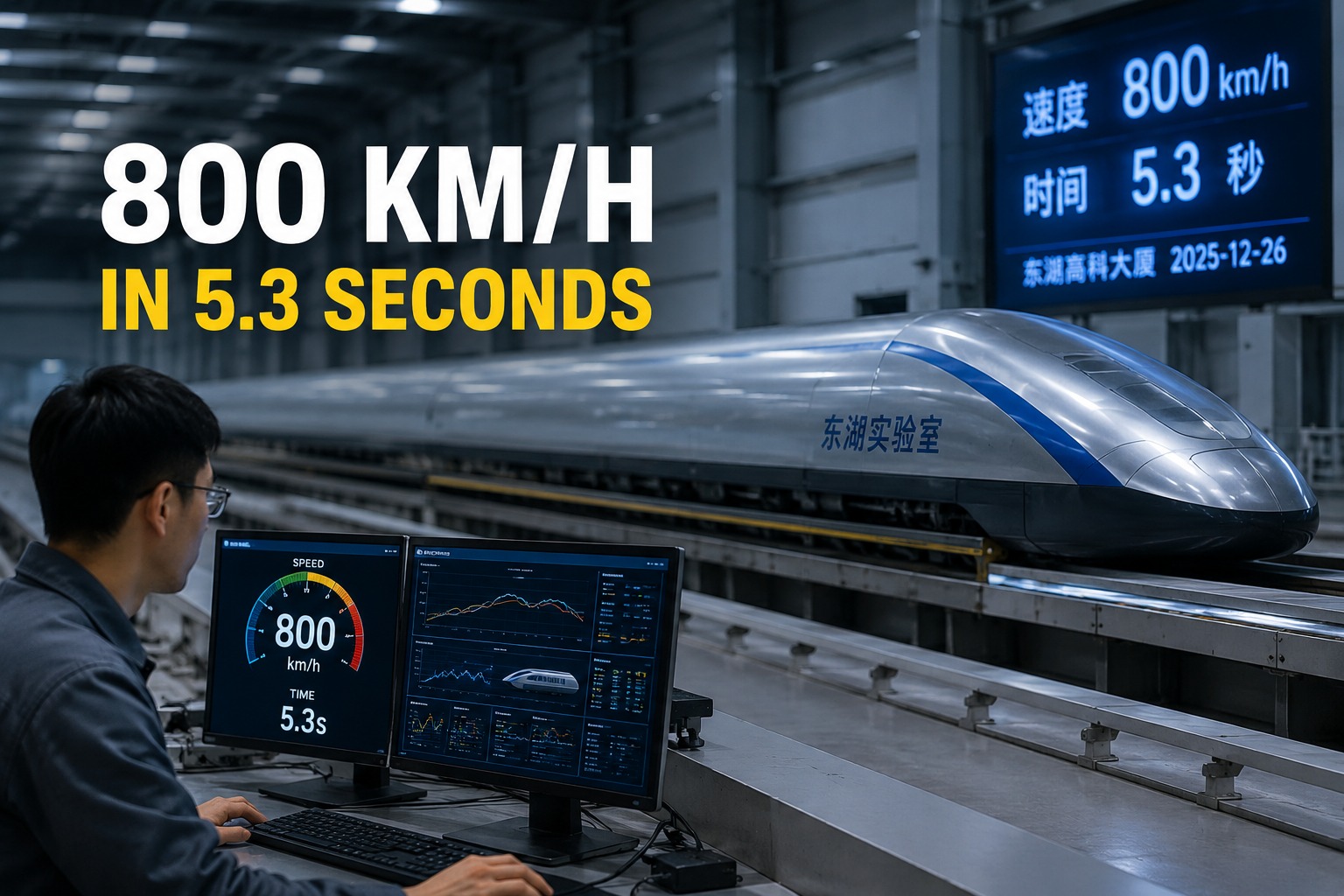
China’s Maglev Breakthrough: Experimental Train Reaches 800 km/h in Just 5.3 Seconds
China has achieved a remarkable milestone in high-speed transportation research: an experimental maglev vehicle weighing about 1.1 tonnes was accelerated from a standstill to 800 km/h in just 5.3 seconds on a 1-kilometre test track in Hubei Province.
The achievement, announced by Hubei’s East Lake Laboratory in December 2025, represents a major step forward in electromagnetic propulsion and short-distance high-speed acceleration. The test vehicle reached its peak speed at roughly 600 metres and was then brought to a controlled stop within the test line.
However, there is an important distinction behind the dramatic headline. This was not a passenger bullet train carrying people. It was a relatively small experimental vehicle designed to test the limits of maglev propulsion, control, suspension and braking technology. Understanding that difference makes the achievement no less impressive—it actually reveals why the experiment matters for the future of transportation and aerospace technology.
What Exactly Did China Achieve?
The experiment was conducted at the East Lake Laboratory in Hubei, central China. Researchers used a dedicated 1,000-metre high-speed maglev test line to accelerate a model vehicle weighing approximately 1.1 tonnes.
According to the laboratory, the vehicle went from zero to 800 km/h in only 5.3 seconds. At that speed, the vehicle was travelling at about 222 metres per second—roughly 133 metres every second.
The result followed two earlier achievements by the same research programme. In June 2025, a roughly 1.03-tonne test vehicle reached 650 km/h in 7.1 seconds. In July, the laboratory reported a 700 km/h result. The 800 km/h test therefore represented another substantial increase in performance within a relatively short period.
The laboratory described the 800 km/h result as a new world record for short-distance acceleration in this category of maglev experimentation.
The significance is not simply the final speed. Reaching such a speed on a track only one kilometre long requires extremely precise coordination between propulsion, vehicle position, suspension, communications and braking.
How Can a Train Accelerate So Quickly?
The key is magnetic levitation and electromagnetic propulsion.
Traditional trains depend on wheels making physical contact with rails. That contact creates rolling resistance, and the mechanical components must withstand enormous forces at high speed.
A maglev system takes a different approach. Magnetic forces can lift and guide the vehicle so that it does not depend on conventional wheel-and-rail contact during high-speed operation. Electromagnetic systems installed along the guideway can then create controlled forces that push the vehicle forward.
China's experimental system combines permanent-magnet electric suspension and guidance with electromagnetic propulsion. This arrangement allows researchers to control the vehicle's movement with extremely high precision.
That does not mean air resistance disappears. In fact, once a vehicle reaches several hundred kilometres per hour, aerodynamic drag becomes a major engineering problem. The faster the vehicle travels, the more demanding aerodynamic stability and energy management become.
This is one reason why the achievement cannot simply be interpreted as “China has built a train that can carry passengers at 800 km/h.” The experiment demonstrates that the underlying propulsion and control technologies can produce extraordinary acceleration under controlled test conditions.
The Physics Behind 0 to 800 km/h
The numbers become even more impressive when the acceleration is examined mathematically.
A speed of 800 km/h is approximately 222.2 metres per second. Reaching that speed from rest in 5.3 seconds corresponds to an average acceleration of roughly 41.9 metres per second squared, or about 4.3 times Earth's gravitational acceleration.
That is a very high acceleration for ordinary passenger transportation.
It also explains why the experimental vehicle should not be confused with a normal passenger train. A passenger railway system must consider comfort and human safety in addition to maximum technical performance.
Researchers are therefore testing what the propulsion system can achieve, not proposing that passengers should routinely experience the same acceleration.
In practical transportation, acceleration would need to be carefully limited and spread over a much longer period. A commercial vehicle carrying hundreds of people would require a completely different acceleration profile.
Why Was a One-Kilometre Track Enough?
At first glance, a one-kilometre test track may sound far too short for an 800 km/h vehicle.
The secret is that this was not a conventional railway designed for continuous passenger service. It was a specialised experimental platform built specifically for rapid acceleration and deceleration.
Earlier demonstrations on the same type of test line showed how electromagnetic propulsion and highly accurate positioning could accelerate a test vehicle over a relatively short distance and then bring it to a stop. Chinese researchers have reported positioning accuracy as fine as several millimetres.
This makes the test facility more like a high-speed laboratory than a railway station-to-station route.
The vehicle's journey was carefully controlled. According to Xinhua, the 800 km/h vehicle reached its peak speed at approximately 600 metres and then stopped at the end of the test line after an overall journey lasting about eight seconds.
That ability to accelerate and stop within such a confined space is itself an important part of the technology.
Why This Is Not Yet an 800 km/h Passenger Train
This distinction is essential.
The experimental vehicle weighed around 1.1 tonnes. A full-size passenger train would be vastly heavier and would have to carry passengers, equipment, safety systems and other infrastructure.
Scaling a technology from a relatively small test vehicle to a commercial train is one of the hardest steps in engineering.
A passenger train operating at 800 km/h would face major challenges involving aerodynamic drag, structural strength, vibration, thermal management, energy consumption, emergency braking, passenger comfort, noise and infrastructure costs.
There would also be the question of what happens when the train encounters unexpected conditions. Commercial railway systems need to operate reliably in changing weather and environmental conditions, while maintaining extremely high safety standards.
Therefore, the 800 km/h experiment should be viewed as a technology demonstration, rather than evidence that passengers will soon be travelling at 800 km/h on China's conventional railway network.
What Makes Maglev Different From Conventional High-Speed Rail?
China already operates an extensive high-speed rail network, while conventional high-speed trains can travel at several hundred kilometres per hour.
Maglev technology attempts to push the limits further by replacing traditional wheel-and-rail propulsion with electromagnetic systems.
One advantage is the reduction of mechanical contact between the vehicle and track. This can reduce certain forms of mechanical wear and allow very high speeds.
But maglev also requires specialised infrastructure. Instead of simply upgrading existing railway tracks, operators need dedicated guideways containing sophisticated electrical and magnetic systems.
That creates a major economic question: How much does additional speed actually benefit passengers compared with the cost of building and operating an entirely new infrastructure network?
For journeys of several hundred kilometres, conventional high-speed rail can already compete strongly with air travel when station access, security and boarding time are included.
For much longer journeys, however, extremely high-speed systems could potentially change the balance between rail and aviation—provided the infrastructure can be built economically.
The Bigger Opportunity May Be Beyond Passenger Trains
Perhaps the most interesting aspect of the East Lake Laboratory experiment is that its potential applications extend beyond rail transportation.
Chinese researchers have identified possible uses for the technology in areas including high-speed electromagnetic sleds, aerospace electromagnetic launching systems, low-altitude technologies and other advanced transportation experiments.
An electromagnetic launch system, for example, could accelerate equipment to extremely high speeds without relying entirely on conventional propulsion.
That makes the research relevant to aerospace engineering as well as transportation.
In an electromagnetic launch system, powerful controlled forces could potentially accelerate a payload along a track before releasing it. Such concepts are technically challenging, but the underlying requirement is similar to the maglev experiment: generate a huge amount of controlled acceleration over a short distance.
This is why a small 1.1-tonne test vehicle can have significance far beyond the size of the vehicle itself.
China’s Rapid Progress in Maglev Testing
The 800 km/h experiment did not happen in isolation.
The same laboratory had already demonstrated 650 km/h in June 2025 using its one-kilometre test line. At that time, researchers said the system had been designed with an eventual target of 800 km/h.
The progression from 650 km/h to 700 km/h and then 800 km/h illustrates how specialised test platforms can allow engineers to improve individual components step by step.
Researchers can measure the vehicle's behaviour, analyse the propulsion system, refine control algorithms and repeat the experiment.
This iterative process is often more important than a single record.
Breaking a speed record attracts attention, but the long-term value comes from learning how to make the system stable, controllable, efficient and reliable.
Could 800 km/h Maglev Become Commercial Reality?
Technically, the experiment demonstrates that extremely high speeds can be achieved over short distances using electromagnetic propulsion.
Commercial operation is a much bigger question.
For an 800 km/h passenger system to become practical, engineers would need to solve several problems simultaneously. The vehicle would have to remain stable at very high speeds, the guideway would need extraordinary precision, the propulsion system would require substantial electrical infrastructure, and passengers would need a comfortable acceleration and braking experience.
There is also the economic side.
Building an entirely new high-speed maglev corridor would require enormous investment. Stations, guideways, power systems, maintenance facilities and safety infrastructure would all have to be developed.
For this reason, the most realistic near-term impact of China's experiment may not be an immediate 800 km/h passenger service. Instead, the research could contribute to a broader family of high-speed electromagnetic technologies.
What Does This Mean for the Future of Transportation?
The most important lesson from the experiment is that the future of transportation may not be defined simply by achieving a higher top speed.
Speed is only one part of the equation.
The real challenge is developing a system that can combine speed with safety, efficiency, reliability, affordability and passenger comfort.
China's 800 km/h maglev test demonstrates that electromagnetic propulsion can generate extraordinary acceleration in a controlled environment. It also shows how short test tracks can be used to investigate technologies that would otherwise require enormous facilities.
The experiment therefore represents a significant engineering milestone—but not the arrival of 800 km/h passenger trains.
Instead, it is a glimpse into what electromagnetic propulsion may eventually make possible.
Frequently Asked Questions
Did China build an 800 km/h passenger train?
No. The record involved a small experimental maglev vehicle weighing about 1.1 tonnes. It was a technology test, not a passenger-carrying commercial train.
How fast did the experimental vehicle accelerate?
It accelerated from zero to 800 km/h in approximately 5.3 seconds.
How long was the test track?
The experimental track was approximately one kilometre long. The vehicle reached peak speed at around 600 metres before being brought to a stop.
Is 800 km/h possible for a normal train?
The experiment demonstrates that such speeds are technically achievable with specialised electromagnetic propulsion. However, a commercial passenger train operating at that speed would face major engineering, safety, infrastructure and economic challenges.
Why is the experiment important?
It advances research into high-speed maglev propulsion, precision control and electromagnetic acceleration. The same technologies could potentially have applications in advanced rail systems, aerospace research and electromagnetic launch systems.
Conclusion
China's 800 km/h maglev experiment is impressive not because a passenger train has suddenly become capable of travelling at that speed, but because researchers have demonstrated an extraordinary level of controlled electromagnetic acceleration within a remarkably short distance.
A 1.1-tonne experimental vehicle reached 800 km/h in 5.3 seconds on a one-kilometre track, following earlier 650 km/h and 700 km/h milestones.
The achievement highlights the enormous potential of magnetic levitation and electromagnetic propulsion. Yet the path from a laboratory test to a practical passenger system is long. Engineers still have to address energy requirements, aerodynamics, passenger comfort, infrastructure costs, reliability and safety.
For now, the 800 km/h run should be understood as a research breakthrough rather than a new everyday railway service.
Its greatest significance may ultimately lie beyond the railway itself. If researchers can continue improving the ability to accelerate and control heavy objects electromagnetically over short distances, the same principles could influence the next generation of high-speed transportation, aerospace systems and electromagnetic launch technologies.
The race toward faster transportation, therefore, may have entered a new phase—not simply one focused on faster trains, but on mastering the electromagnetic forces needed to move vehicles at extraordinary speeds with precision.