Are Temporary Email Addresses Legal? Plain-English Guide
Are Temporary Email Addresses Legal? A Plain-English Look at the Rules
By SHARIQ · September 6, 2026 · 10 min read
Not legal advice. This article is general information about how the law tends to treat disposable email, written for a non-specialist reader. It is not advice, no lawyer–client relationship is created by reading it, and the rules differ significantly between countries and change over time. For a decision that matters, consult a qualified lawyer in your jurisdiction. |
THE SHORT VERSION
|
People ask this question in two very different tones. Some are worried they’ve done something wrong by keeping a shopping site out of their real inbox. Others are asking whether a throwaway address will get them out of something. The honest answer separates cleanly along that line — and the separation is the whole subject.
The short answer
Creating and using a disposable email address is legal in the United States, across the European Union, in the United Kingdom, and as far as any general survey of law suggests, essentially everywhere else. There is no statute that obliges you to give a particular company a durable address, and none that makes receiving mail at a temporary one an offence.
What can be unlawful is conduct you carry out using one — and that conduct would be equally unlawful conducted from a permanent address. The tool is neutral. That’s the entire framework, and most confusion comes from collapsing it.
Why the tool itself is lawful
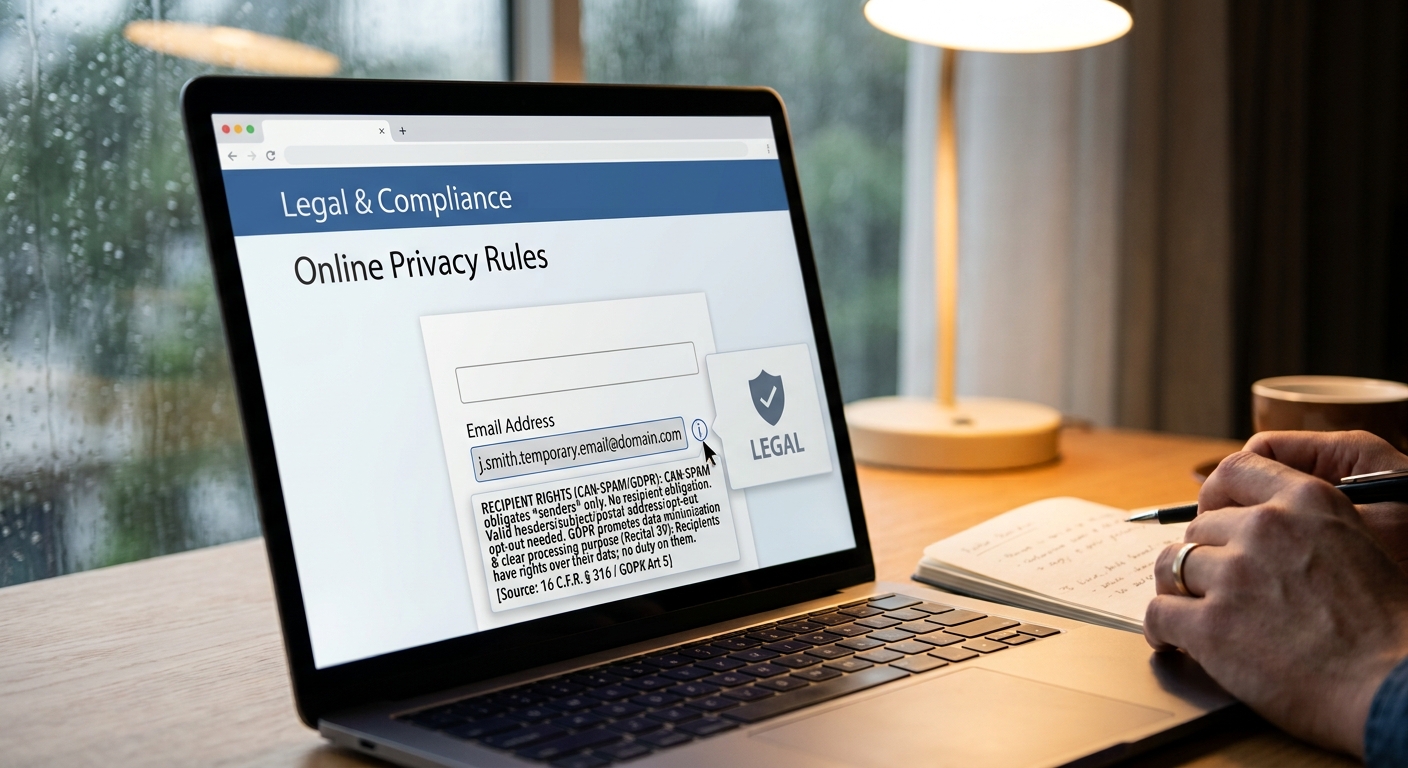
It helps to see how the main email statutes are actually built. In the United States, CAN-SPAM is the federal law governing commercial email, and it is directed squarely at senders. It requires accurate header information, honest subject lines, clear identification of advertising, a valid physical postal address, and a working opt-out mechanism honoured within ten business days — with penalties reaching tens of thousands of dollars per offending message.
Notice what isn’t there. The Act creates rights for recipients and imposes no compliance duties on them. Nothing in it says you must supply a real, permanent or long-lived address to anyone.
European law leans further in the same direction. The GDPR’s first principles require that personal data be
“adequate, relevant and limited to what is necessary in relation to the purposes for which they are processed” GDPR, Article 5(1)(c) — the data minimisation principle |
and that it be kept in identifiable form no longer than necessary. Those principles bind organisations rather than individuals, so they don’t give you a positive right to use temp mail. But they describe a legal culture in which handing over the minimum data a transaction requires is the expected posture, not a suspicious one. Someone using a disposable address to download a whitepaper is behaving in a way European data protection law broadly endorses.
Breaking the rules is not the same as breaking the law
This is where most people’s intuition goes wrong, and it deserves care.
Many sites require a “valid” or “current” email address in their terms of service. Using a disposable one may well breach that term. A breach of terms is a contract problem: the site can suspend or close your account, refuse service, and in principle pursue civil remedies. That is genuinely a consequence. It is not a criminal one.
American law on this became considerably clearer in 2021. In Van Buren v. United States, the Supreme Court rejected the government’s argument that violating a computer use policy amounts to “exceeding authorized access” under the Computer Fraud and Abuse Act. The Court adopted what commentators call a gates-up-or-down inquiry: either you were entitled to enter that part of the system, or you were not. Restrictions on how or why you use access you legitimately hold are not, by themselves, federal crimes.
The practical effect is significant. Signing up to a newsletter with a throwaway address, in breach of a terms clause, is not a computer crime in the United States. It is a broken agreement.
TWO HONEST CAVEATS The Court expressly left open whether an access restriction must be technological rather than merely contractual, so the boundary isn’t settled at every edge. And Van Buren interprets one American statute. Other countries draw the line between unauthorised access and rule-breaking differently, and some more broadly. Don’t export the US position wholesale. |
Where the line actually is
In every case below, the illegality comes from the underlying act. The disposable address is the method, not the offence — and using a permanent one wouldn’t help.
| WHAT YOU’RE DOING | STATUS | WHAT TENDS TO HAPPEN |
|---|---|---|
Keeping marketing mail out of your inbox | Lawful | Nothing. This is ordinary privacy hygiene. |
Signing up where terms demand a “valid” address | Contract breach | Account closed or suspended if noticed. |
Cycling free trials to avoid paying | Can be fraud | Termination and civil exposure; deception for financial gain can attract criminal liability depending on scale and jurisdiction. |
Evading a ban, block or court order | Aggravating | Extends the original problem; breaching a court order is contempt regardless of method. |
Harassment, threats or defamation | Criminal / actionable | Unlawful independently of the address, and anonymity is far less durable than people assume. |
Opening a regulated financial account | Blocked by law | Know-your-customer rules require verified identity; false details risk frozen funds and legal exposure. |
Getting past an age check | Increasingly regulated | Account closure; age-verification duties are tightening in several jurisdictions. |
General patterns, not a determination about any specific situation. Outcomes depend heavily on facts and jurisdiction.
The two that catch people out
Serial free trials
This is the most common misuse, and people underrate it because it feels victimless and the mechanism is so easy. Legally, repeatedly obtaining a paid service without paying, by misrepresenting yourself as a new customer, is a species of obtaining a benefit by deception. Whether any given instance draws more than an account ban depends on scale, jurisdiction and how much the company cares — but “it was only a free trial” is a description of the amount, not a defence to the character of the act.
Anonymity that isn’t
The other trap is treating a disposable address as a cloak. It isn’t one. Your IP address is visible to the service; mail server logs record the transaction; payment details, browser fingerprints and timing patterns all persist independently of the address. Disposable email hides you from a marketing database, which is what it’s for. It does not hide you from a legal process, and someone relying on it for that is relying on a misunderstanding.
WORTH SAYING PLAINLY If your reason for wanting a throwaway address is that you intend to do something you’d be in trouble for, the address will not protect you, and this article should not be read as suggesting otherwise. It is a tool for reducing junk mail and unwanted data collection, and it is genuinely good at that. |
Sites can refuse them, too
The freedom runs both ways. A private service is generally entitled to decide which addresses it will accept, and screening sign-ups against public blocklists of known disposable domains is routine anti-abuse practice. Being rejected isn’t a violation of your rights; it’s a company declining to deal on those terms — exactly as you are entitled to decline to hand over a permanent address.
Sensible responses are to use a real address for that service, use an alias that forwards to your real inbox, or decide the service isn’t worth the account. Hunting for a domain the blocklist hasn’t caught yet is a losing game, and where the site is a bank or a regulated platform, the screening is there for reasons that go well beyond preference.
A rule of thumb that holds up
One question resolves nearly every case: would this be fine if I used my real address?
Downloading a guide, joining a forum, connecting to café Wi-Fi, trying an app once — fine with a real address, therefore fine with a temporary one. Taking a fifth free trial, returning to a service you were banned from, opening a brokerage account under invented details — not fine with a real address, and not made fine by a temporary one.
The disposable address changes who ends up holding your data. It does not change the nature of what you’re doing.
Frequently asked questions
Is it illegal to use a temporary email address?
No. There is no law in the US, EU or UK requiring you to give a particular website a permanent email address. Creating and using a disposable inbox is lawful. Legal questions arise from what you use it to do, not from the tool.
Is breaking a website’s terms of service a crime?
Generally no — it’s a contract matter. In Van Buren v. United States (2021) the US Supreme Court rejected the argument that violating a computer use policy amounts to “exceeding authorized access” under the Computer Fraud and Abuse Act, adopting a gates-up-or-down test instead. Terms restricting how or why you use access you legitimately have aren’t in themselves criminal. The usual consequence of breaching terms is a closed account.
Does CAN-SPAM require me to give companies my real email address?
No. CAN-SPAM binds senders of commercial email, not recipients. It requires accurate headers, truthful subject lines, identification of advertising, a valid physical address and a working opt-out honoured within ten business days, with substantial per-message penalties. It gives recipients rights and imposes no duties on them.
When does using a disposable address actually become illegal?
When it forms part of conduct that is already unlawful. Obtaining something of value by deception can be fraud. Threats and harassment are crimes regardless of the address. Supplying false identity details to a regulated financial service conflicts with know-your-customer obligations. The illegality is in the underlying act.
Can a website legally block disposable email addresses?
Yes. A private service is generally free to decide which addresses it accepts, and screening against blocklists of known disposable domains is a routine anti-abuse measure. Being refused isn’t a rights violation — it’s the site declining to contract on those terms.
The bottom line
Disposable email sits in the same legal category as an unlisted phone number or a PO box: a lawful way of controlling who can reach you and what they learn about you in the process. Nobody is entitled to your permanent address simply because they built a form.
What the law cares about is conduct. Use a temporary inbox to keep a decade of newsletters out of your life and you are doing something entirely ordinary, and arguably exactly what data protection principles envisage. Use one as a component of deception and you have a deception problem, which the address was never going to solve.