
Japan Successfully Beams Solar Power from Space to Earth in Historic Test
🌞 A major breakthrough in renewable energy: Japan has wirelessly transmitted solar power from space to Earth for the first time, opening the door to continuous, weather-proof energy generation.
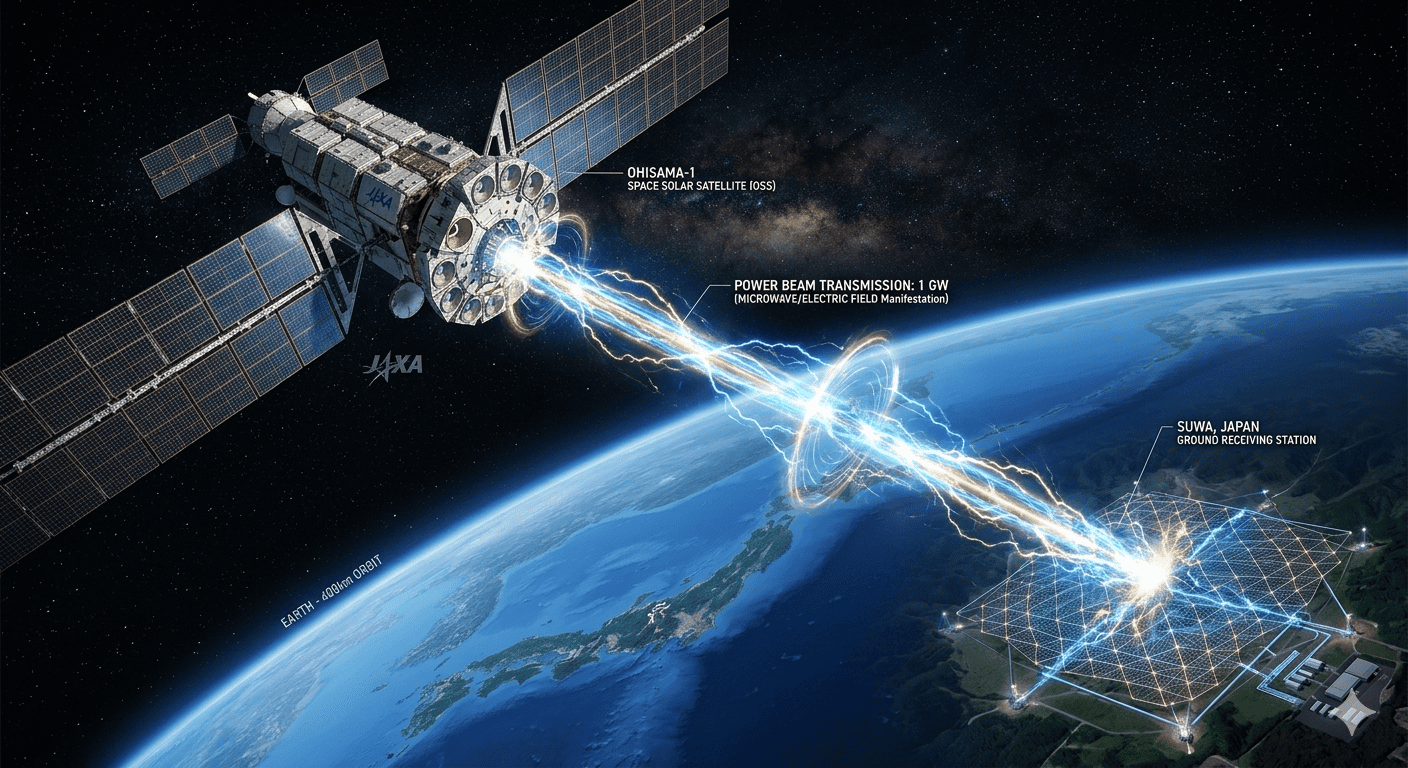
Japan Aerospace Exploration Agency (JAXA) achieved a historic milestone by transmitting electricity collected from solar panels in orbit directly to a ground station in Suwa, central Japan. This demonstration confirms that space-based solar power is technically feasible and could transform global energy systems in the coming decades.
🛰 How the Space Solar Test Worked
The experiment used the OHISAMA satellite, roughly the size of a washing machine, orbiting Earth at 400 kilometers. Key steps:
- Solar panels onboard collected sunlight and converted it into electricity
- Electricity was transformed into microwave signals
- Ground-based rectennas received the microwaves and converted them back into usable electricity
The satellite transmitted about 1 kilowatt of power, enough to run a coffee maker. Though modest, the test proves the technology works in real space conditions.
⚡ Why Space Solar Power Is a Game-Changer
Unlike Earth-based solar panels:
- Orbital panels receive constant sunlight
- No impact from weather, clouds, or nighttime
- Generates roughly 13 times more annual energy than similar ground installations
For Japan, which imports over 90% of its energy, this technology provides a strategic path to energy independence while offering a continuous, disaster-proof power source.
🛠 Technical Challenges and Innovations
Beaming power from space requires extreme precision:
- Satellite moves at 17,000 mph; microwave beam must stay aligned to ground target
- Angular deviation must remain below 0.001 degrees
- Advances in microwave transmission, lightweight materials, and reduced launch costs (thanks to companies like SpaceX) made the test possible
These innovations turn a decades-old concept into a real, functioning system.
🌍 Global Competition in Space Solar
Japan is not alone in pursuing orbital solar power:
- United States: Caltech MAPLE experiment in 2023
- NASA: Assessing space solar to reach net-zero emissions by 2050
- China: Plans kilometer-scale space solar arrays by the 2030s
- European Space Agency: Studying SOLARIS initiative
Japan’s goal: a 1-gigawatt orbital solar array within 25 years, powering hundreds of thousands of homes.
💰 Costs and Safety Considerations
While technically feasible, challenges remain:
- Space solar could cost up to 10x more than terrestrial solar or wind (NASA 2021)
- Requires breakthroughs in assembly, maintenance, and power-beaming efficiency
- Microwave beam intensity at ground is comparable to sunlight, mitigating safety concerns
Reducing launch costs, particularly via reusable rockets like SpaceX Starship, is critical for making the concept economically viable.
🔑 Implications for the Future
- Continuous baseload power for disaster-prone or remote regions
- Reduced reliance on land and rare-earth materials compared to massive ground solar farms
- Supports growing electricity demand, particularly from data centers and AI expansion
- Provides energy independence for import-reliant nations
This milestone confirms space solar power is feasible, setting the stage for a global race toward orbital energy systems.
📌 Final Thoughts
Japan’s successful test demonstrates that harvesting solar energy from space is no longer science fiction. While economic scaling is a challenge, this breakthrough marks a critical step toward sustainable, continuous, and reliable global energy solutions. With multiple nations investing in similar projects, the space solar power race has officially begun.
Article Highlights
- Japan transmitted solar power from orbit to Earth for the first time
- OHISAMA satellite collected sunlight and beamed microwaves to Suwa ground station
- Technology bypasses weather and nighttime, generating 13x more energy annually
- Future plans include a 1-gigawatt orbital solar array
- Global competitors include the US, China, and ESA