
Ancient Whale Graveyard Discovered Deep in the Indian Ocean: A Window Into Millions of Years of Marine History
Introduction
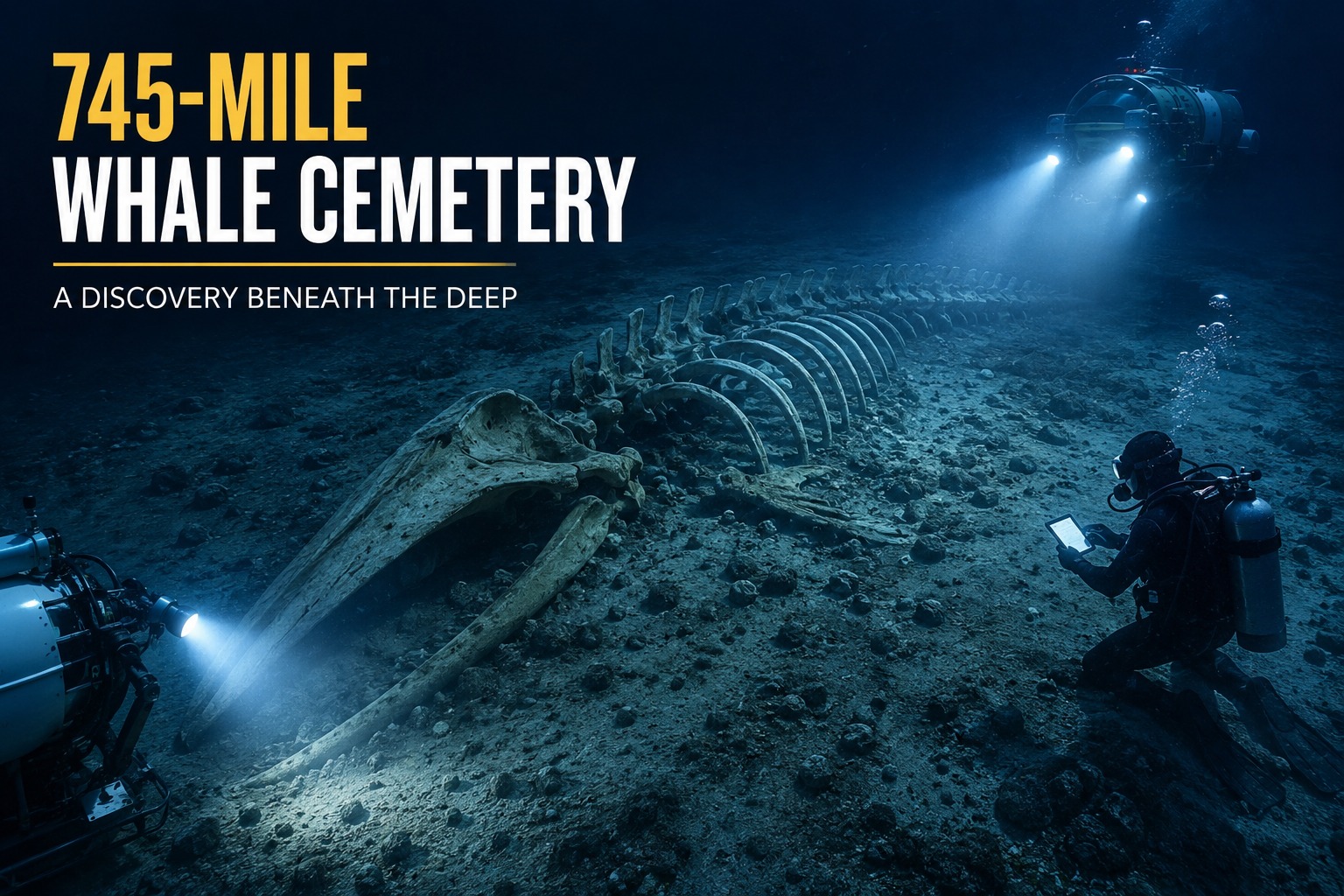
The deep ocean remains one of the least explored places on Earth, hiding secrets that have survived for millions of years. Recently, an international team of researchers reported the discovery of a vast whale graveyard nearly 23,000 feet below the surface of the Indian Ocean. Stretching across an estimated 745 miles, this extraordinary underwater site could offer scientists valuable clues about ancient marine ecosystems, whale evolution, and the hidden processes that shape life in the deepest parts of our planet.
Far from being merely a collection of bones, the discovery represents a unique natural archive. Each whale skeleton tells a story about Earth's past, revealing how giant marine mammals lived, died, and even supported life long after their deaths.
The Discovery of an Enormous Whale Graveyard
The newly identified whale graveyard lies in the depths of the Indian Ocean, an environment characterized by crushing pressure, freezing temperatures, and complete darkness. According to researchers, the site contains numerous whale remains accumulated over an immense period of time.
What makes this discovery particularly remarkable is its size. Scientists estimate that the graveyard extends for approximately 745 miles, making it one of the largest concentrations of whale remains ever identified.
Deep-sea discoveries of this scale are extremely rare because only a tiny fraction of the ocean floor has been thoroughly mapped and explored. Advances in underwater robotics, sonar technology, and deep-sea imaging have made it possible for researchers to investigate regions that were once inaccessible.
Why Whale Falls Matter
When a whale dies, its body eventually sinks to the ocean floor in a process known as a "whale fall." While this might appear to be the end of the animal's story, it actually marks the beginning of a fascinating ecological cycle.
A single whale carcass can support entire communities of marine organisms for decades. Deep-sea creatures such as worms, crabs, shrimp, and specialized bacteria rely on these remains as a source of nutrients in environments where food is scarce.
Scientists generally describe the decomposition process in several stages:
- Scavengers such as sharks and crustaceans consume soft tissues.
- Specialized organisms feed on remaining organic material.
- Bacteria break down fats inside the bones, creating chemical reactions that sustain unique ecosystems.
This process transforms whale skeletons into biological hotspots, supporting species that may not survive elsewhere in the deep ocean.
A Glimpse Into Millions of Years of Ocean History
One of the most exciting aspects of this discovery is its potential to reveal information about ancient oceans. Some of the whale remains found in the region are believed to be millions of years old.
By studying these bones, researchers can investigate several important questions:
How Did Ancient Whales Evolve?
Modern whales evolved from land-dwelling mammals over approximately 50 million years. Fossil remains found within the graveyard may help scientists better understand how different whale species adapted to changing climates and ocean conditions.
Bone structures can reveal information about body size, migration patterns, and evolutionary relationships between extinct and modern whales.
What Was the Ancient Climate Like?
Whale bones preserve chemical signatures that act like natural records of environmental conditions. Scientists can analyze isotopes preserved in the skeletons to reconstruct ancient ocean temperatures and changes in marine ecosystems.
These findings can contribute to our understanding of long-term climate change and how marine life responded to environmental shifts in the past.
How Did Deep-Sea Ecosystems Develop?
Whale falls are thought to play an important role in the evolution of deep-sea species. Some scientists believe that organisms living around hydrothermal vents and cold seeps may share evolutionary connections with species that originally thrived around whale carcasses.
Studying this enormous whale cemetery may help explain how isolated communities of deep-sea life spread and diversified over millions of years.
Why So Many Whales Gathered in One Region
The presence of such a large concentration of whale remains raises an intriguing question: why did so many whales end up in this particular area?
Researchers have proposed several possible explanations.
Natural Migration Routes
Whales have followed seasonal migration paths for millions of years. If this area once lay along a major migration corridor, the accumulation of whale carcasses over geological timescales could explain the extraordinary number of skeletons.
Ocean Currents and Topography
Powerful underwater currents may have transported remains toward deep trenches or valleys where they gradually accumulated. The shape of the seafloor itself can influence where sinking objects eventually settle.
Geological Stability
Some regions of the ocean floor experience relatively little disturbance over millions of years. Stable conditions may have allowed ancient whale skeletons to remain preserved instead of being buried or destroyed.
Further research will be necessary to determine which factors contributed most to the formation of this remarkable underwater cemetery.
The Challenges of Exploring the Deep Ocean
Investigating a site located nearly 23,000 feet below sea level is an extraordinary technological challenge.
At these depths, water pressure exceeds 10,000 pounds per square inch, enough to crush ordinary equipment. Human divers cannot survive in such conditions, so scientists rely on advanced remotely operated vehicles (ROVs) and autonomous underwater vehicles (AUVs).
These robotic systems are equipped with:
- High-definition cameras.
- Sonar mapping instruments.
- Robotic arms for collecting samples.
- Sensors that measure temperature and chemical conditions.
The data collected by these technologies allows researchers to create detailed three-dimensional maps of the seafloor and analyze the surrounding ecosystem without disturbing it.
Similar Discoveries Around the World
Although large whale graveyards are rare, scientists have documented smaller whale-fall communities in several oceans.
In the Pacific Ocean, researchers have discovered whale skeletons supporting hundreds of species, including organisms previously unknown to science. Similar findings in the Atlantic Ocean have demonstrated that whale falls can remain biologically active for decades.
However, the scale of the Indian Ocean site appears to be far greater, making it especially valuable for scientific research.
The discovery highlights how much remains unknown about our planet. Despite decades of exploration, experts estimate that more than 80 percent of the ocean remains unexplored.
What This Means for Marine Conservation
Understanding ancient ecosystems can help scientists protect modern oceans.
Whales play a crucial role in maintaining healthy marine environments. Through their feeding behavior and nutrient cycling, they support fisheries and contribute to carbon storage processes that influence Earth's climate.
Studying long-term whale populations may help researchers understand how human activities, including commercial whaling, pollution, and climate change, affect marine biodiversity.
The whale graveyard also emphasizes the importance of preserving deep-sea habitats, many of which face increasing threats from seabed mining and industrial development.
As scientists continue exploring the ocean floor, discoveries like this remind us that the deep sea contains ecosystems that are both fragile and irreplaceable.
Could There Be More Hidden Graveyards?
Many experts believe that similar sites may exist elsewhere around the globe. Since only a small percentage of the seafloor has been studied in detail, future expeditions could reveal additional whale cemeteries and previously unknown ecosystems.
Advancements in artificial intelligence, autonomous robots, and high-resolution mapping technologies are expected to revolutionize deep-sea exploration over the coming decades. These tools may uncover entirely new chapters of Earth's biological history.
Conclusion
The discovery of a massive whale graveyard nearly 23,000 feet beneath the Indian Ocean offers an extraordinary glimpse into the hidden history of marine life. Extending across approximately 745 miles, the site serves as both a fossil archive and a thriving ecological laboratory.
Beyond its scientific significance, the finding underscores how little humanity truly knows about the oceans that cover most of our planet. Every new expedition into the deep sea has the potential to reveal remarkable stories that have remained hidden for millions of years.
As technology continues to push the boundaries of exploration, discoveries like this ancient whale cemetery remind us that some of Earth's greatest mysteries still lie beneath the waves, waiting to be understood.