
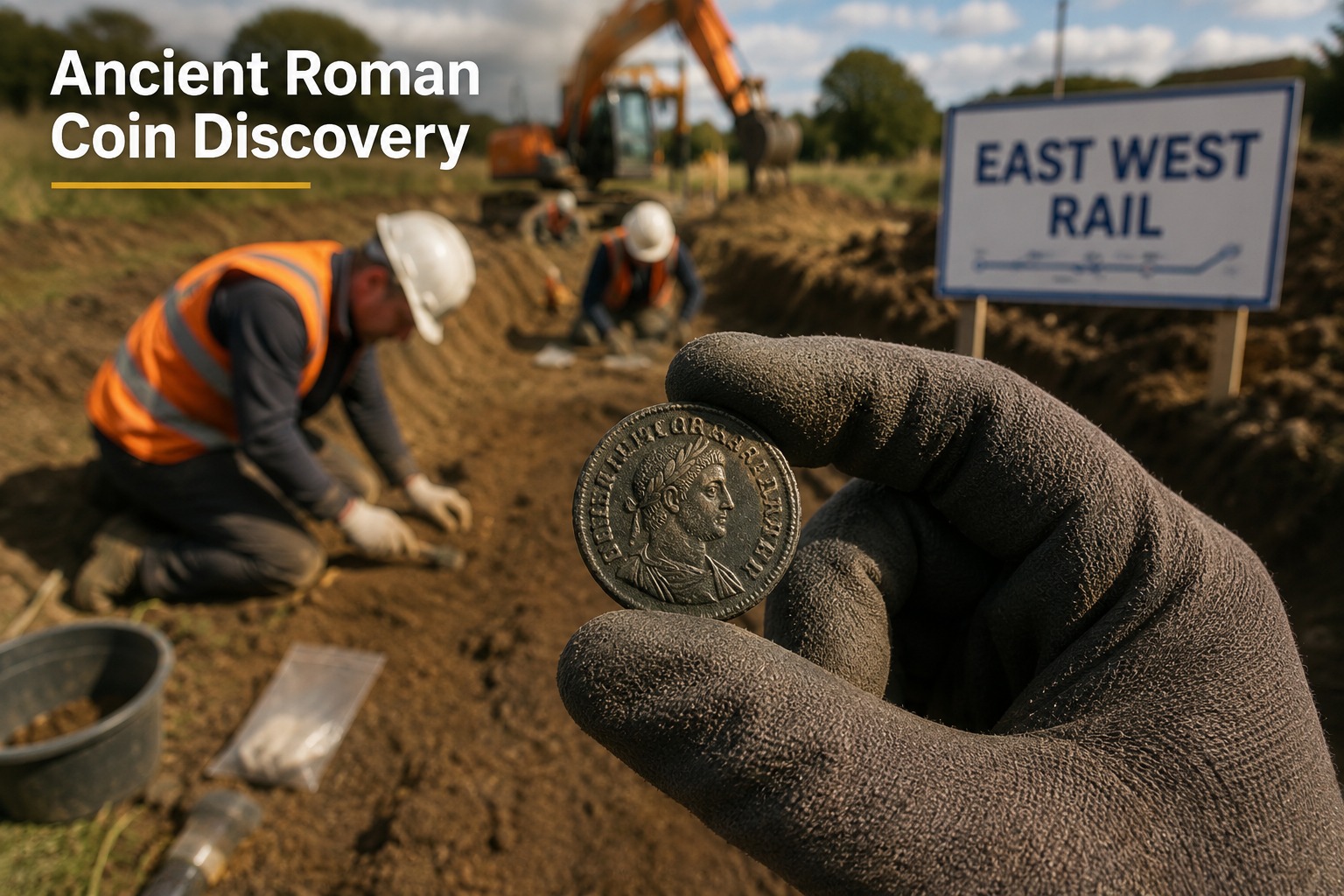
Ancient Roman Coin Discovered During East West Rail Excavation in England
A 1,740-Year-Old Roman Coin Unearthed During Railway Construction
Major infrastructure projects often reveal more than engineers expect. While construction teams focus on building the future, archaeologists frequently uncover remarkable traces of the past hidden beneath the ground. A recent discovery in eastern England is a perfect example of how modern development and ancient history can intersect.
During archaeological excavations for the new East West Rail project, experts uncovered a rare Roman coin dating back to 287 AD. The coin bears the name of Emperor Carausius, one of the most intriguing rulers of Roman Britain. Archaeologists estimate the coin is approximately 1,740 years old, making it an important addition to Britain's rich archaeological record.
The discovery not only sheds light on Roman Britain but also highlights why archaeological surveys are an essential part of large-scale construction projects.
Why the Discovery Matters
The coin was discovered during excavation work in Bedfordshire and Cambridgeshire, where archaeologists are conducting extensive investigations before railway construction begins. Around 1,000 trial trenches have been dug across the planned route to document and preserve any historical remains before development continues.
Such surveys are designed to ensure that important archaeological sites are carefully studied rather than accidentally destroyed by heavy machinery.
Finding a coin from the reign of Carausius is particularly significant because coins are among the most valuable sources of historical information. They provide evidence about rulers, economies, trade, religion, political authority, and even artistic styles from a particular period.
Who Was Emperor Carausius?
Carausius remains one of the most fascinating figures in Roman history. Originally a military commander responsible for defending the English Channel from pirates, he declared himself emperor around 286 AD after falling out with the Roman government.
Instead of surrendering to Rome, Carausius established an independent Roman state centered in Britain and parts of northern Gaul (modern-day France). His reign lasted only a few years before he was assassinated in 293 AD, but during that short period he minted large numbers of coins to strengthen his legitimacy.
His coins were carefully designed to portray him as the rightful Roman emperor. They featured traditional Roman symbols, imperial portraits, and inscriptions intended to convince both soldiers and civilians that his rule was legitimate.
Because Carausius ruled for such a brief period, many of his coins are considered historically valuable, especially when found in archaeological contexts.
Why Roman Coins Are So Important
To modern historians, ancient coins are far more than pieces of metal.
Each coin acts like a miniature historical document. It records:
- The ruler in power.
- Political messages issued by the government.
- Artistic styles of the period.
- Economic conditions.
- Minting locations.
- Religious and cultural symbols.
Unlike many written records that have been lost over time, coins often survive underground for centuries. Their inscriptions and images can remain remarkably well preserved, allowing archaeologists to reconstruct important historical events.
East West Rail and Archaeology
The East West Rail project aims to reconnect communities across England by creating improved railway links between Oxford, Cambridge, Bedford, and surrounding regions.
Before construction begins on any section of the railway, archaeologists conduct extensive investigations because England's landscape contains thousands of years of human history buried beneath farmland, villages, and open countryside.
The excavation program includes approximately 1,000 trial trenches, allowing specialists to identify ancient settlements, roads, graves, pottery, coins, and other cultural remains.
This careful process balances modern infrastructure development with the preservation of national heritage.
Roman Britain: A Land Rich in Hidden History
The Romans invaded Britain in 43 AD under Emperor Claudius and remained for nearly four centuries.
During their occupation, they built:
- Roads connecting major towns.
- Forts and military camps.
- Villas and farming estates.
- Bathhouses.
- Temples.
- Market centers.
Even today, countless Roman artifacts continue to emerge during construction projects across England.
Many discoveries remain buried because modern towns, farms, and roads have developed over ancient settlements. Whenever new infrastructure projects require excavation, archaeologists gain another opportunity to uncover pieces of Britain's Roman past.
How Archaeologists Study Ancient Coins
Recovering a coin is only the beginning of the scientific process.
Once discovered, specialists carefully clean and examine the artifact without damaging its surface. High-resolution photography, microscopic analysis, and comparisons with museum collections help determine:
- The exact ruler shown.
- The year of minting.
- The mint where it was produced.
- The metal composition.
- Signs of wear and circulation.
- Historical significance.
Researchers also study the surrounding soil and nearby artifacts because the location where a coin is found often provides as much information as the coin itself.
If discovered within a settlement, road, or burial site, the coin can help establish the age of the entire archaeological layer.
Why Construction Projects Lead to Historic Discoveries
Many of the world's greatest archaeological discoveries have occurred during construction rather than planned excavations.
Road building, railway expansion, housing developments, and utility installations often expose areas that have remained untouched for centuries.
Modern regulations in countries such as the United Kingdom require archaeological assessments before major projects begin. This ensures valuable historical evidence is documented and, where possible, preserved.
Without these surveys, countless artifacts would be lost forever beneath construction equipment.
Preserving the Past While Building the Future
The discovery of the Carausius coin demonstrates how archaeology and modern engineering can work together.
Infrastructure projects improve transportation, support economic growth, and benefit communities. At the same time, archaeological investigations protect cultural heritage by recording evidence of civilizations that once occupied the same land.
Each discovery contributes another piece to the historical puzzle, helping scholars better understand life during Roman Britain.
Even a single coin can reveal information about politics, trade, military activity, and regional administration nearly two thousand years ago.
What Happens Next?
The newly discovered coin will likely undergo detailed conservation and scientific analysis before being cataloged by archaeological specialists.
Researchers may compare it with other Carausius coins found across Britain to determine whether it was part of local circulation, military payments, or a larger collection of buried artifacts.
If additional Roman objects are uncovered nearby, archaeologists could gain new insights into settlements or activities that once existed along the future railway route.
The findings may eventually be displayed in museums or published in archaeological reports, allowing both researchers and the public to learn more about this remarkable period of British history.
Conclusion
The discovery of a 1,740-year-old Roman coin during excavations for England's East West Rail project serves as a reminder that history often lies hidden beneath our feet. Bearing the name of Emperor Carausius, the rare coin offers valuable evidence of a turbulent period in Roman Britain and highlights the importance of archaeological work alongside modern construction.
As engineers build the railways of tomorrow, archaeologists continue uncovering the stories of yesterday. Every artifact recovered—whether a coin, pottery fragment, or ancient structure—adds to our understanding of the people who lived, ruled, traded, and shaped Britain nearly two millennia ago.
This remarkable find demonstrates that progress and preservation do not have to compete. Instead, they can work hand in hand, ensuring that while societies move forward, the treasures of the past are not forgotten.