
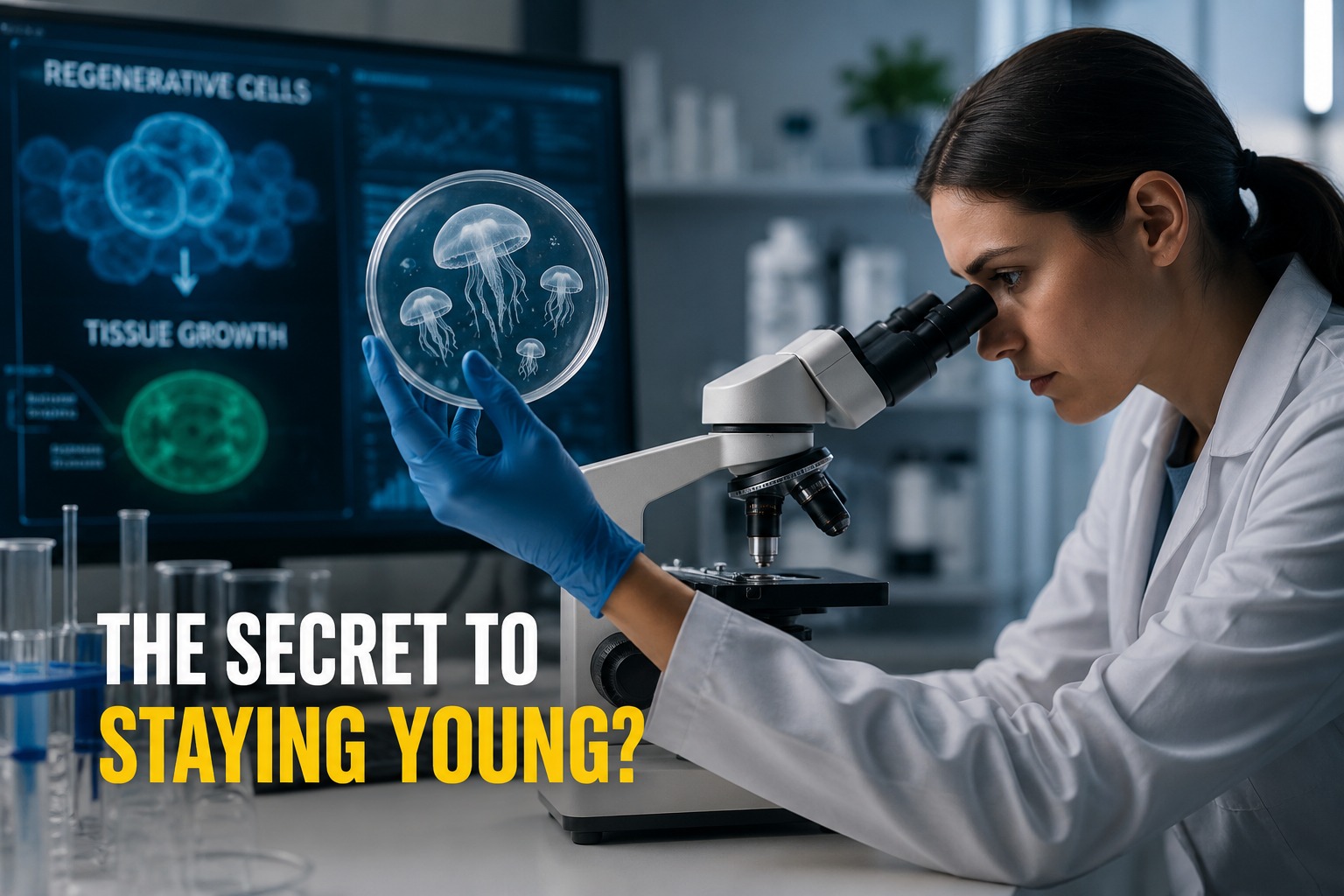
Could Humans Stay Young Forever? Scientists Find New Hope in a Tiny Sea Creature
For centuries, humans have dreamed of slowing aging—or even stopping it altogether. From ancient myths about the Fountain of Youth to modern anti-aging medicine, the desire to remain young has never faded. Today, advances in genetics and regenerative medicine are bringing science closer than ever to understanding why we age. Now, researchers believe that a tiny marine organism may hold valuable clues that could transform the future of aging research.
A recent study has focused on an unusual sea creature called Hydractinia symbiolongicarpus, a small colonial marine animal related to jellyfish. Scientists have discovered that this organism possesses extraordinary regenerative abilities thanks to special "master cells" that can develop into many different types of tissues. While this does not mean humans will become immortal anytime soon, the findings may help researchers better understand cellular aging, tissue repair, and regenerative medicine.
Why Aging Happens in the First Place
Aging is a natural biological process that affects every living organism. As we grow older, our cells gradually lose their ability to divide, repair damage, and function efficiently. DNA accumulates mutations, proteins become less effective, and the body's stem cells become less capable of replacing damaged tissues.
This gradual decline leads to many familiar signs of aging, including wrinkles, weaker muscles, slower healing, declining immunity, and an increased risk of diseases such as cancer, Alzheimer's disease, and heart disease.
For decades, scientists have searched for ways to slow or even reverse these biological changes. Although no proven method exists to stop aging completely, understanding how some organisms naturally regenerate themselves may reveal entirely new approaches.
Meet Hydractinia symbiolongicarpus
The latest breakthrough centers on Hydractinia symbiolongicarpus, a tiny marine cnidarian that grows on hermit crab shells. Despite its simple appearance, this animal possesses remarkable biological capabilities that have attracted the attention of developmental biologists around the world.
Unlike humans, Hydractinia continuously renews its body throughout its lifetime. If parts of its body are damaged or lost, it can regenerate them using highly specialized stem-like cells.
Researchers have been studying this organism because its regeneration mechanisms appear surprisingly efficient and may reveal universal biological principles that also exist in more complex animals.
The Discovery of "Master Cells"
One of the most exciting findings involves a unique population of cells often described as master cells. These cells behave similarly to powerful stem cells because they have the ability to develop into multiple specialized tissue types.
Scientists found that these cells can generate various structures throughout the animal's body whenever repair or regeneration is needed.
This flexibility is what makes the discovery particularly important.
In humans, most adult cells become specialized early in development. Once a skin cell becomes a skin cell, or a muscle cell becomes a muscle cell, they rarely change into something else. Stem cells provide limited repair capabilities, but their regenerative potential decreases with age.
Hydractinia appears to maintain a much more active and adaptable regenerative system throughout its life.
Why This Matters for Human Aging
Although humans are vastly more complex than marine invertebrates, many fundamental biological processes are surprisingly similar across species.
Researchers hope that studying Hydractinia's master cells could help answer several major questions:
- Why do stem cells lose efficiency with age?
- How can damaged tissues be repaired more effectively?
- Can aging cells be rejuvenated safely?
- What genetic pathways control continuous regeneration?
Finding answers to these questions could eventually lead to therapies that slow age-related decline rather than simply treating diseases after they appear.
Regeneration Is Not the Same as Immortality
It is important to understand what this research actually means.
Many headlines suggest scientists have found the secret to eternal youth. In reality, that is far from the current scientific evidence.
Hydractinia's regenerative ability does not make it biologically immortal in the way science fiction often imagines. While it can continuously replace damaged tissues, it can still die due to disease, environmental changes, predators, or other biological factors.
Similarly, even if researchers learn how to improve human tissue regeneration, that would not automatically eliminate aging or guarantee unlimited lifespan.
Instead, the goal is healthier aging.
The Growing Field of Regenerative Medicine
The discovery fits into a rapidly expanding area of medicine known as regenerative medicine.
Rather than simply treating symptoms, regenerative medicine aims to repair or replace damaged tissues using stem cells, gene editing, tissue engineering, and cellular therapies.
Researchers are already investigating treatments that may help repair:
- Damaged heart tissue after heart attacks
- Spinal cord injuries
- Degenerative eye diseases
- Cartilage damage
- Certain neurological disorders
Insights from organisms like Hydractinia may provide additional biological tools to improve these therapies.
Could Humans Ever Reverse Aging?
Scientists are exploring several promising approaches to slowing biological aging.
One area involves removing senescent cells, sometimes called "zombie cells." These are damaged cells that stop dividing but continue releasing harmful inflammatory chemicals that contribute to aging.
Another approach focuses on cellular reprogramming, where certain genetic factors may partially reset aging cells to a younger biological state without changing their identity.
Researchers are also studying telomeres, DNA repair mechanisms, mitochondrial function, and stem cell rejuvenation.
Hydractinia's regenerative system adds another valuable model that may help scientists understand how healthy tissues remain youthful over long periods.
Challenges Scientists Still Face
Despite the excitement, translating discoveries from simple marine organisms to humans is extraordinarily difficult.
Humans contain trillions of highly specialized cells organized into complex organs and biological systems.
Any therapy that stimulates uncontrolled cell growth carries serious risks, including cancer.
Researchers must ensure that any future regenerative treatment can safely repair tissues without disrupting normal biological functions.
In addition, aging itself is influenced by many interconnected factors including genetics, metabolism, environmental exposure, inflammation, immune function, and lifestyle.
There is unlikely to be a single "anti-aging gene" that solves everything.
What This Research Could Mean for Healthcare
Even if eternal youth remains impossible, understanding regenerative biology could dramatically improve medicine.
Future therapies inspired by Hydractinia may help people:
- Recover faster from injuries.
- Heal damaged organs more effectively.
- Delay age-related diseases.
- Maintain healthier tissues for longer.
- Improve quality of life during old age.
Instead of simply increasing lifespan, researchers increasingly emphasize extending healthspan—the number of years people remain healthy, active, and independent.
That goal alone could transform healthcare worldwide.
Lessons Nature Continues to Teach Us
Nature has repeatedly inspired medical breakthroughs.
Spider silk has influenced advanced biomaterials.
Venom from snakes has contributed to blood pressure medications.
Bacteria led to the discovery of antibiotics.
Now, tiny marine organisms may offer clues about regeneration and healthy aging.
Studying these remarkable creatures reminds scientists that evolution has already solved many biological problems in different ways. The challenge is understanding those solutions and determining whether they can be safely adapted for human medicine.
Conclusion
The discovery of powerful regenerative "master cells" in Hydractinia symbiolongicarpus represents another exciting step forward in aging and regenerative biology. While the findings do not mean scientists have discovered the secret to eternal youth, they provide valuable insight into how living organisms repair themselves and maintain healthy tissues.
Human aging remains an incredibly complex process, and no existing therapy can stop or reverse it completely. However, research into organisms like Hydractinia is expanding our understanding of stem cells, tissue regeneration, and cellular repair. In the coming decades, these discoveries may help scientists develop treatments that allow people to live healthier, longer lives—even if immortality remains beyond our reach.
Rather than promising everlasting youth, this research offers something far more realistic and potentially more valuable: the possibility of aging with better health, stronger bodies, and improved quality of life.